
Greetings! I'm Aneesh Sreedharan, CEO of 2Hats Logic Solutions. At 2Hats Logic Solutions, we are dedicated to providing technical expertise and resolving your concerns in the world of technology. Our blog page serves as a resource where we share insights and experiences, offering valuable perspectives on your queries.

Black Friday E-commerce Preparation: 2026 Complete Store Checklist
Ask AI


Black Friday 2026 falls on November 27, with Cyber Monday following on November 30. Last year, US shoppers spent a record $11.8 billion online on Black Friday, up 9.1% from 2024, and Cyber Monday went even higher at $14.25 billion.
This checklist covers what your store needs before the rush: site performance, visibility in AI shopping assistants, inventory, payments, marketing, support, back office operations, and the EU pricing rules that catch many German shops. Work through it section by section, starting with the timeline.
Black Friday 2026 Countdown Timeline
The best results come from treating Black Friday as a four-week project, not a single day. Here is what to do and when.
- 4 weeks out (by October 30): Finalize offers and margins, confirm stock and supplier delivery dates, set up tracking, and run your first load test.
- 3 weeks out (by November 6): Build landing pages, update product schema and feeds, prepare email segments, and check that discount prices follow EU rules.
- 2 weeks out (by November 13): Freeze code. No new plugins, theme changes, or major updates after this date. Run a final load test.
- Week of Black Friday (November 23 to 27): Send teaser emails, warm up retargeting audiences, brief your support team, and monitor dashboards daily.
- Black Friday to Cyber Monday (November 27 to 30): Monitor the site live, watch stock levels, and adjust offers based on what is selling.
- December: Focus on retention, returns, and reviewing results for next year.
Key Steps for Successful Black Friday E-commerce Preparation
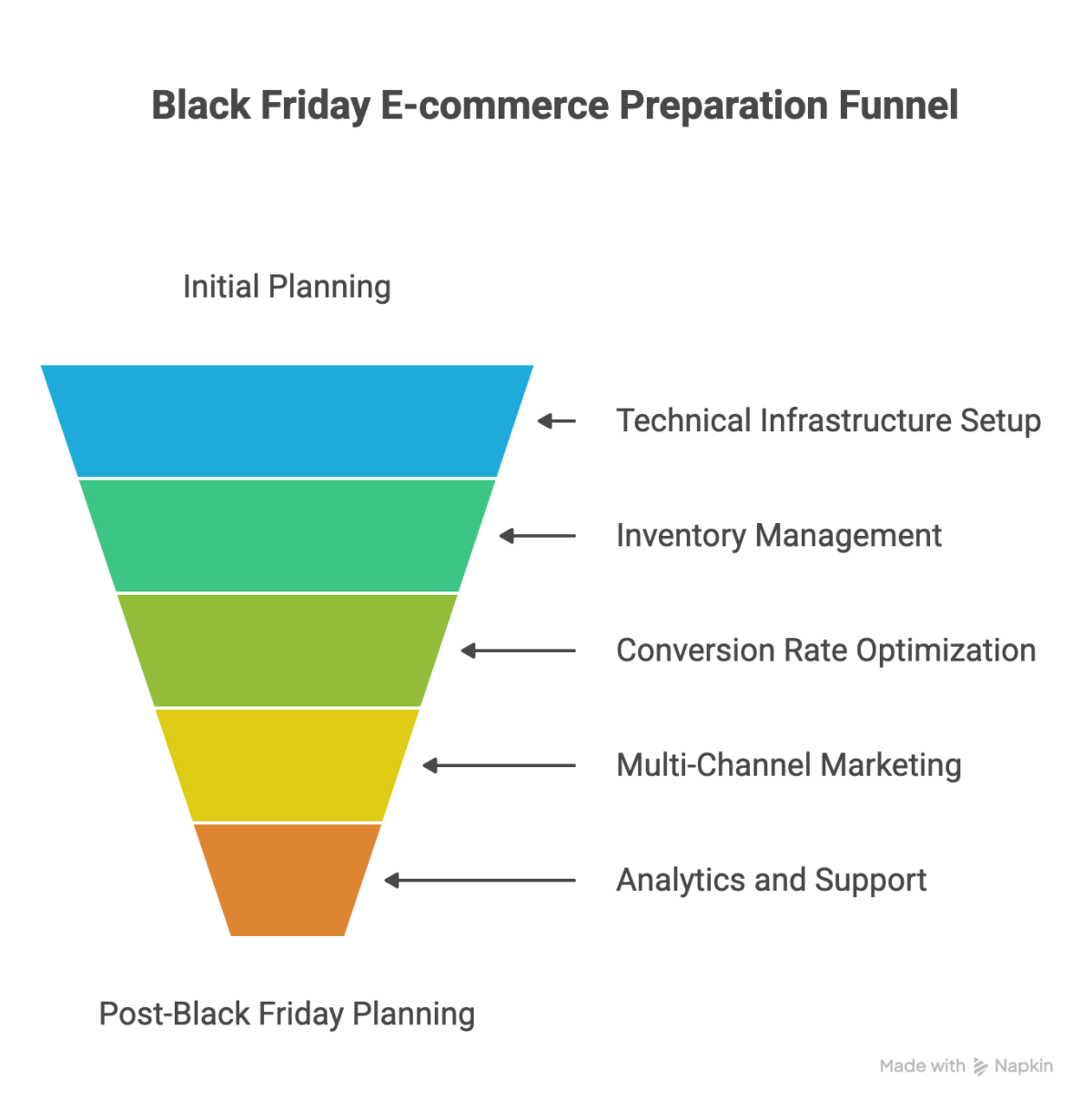
Technical Infrastructure for Black Friday E-commerce Preparation
A flawless, fast, and scalable website infrastructure is the backbone of successful Black Friday e-commerce preparation. When millions of shoppers flood your online store, any downtime or slow performance means lost sales and dissatisfied customers.
Start by conducting comprehensive load testing to simulate high volumes of traffic and identify potential bottlenecks. Use content delivery networks (CDNs) to serve content quickly to shoppers across Europe and globally. Enable auto-scaling on your hosting servers to manage traffic spikes efficiently.
Mobile optimization is a pivotal element. Seven out of ten retail site visits now come from mobile devices, and phones accounted for 56.4% of online transactions during the 2025 holiday season. Focus on minimizing mobile page load times, simplifying the mobile checkout process, and integrating popular digital wallets such as Apple Pay and Google Pay for smooth payment experiences.
Freeze code two weeks before the event and keep a tested rollback plan, so a last-minute update cannot break checkout during peak traffic.
Technical Checklist:
- Run full load and stress tests to ensure uptime
- Implement CDN and server auto-scaling
- Optimize mobile responsiveness and checkout speed
- Ensure SSL certification and payment compliance
- Establish automated backup systems and security protocols
- Set a code freeze date and a rollback plan
- Set up uptime and error alerts with a named person on call
Failing to prioritize technical readiness risks site crashes, slow checkouts, and a poor user experience, leading to costly errors during Black Friday frenzy.
Get Found by AI Shopping Assistants
More shoppers now research deals in ChatGPT, Gemini, Perplexity, and Google’s AI Mode before they visit a store. During the 2025 holiday season, traffic to retail sites from generative Consumer use of generative AI for online shopping research surged by 693% year-over-year. On Black Friday, that traffic converted 38% better than traffic from other sources.
AI assistants can only recommend products they can read and trust. Your product data needs to be complete, structured, and consistent everywhere it appears.
AI Visibility Checklist:
- Add Product and Offer schema with current price, sale price, availability, and the offer end date (priceValidUntil)
- Keep your Google Merchant Center feed in sync with live prices and stock
- Write product titles and descriptions with key specs, not just marketing copy
- Publish a Black Friday deals page and FAQ in plain language that AI tools can quote
- Check that robots.txt does not block the AI crawlers you want to be visible in
- Track AI referral traffic in GA4 with a custom channel group
Inventory Management and Planning
Inventory planning sits at the core of Black Friday preparation. In 2025, electronics, apparel, and furniture drove more than half of US online holiday sales growth, with toys and cosmetics also growing. A data-driven approach to inventory protects your business from lost sales or excess stock that eats into profits.
Analyze sales data from previous Black Fridays to forecast demand accurately. Use AI demand forecasting tools that factor in promotions, seasonality, and channel trends, rather than relying on last year’s numbers alone. Set up real-time inventory tracking that syncs across all sales channels, including your e-commerce platform, marketplaces, and physical stores.
Communicate early and clearly with suppliers to confirm delivery schedules and create contingencies through backup suppliers. This reduces the risk of stockouts due to supply chain disruptions.
Inventory Planning Checklist:
- Analyze historic Black Friday sales and trends
- Forecast demand for key categories and products
- Prioritize stocking of bestsellers and seasonal hits
- Set automated low-stock alerts and real-time sync
- Coordinate supplier delivery and contingency plans
- Plan returns handling and restocking for December and January
Inventory mismanagement frustrates customers and wastes capital. Solid inventory planning is a pillar of your Black Friday e-commerce preparation strategy.
Want your store checked before Black Friday?
Conversion Rate Optimization Techniques
To make the most of peak traffic, your Black Friday e-commerce preparation must also elevate conversion rates. Simplify the checkout experience by enabling guest checkout and one-click payment options, reducing friction that leads to cart abandonment. Clearly display trust signals such as security badges, customer reviews, and transparent return policies to improve shopper confidence.
Offer buy now, pay later (BNPL) options at checkout. Shoppers used deferred payments for $20 billion of US online holiday spending in 2025.
Develop dedicated Black Friday landing pages targeting key offer categories. Use urgency triggers like countdown timers and stock messages only when they are accurate. Fake countdowns and false stock claims count as unfair commercial practices under EU consumer law. Optimize product pages by featuring high-quality images and benefits-driven descriptions, especially adapted for mobile users.
Conversion Optimization Checklist:
- Enable guest checkout, digital wallets, and BNPL payment options
- Display security badges, customer reviews, and hassle-free returns
- Create Black Friday-themed landing pages with countdown timers
- Add honest urgency messaging, such as real stock levels or the actual offer end time
- Optimize all pages for fast mobile load times
- Show discounts with the correct reference price (see the EU compliance section)
Each percentage point increase in conversion amplifies your Black Friday revenue; never underestimate this phase.
Multi-Channel Marketing Campaign Development
An effective marketing engine is vital to your Black Friday e-commerce preparation. Start building anticipation at least four weeks ahead. Launch segmented email marketing campaigns that cater to distinct messages to first-time shoppers, loyal customers, and cart abandoners. Use dynamic content in emails and on-site pop-ups for personalized product recommendations and countdowns.
Social media campaigns should span organic posts, stories, and influencer partnerships, scheduled meticulously to maximize reach across the entire Black Friday funnel. Adobe’s 2025 data shows shoppers increasingly use social media to discover new products, alongside paid search and email. Paid advertising campaigns on Google, Facebook, Instagram, and retargeting across devices keep your brand top of mind during the last-minute buying frenzy.
Marketing Campaign Checklist:
- Send segmented email sequences, starting with early access for subscribers
- Use personalized content, product recommendations, and urgency triggers
- Schedule social media posts and influencer engagements
- Run targeted, budget-monitored paid ads with retargeting
- Employ exclusive offers for email subscribers and VIPs
Black Friday e-commerce preparation with unified marketing drives traffic and conversions synergistically.
Analytics Setup and Proactive Customer Support
Measuring performance in near real-time is essential. Configure Google Analytics 4 with enhanced e-commerce tracking to monitor traffic sources, conversion funnels, product views, and abandoned carts. Build live dashboards for rapid insights, enabling quick adjustments to campaigns or site performance. For EU stores, set up Google Consent Mode v2 so GA4 and Google Ads can model conversions from shoppers who decline cookies.
Customer support must scale with the demand surge. Extend hours, update FAQs tailored to holiday sales, and implement live chat with chatbot automation to handle common questions efficiently. An AI sales assistant trained on your product catalog can also answer sizing, compatibility, and delivery questions that would otherwise reach your team. Quick, helpful support builds shopper trust and reduces cart abandonment.
Analytics and Support Checklist:
- Enable GA4 ecommerce event tracking, Consent Mode v2, and real-time dashboards
- Provide expanded support hours and additional headcount
- Refresh FAQs with dedicated Black Friday information
- Deploy live chat and chatbot automation for common inquiries
- Monitor customer feedback for continuous improvement
Analytics and support are the operational pillars stabilizing your Black Friday e-commerce preparation.
Back Office and Order Processing
Black Friday does not end at checkout. Order volumes can multiply within a few days, and every order still needs to reach your ERP, warehouse, and accounting correctly. Manual steps that work in a normal week become the bottleneck.
Back Office Checklist:
- Test that orders, stock, and prices sync correctly between your shop, marketplaces, and ERP at high volume
- Automate entry of B2B and email orders so they do not pile up in inboxes
- Plan warehouse staffing and shipping deadlines, and show those deadlines clearly in the shop
- Prepare for higher return volumes in December and January
Post-Black Friday Retention and Cyber Monday Planning
Black Friday e-commerce preparation shouldn’t end when sales conclude. Cyber Monday was the biggest online shopping day of 2025 at $14.25 billion, and the five days from Thanksgiving to Cyber Monday brought in $44.2 billion. Treat the whole Cyber Week as one campaign. Send timely thank-you emails with cross-selling recommendations and satisfaction surveys to new customers.
Plan December retention efforts with exclusive promotions, loyalty programs, and bundled offers. Analyzing your Black Friday outcomes ensures continual improvement and optimized strategies for the following year.
Post-Event Checklist:
- Organize Cyber Monday campaigns and inventory updates
- Send personalized follow-up and satisfaction emails
- Launch December retention offers targeting new customers
- Analyze data on sales, traffic, and marketing effectiveness
- Adjust strategies ahead of next Black Friday
Customer lifetime value grows from smart Black Friday e-commerce preparation extended into lasting relationships.
European Market-Specific Considerations in Preparation
For German and European online retailers, Black Friday e-commerce preparation requires localization. Ensure full GDPR compliance in marketing communications and customer data handling. Price displays must clearly show VAT-inclusive amounts, meeting local regulations.
Optimize campaign launches to match European time zones. Offer regionally preferred payment methods such as PayPal, Klarna, SEPA Direct Debit, and pay by bank options. Localize language, currency, and customer service availability to boost conversions and satisfaction.
Price Reduction Rules
When you advertise a discount in the EU, the reference price must be the lowest price you charged in the 30 days before the reduction. In Germany, this rule is set out in §11 of the Price Indication Ordinance (PAngV). Raising prices in October to show a bigger Black Friday discount is exactly what this rule targets.
Accessibility Requirements
Since June 28, 2025, most B2C online shops in the EU must meet accessibility requirements under the European Accessibility Act, implemented in Germany as the BFSG. Black Friday landing pages, countdown banners, and pop-ups need to be accessible too. Micro enterprises are exempt.
Online Withdrawal Function
From June 19, 2026, EU rules require online shops to offer a clearly labelled withdrawal function that lets consumers cancel a distance contract online. Check that it works before peak season.
Regional Customization Checklist:
- Comply with GDPR protocols for consent and data processing
- Display VAT-inclusive prices clearly
- Offer PayPal, Klarna, SEPA, and other payment methods local shoppers expect
- Schedule campaigns aligned with local business hours
- Localize support content and customer communications
- Show the lowest price from the previous 30 days for every discounted product
- Check landing pages and banners against accessibility requirements
- Confirm the online withdrawal function is live
Tailored Black Friday e-commerce preparation for Europe maximizes impact and avoids compliance pitfalls.
Conclusion
Black Friday 2026 represents a tremendous opportunity for e-commerce stores ready to seize it. Success depends on technical stability, accurate inventory, visibility in AI search, honest offers, support and back-office teams that can scale, and planning beyond the weekend itself.
By following this comprehensive checklist and tailoring your approach to regional regulations and customer expectations, your store can maximize sales and set the stage for sustained growth beyond the holiday season. Start with the timeline above and work through one section at a time.
Weekly Insights
Get our best content delivered to your inbox every week.
FAQ
When should I start preparing for Black Friday 2026?
Ideally, six to eight weeks before November 27. If you are starting later, focus the final four weeks on load testing, a code freeze, inventory checks, and your email list.
How long before Black Friday should I stop making site changes?
Set a code freeze about two weeks before the event. After that, only fix critical bugs so nothing new can break checkout during peak traffic.
Can I show a crossed-out price for Black Friday in Germany?
Yes, as long as the reference price is the lowest price you charged in the 30 days before the discount.
How do I get my products recommended by AI shopping assistants?
Use complete product schema, keep your product feeds accurate, write clear product descriptions, and publish a crawlable deals page.
Ask AI

Related Articles