Greetings! I'm Aneesh Sreedharan, CEO of 2Hats Logic Solutions. At 2Hats Logic Solutions, we are dedicated to providing technical expertise and resolving your concerns in the world of technology. Our blog page serves as a resource where we share insights and experiences, offering valuable perspectives on your queries.

Online shoppers are beginning to use AI tools to research products, compare options, and narrow down their choices. Instead of browsing through dozens of product pages, they can describe what they need and ask an AI assistant to help them find suitable products.
For e-commerce businesses, this creates a new consideration: how easily can digital systems access, interpret, and use your product information?
Your product catalogue may contain thousands of products, detailed descriptions, and multiple variants. But if key specifications are missing, attributes are inconsistent, or information differs across systems, it can be harder for AI tools to interpret what you sell accurately.
Preparing for AI-driven shopping starts with the quality and structure of your product data. Before investing in new AI capabilities, it is worth checking whether your existing product information is complete, consistent, and accessible to the systems that need it.
In this article, we’ll explore what AI buying assistants may need from your product data, the common catalogue issues to look for, and the practical steps you can take to prepare your e-commerce store.
What Do AI Assistants Need from Your Product Data?
An AI buying assistant needs reliable product information to help shoppers identify relevant options and compare products against their requirements. The exact information and access methods depend on the AI platform, but the underlying principle is the same: product details need to be clear, consistent, and usable.
For example, a shopper looking for a rug for a busy dining room might care about its material, dimensions, ease of cleaning, and suitability for frequent use. A product title and a short marketing description may not provide enough information to assess those requirements.
Here are some of the key areas to review.
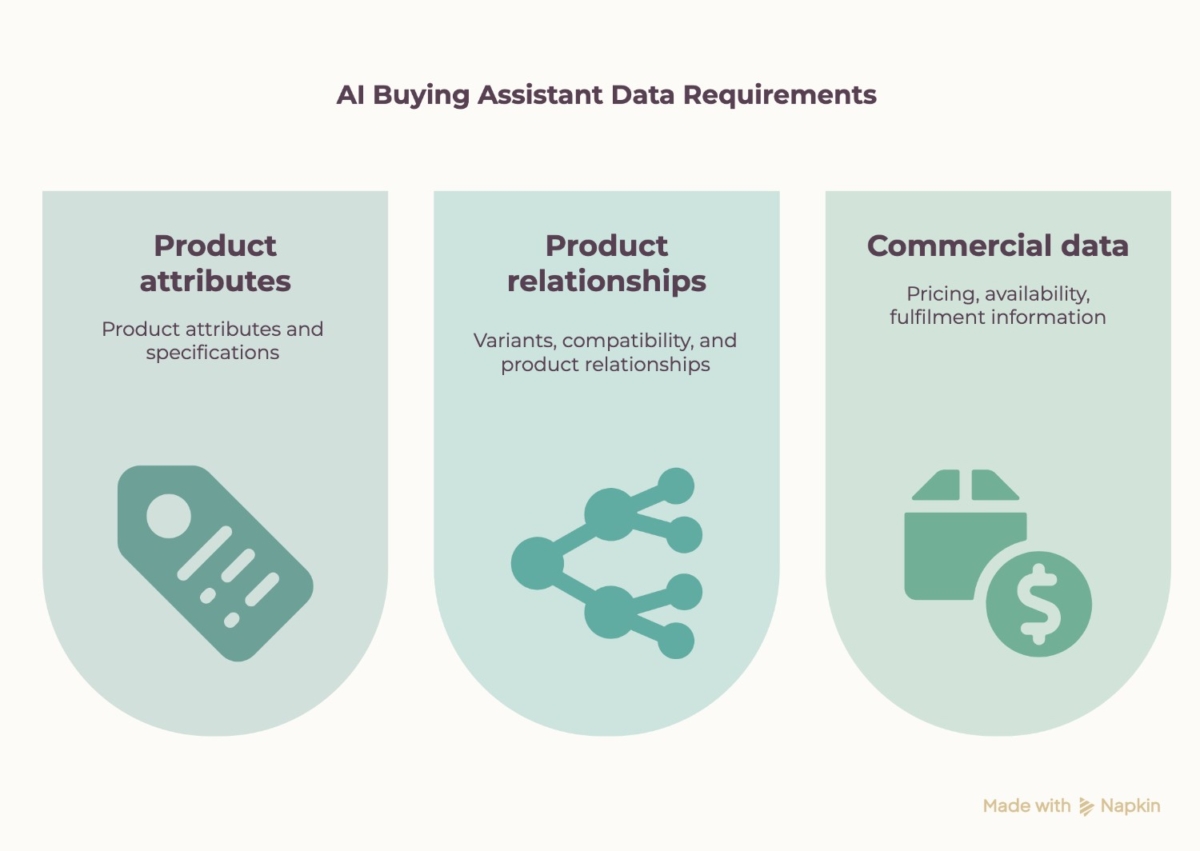
Product attributes and specifications
Product attributes turn general product descriptions into specific, comparable information. Depending on your catalogue, these might include dimensions, materials, weight, technical specifications, care instructions, or compatibility details.
If one product lists its dimensions in a structured field while another includes them only in a paragraph, comparing the two may be more difficult for systems that rely on structured product information.
Review whether your important product attributes are populated consistently across your catalogue, especially for products customers commonly compare.
Variants, compatibility and product relationships
Many products come in multiple sizes, colours, materials or configurations. Others depend on compatibility with particular devices, components or accessories.
Your product data should make these relationships clear. For example, a replacement component should identify the equipment it fits, while a configurable product should clearly represent its available options.
When this information is incomplete or disconnected, it becomes harder to determine which product or variant matches a shopper’s requirements.
Pricing, availability and fulfilment information
Product suitability is only part of a purchasing decision. Shoppers may also want to know the current price, whether an item is available, delivery options and relevant fulfilment conditions.
This information can change frequently, so it needs to remain consistent across the systems and channels that use it. An outdated price or stock status can create confusion and undermine the shopping experience.
For businesses using an e-commerce platform alongside an ERP or inventory management system, it is important to understand how these updates move between systems and where delays or inconsistencies may occur.
Ultimately, preparing product data for AI buying assistants is not just about adding more information. It is about making the right information accurate, consistent, and usable.
Signs Your Product Catalogue Isn’t Ready for AI-Driven Shopping
A large product catalogue doesn’t necessarily mean your product data is ready for AI-driven shopping. Even established e-commerce stores can have gaps in their product information, particularly when data comes from multiple suppliers, teams, or business systems.
Here are four common issues worth checking.
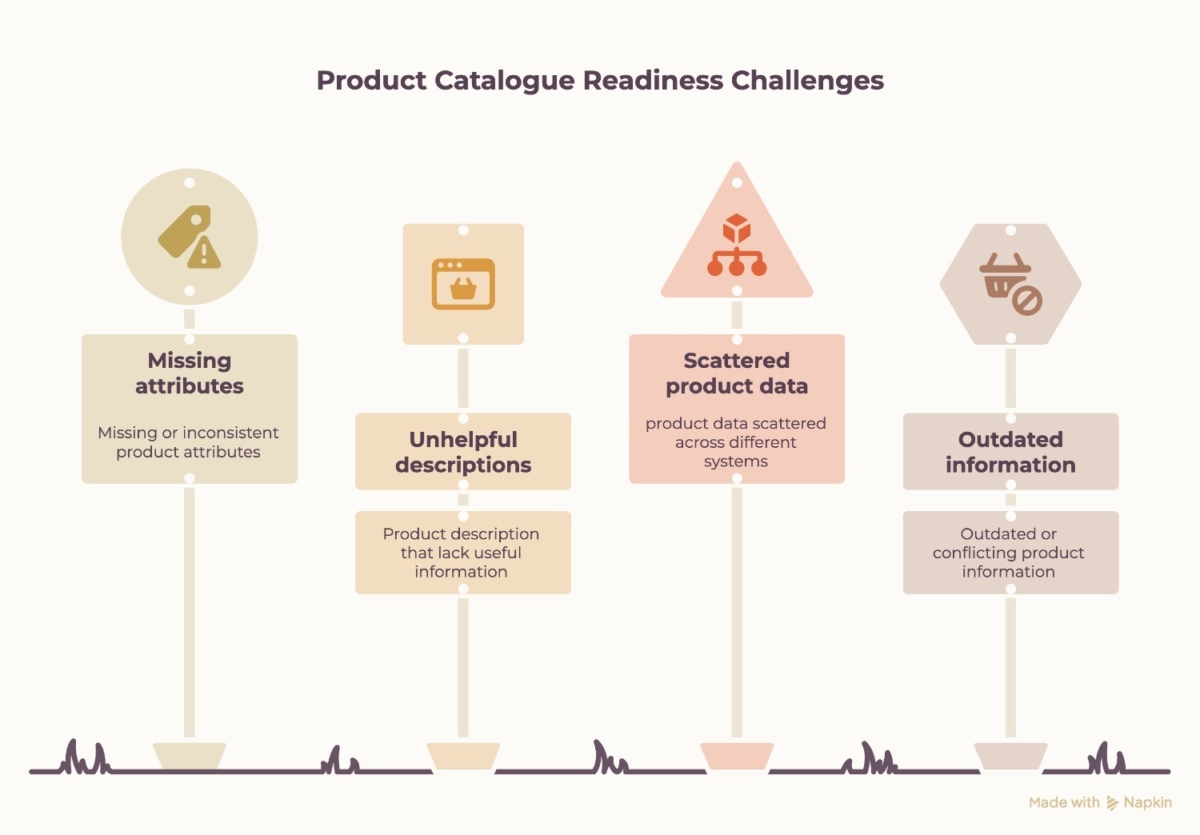
- Missing or inconsistent product attributes
Product attributes help describe what an item is, what it does, and how it differs from other products. When important attributes are missing or recorded inconsistently, it becomes harder to compare products accurately.
For example, one supplier might list a product’s dimensions as separate length, width, and height fields, while another includes them only in the product description. Some products may lack materials, technical specifications, and compatibility details, while others include them.
What to check: Identify the attributes customers need to compare products in each category. Check how consistently those attributes are populated across your catalogue.
2. Unhelpful Descriptions
A product description can be well written but still leave important questions unanswered. Marketing language such as “premium quality” or “built for everyday use” does not necessarily explain a product’s specifications, limitations, or intended applications.
Consider a customer comparing two office chairs. Information about adjustability, dimensions, weight capacity, and materials may be more useful for evaluating suitability than general claims about comfort and quality.
What to check: Review your descriptions to see whether they answer common purchasing questions. Where relevant, supplement descriptive text with specific, structured product attributes.
3. Product Data Scattered across different systems
Product information often exists in several places. Your e-commerce platform may store descriptions and variants, a PIM may manage catalogue attributes, and an ERP may maintain product identifiers, pricing, or stock information.
If these systems are not properly connected, information can become inconsistent or incomplete. A product updated in one system may still have outdated details in another. Important specifications may also remain in supplier spreadsheets or documents instead of being incorporated into the main catalogue.
What to check: Map where your product information is stored, which system owns each data field, and how updates reach your storefront and other sales channels.
Why these issues matter
These problems are not unique to AI shopping. They can already affect site search, product filtering, comparison tools, and the overall shopping experience. As more AI-driven discovery options emerge, reliable product information becomes an important foundation for supporting them.
Fixing these issues does not guarantee that an AI assistant will surface or recommend your products. However, it gives your business a stronger foundation for presenting accurate, useful product information across the systems and channels that can access it.
How to Prepare Your Product Data for AI Assistants
Preparing your product catalogue for AI-driven shopping starts with improving the information you already have. You do not necessarily need to rebuild your catalogue or introduce a new platform. In many cases, the first step is to identify gaps in your existing data and establish a consistent way to manage it.
Here are five areas to focus on.
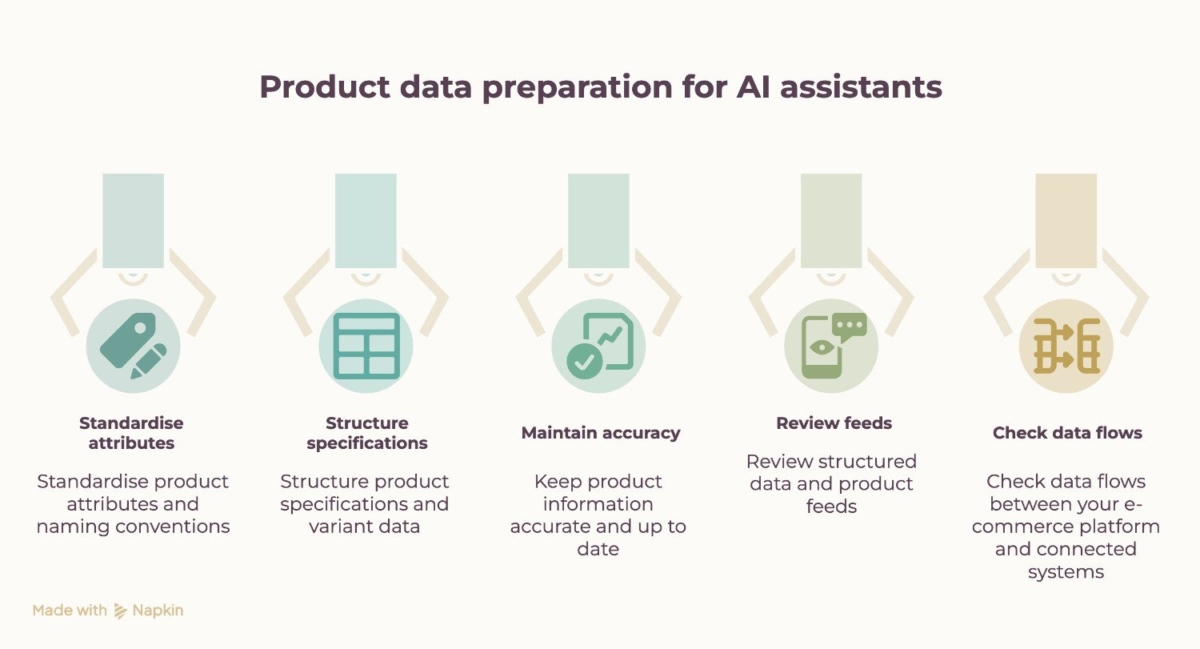
Standardise product attributes and naming conventions
Start by defining the product attributes that matter for each category and using consistent names, formats and values across your catalogue.
For example, if you sell furniture, dimensions, materials, colours and assembly requirements may be important. For electronics, you may need technical specifications, supported standards and compatibility information.
If different products use different labels or formats for the same attribute, comparisons become more difficult. Standardising these fields makes product information easier to manage and helps systems interpret equivalent details consistently.
What to do:
- Define required attributes for each product category.
- Use consistent field names, units of measurement, and value formats.
- Identify missing or conflicting values.
- Establish rules for adding and updating product information.
Structure product specifications and variant data
Important product details should not be buried in long descriptions when they can be represented clearly in dedicated fields.
For example, a product description might mention that a chair has adjustable armrests, a maximum weight capacity and several colour options. Where your platform supports it, these details should also be represented in the relevant product attributes and variant fields.
The same applies to product relationships. Accessories, replacement parts and compatible products should be linked appropriately, rather than relying entirely on descriptive text to explain the connection.
What to do:
- Separate key specifications from general marketing copy.
- Represent variants consistently within your product catalogue.
- Record compatibility and product relationships where relevant.
- Make sure each variant has the correct attributes, identifiers, and associated information.
Keep product information accurate and up to date
AI systems cannot reliably answer questions using product information that is incorrect or outdated. This makes ongoing data maintenance just as important as the initial clean-up.
Review how product information moves between your e-commerce platform and connected systems. If an ERP manages stock or pricing, for example, check that updates reach the storefront and any relevant product feeds as expected.
Not every product field needs to change at the same frequency. Stock and price may require frequent updates, while materials or dimensions generally change less often. Your update processes should reflect these differences.
What to do:
- Identify the source of truth for each important data field.
- Define how frequently changing information should be synchronised.
- Monitor failed updates and inconsistencies between systems.
- Assign responsibility for reviewing and correcting product data.
Review structured data and product feeds
Structured data and product feeds can help make product information available to systems that use these formats. However, they serve different purposes and should be reviewed separately.
Structured data, such as relevant Schema.org Product markup, can describe details including product names, offers, prices, and availability on supported pages. Product feeds provide product information in a format required by a particular channel or platform.
Neither guarantees that an AI buying assistant will discover, retrieve, or recommend a product. Requirements vary between platforms, so your implementation should reflect the specific systems you want to support.
What to do:
- Check that relevant product pages use accurate, valid structured data.
- Make sure marked-up prices and availability match what shoppers see.
- Review product feeds for missing fields, invalid values, and outdated information.
- Check the documentation for the AI shopping platforms and channels relevant to your business.
Check data flows between your e-commerce platform and connected systems
Product data often passes through several systems before it reaches a shopper. A PIM may manage product attributes, an ERP may hold operational data, and an e-commerce platform may publish the final product pages.
If these connections are unreliable, improving individual product records may not solve the underlying problem. Data may be overwritten, updates may fail, or different systems may use incompatible field structures.
This is where integration work can become important. The aim is to make sure the right information reaches the right destination in the expected format, with appropriate validation and error handling.
What to do:
- Map how product information moves between your PIM, ERP, e-commerce platform, and relevant channels.
- Identify missing mappings, duplicated fields, and manual update steps.
- Validate incoming data before it is published.
- Add monitoring and error handling so failed synchronisations can be identified and resolved.
These improvements create a more reliable product data foundation. The next step is to assess which gaps matter most in your store and prioritise the work accordingly.
How to Assess Your Store’s AI Readiness
Before investing in new tools or making major changes to your e-commerce setup, assess the quality of your existing product data. A simple review can help you identify gaps, understand their impact and decide what to address first.
Use the following checklist to evaluate your store.
Product data readiness checklist
1. Product information completeness
- Are the essential attributes populated for each product category?
- Do product descriptions answer common customer questions?
- Are technical specifications, dimensions and compatibility details available where needed?
2. Data consistency
- Are product attributes named and formatted consistently?
- Are units of measurement and variant values standardised?
- Do product details match across your storefront and connected systems?
3. Data accuracy and maintenance
- Are prices and stock availability updated reliably?
- Is there a clear source of truth for each important data field?
- Can your team identify and correct outdated or conflicting information?
4. Structured data and feeds
- Is relevant product structured data implemented correctly on your storefront?
- Do product feeds meet the requirements of the channels that use them?
- Are missing fields, invalid values and synchronisation errors monitored?
5. System integrations
- Can product information move reliably between your e-commerce platform, PIM and ERP?
- Are manual updates or duplicate data entry creating inconsistencies?
- Are failed data transfers detected and resolved?
How should you prioritise the gaps?
Not every issue needs to be fixed at once. Start with problems that affect product accuracy, customer decisions and the reliability of your connected systems.
For example, incorrect stock information may need immediate attention, while improving less important descriptive attributes can be scheduled later. If many products have the same missing fields, addressing the underlying data model or import process may be more effective than updating each product individually.
A useful starting point is to group your findings into three categories:
- High priority: Incorrect prices, stock information, critical specifications or compatibility details.
- Medium priority: Missing attributes, inconsistent naming and incomplete product descriptions.
- Longer-term improvements: Catalogue enrichment, broader feed optimisation and additional integrations for specific AI shopping channels.
This is a practical prioritisation approach, not a universal ranking. The order will depend on your catalogue, business model and the systems you need to support.
Completing this assessment will not certify your store as ready for every AI buying assistant. It will, however, give you a clearer picture of your product data quality and the improvements needed to support more reliable product discovery.
When Do You Need Technical Support to Prepare Your Product Data?
Many product data issues can be addressed through better catalogue management and clearer processes. However, some problems require changes to your e-commerce platform, data model or system integrations.
Knowing the difference can help you avoid spending time fixing individual product records when the underlying issue affects your entire catalogue.
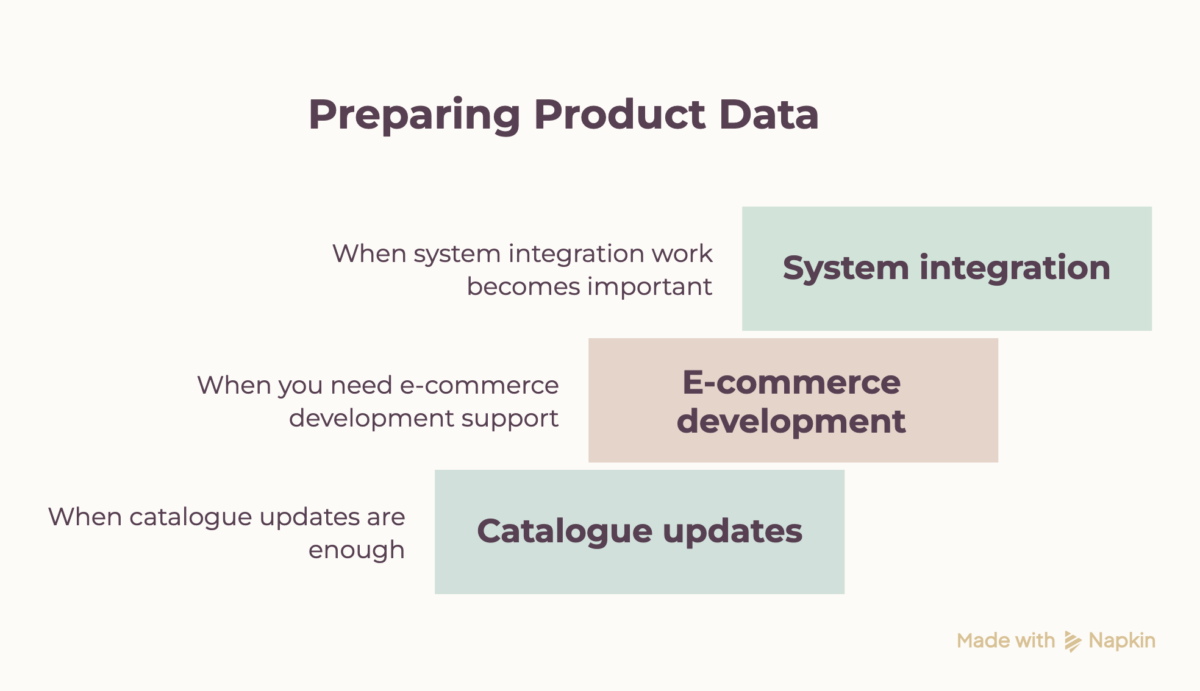
When catalogue updates are enough
If the problem is limited to missing descriptions, inconsistent naming or incomplete attributes, your product or catalogue management team may be able to resolve it using existing tools.
For example, standardising material names across a product category or filling in missing specifications may be a straightforward data management task, provided your platform already supports the necessary fields.
Start with your existing capabilities before introducing additional tools or development work.
When you need e-commerce development support
Technical support may be necessary when your current platform cannot represent the product information your business needs, or when existing implementations prevent that information from being used reliably.
Examples include:
- Extending product data fields to support additional specifications or compatibility information.
- Changing how complex variants and configurable products are represented.
- Correcting structured data implementation on product pages.
- Customising product imports and exports to preserve important attributes.
- Improving how product information is presented across storefronts and sales channels.
The right solution depends on your platform, catalogue structure and business requirements. A review of the existing setup can help determine whether configuration changes are sufficient or custom development is needed.
When system integration work becomes important
If product information is managed across an ERP, PIM, e-commerce platform and other business systems, the challenge may lie in how those systems exchange data.
For example, your PIM may contain detailed product specifications, but your storefront import process may not transfer all those attributes. Alternatively, an ERP update may overwrite a field that your e-commerce team maintains separately.
In these cases, technical work may involve:
- Mapping fields between connected systems.
- Correcting data transformations and synchronisation rules.
- Validating product information before it reaches the storefront.
- Improving error handling and monitoring for failed updates.
- Reducing manual data transfers between systems.
Addressing the integration itself can help prevent the same data issues from recurring across hundreds or thousands of products.
Build on your existing e-commerce setup
Preparing for AI-driven shopping does not automatically mean replacing your e-commerce platform or investing in a separate AI solution. A more practical approach is to assess your current catalogue, identify the most important data gaps, and determine whether your existing platform and integrations can address them.
An experienced e-commerce development partner can help review your setup, identify technical limitations and prioritise improvements across your storefront and connected systems. For businesses using platforms such as Shopware or Shopify, this may involve a combination of platform configuration, custom development, product data improvements and ERP or PIM integrations.
The objective is to build a reliable product information foundation that supports your current e-commerce operations while making it easier to accommodate new shopping technologies as your requirements evolve.
Get Your E-commerce Store Ready for AI-Driven Shopping
AI buying assistants are creating new ways for shoppers to discover and compare products. For e-commerce businesses, preparing for these changes starts with a familiar but important task: making sure product information is accurate, consistent and accessible to the systems that need it.
Review your catalogue, standardise important attributes, check your structured data and product feeds, and make sure information flows reliably between your e-commerce platform and connected systems. Prioritise the gaps that affect product accuracy and customer decisions before investing in more complex changes.
There is no single implementation that guarantees visibility across every AI shopping platform. However, a well-managed product data foundation can help your business maintain reliable information and prepare for evolving product discovery methods.
Need help improving your product data or e-commerce integrations?
Table of contents
- What Do AI Assistants Need from Your Product Data?
- Signs Your Product Catalogue Isn't Ready for AI-Driven Shopping
- How to Prepare Your Product Data for AI Assistants
- How to Assess Your Store's AI Readiness
- When Do You Need Technical Support to Prepare Your Product Data?
- Get Your E-commerce Store Ready for AI-Driven Shopping

Related Articles