Greetings! I'm Aneesh Sreedharan, CEO of 2Hats Logic Solutions. At 2Hats Logic Solutions, we are dedicated to providing technical expertise and resolving your concerns in the world of technology. Our blog page serves as a resource where we share insights and experiences, offering valuable perspectives on your queries.
Quick Summary
The payoff: higher conversion, stronger retention, and a customer experience that feels remembered rather than repeated.
Omnichannel retail connects every customer touchpoint, app, website, social, and store into one continuous experience, instead of channels operating as separate silos.
AI is the mechanism that makes this connection work: it reads browsing behavior, cart activity, and purchase history, then turns that into a single, usable customer profile.
The core value is the cart-to-associate handoff, when a store employee can see what a customer looked at online, they can offer specific, informed help instead of guessing.
Beyond the cart handoff, AI also supports personalized recommendations, predictive inventory planning, and chatbots that hand off context to live staff.
The main obstacles are data silos, integration debt from older systems, and getting store teams to actually trust and use the tools.
Most shoppers today don’t stick to one channel, and they never really did. They’ll spot a product on Instagram, drop it in a cart on their phone during lunch, compare prices on a laptop that evening, and walk into a store on the weekend to see it in person. The real question retailers face isn’t whether to support all of these touchpoints; most already do that much. It’s whether those touchpoints actually talk to each other.
That’s the gap AI is closing in omnichannel retail. When a store associate can see what a customer was browsing an hour earlier, the entire interaction changes. This piece covers what omnichannel retail actually means, why AI has become central to it, and the part most people are really here for- how it moves information from an online cart into the hands of the person standing at the counter.
What Is Omnichannel Retail?
Omnichannel retail is a strategy where every channel a customer touches, app, website, social, physical store draws from the same shared understanding of who that customer is and what they want. Nobody has to repeat themselves. Nobody starts from zero just because they switched devices.
That’s worth separating from multichannel retail, which sounds similar but behaves differently in practice. A multichannel brand might sell through five channels that each run as their own silo, with their own data and their own version of the customer. Omnichannel retail links those channels together, and that link is what makes the omnichannel customer experience feel coherent rather than fragmented.
Underneath all of it sits unified commerce, pulling sales, inventory, customer data, and fulfillment into one operational system instead of several disconnected ones. Skip that foundation, and any omnichannel retail strategy tends to buckle the first time it’s put under real pressure.
Why It Matters
Shoppers have gotten used to a certain level of continuity. They expect a brand to remember what they looked at, to know what’s in stock before they drive across town for it, and to offer support that doesn’t require re-explaining their whole history. Someone who adds a jacket to their cart and never buys expects that context to still be waiting when they walk into the store two days later.
Retailers who deliver on that tend to see it show up in loyalty numbers and conversion rates. The experience gets simpler for the shopper and more efficient for the business, a rare case of both sides wanting the same outcome.
Why AI Matters in Omnichannel Retail
AI in retail earns its place because it’s the most practical way to turn a flood of customer data into something usable in the moment. Data on its own doesn’t do much; someone, or something, has to interpret it fast enough for it to still be relevant. That’s where AI comes in: spotting patterns, predicting what a customer is likely to do next, and triggering the right response before the moment passes.
In an omnichannel setup, that means stitching together browsing activity, purchase history, cart behavior, store visits, and past service conversations into something close to a full picture of the shopper. Once that picture exists, personalization stops depending on someone manually pulling reports and starts happening as the customer moves through their day.
The bigger shift AI brings is speed. Retailers used to react to what happened last quarter. Now they can react to what’s happening right now, while the customer is still deciding.
Where AI Adds the Most Value
- Sharper customer understanding
- Better product recommendations
- Real-time inventory visibility
- More capable store associates
- Leaner day-to-day operations
These matter most in omnichannel environments specifically, because a single dropped handoff, a cart that doesn’t sync, a stock count that’s wrong, is enough to lose a customer who was otherwise ready to buy.
How AI Connects the Online Cart to In-Store Staff
This is really the heart of the story. Personalizing a website is one problem. Getting that same intelligence into a store associate’s hands in time to shape a live conversation is a different one entirely, and it’s where most of the real value sits.
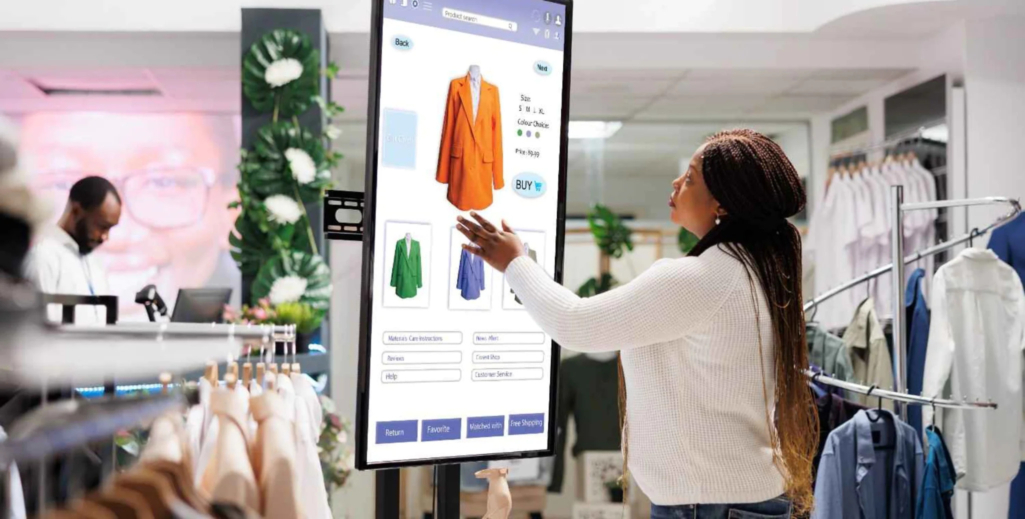
Here’s what that looks like in practice. A customer browses, adds items to a cart, saves a few favorites, and maybe clicks through a recommendation or two. AI reads those signals and ties them to a customer profile. When that same person walks into a store later, the associate isn’t starting cold; they can see preferred styles, recent purchases, and whatever’s still sitting in that abandoned cart.
The associate stops guessing and starts working from something closer to a briefing.
The Handoff, Step by Step
- The customer browses products online.
- AI reads the behavior and picks out intent signals.
- That cart or wishlist gets saved to a shared profile.
- Store systems surface the relevant details to the associate.
- The associate offers something specific, the right size, a complementary product, or an answer to a question the customer hasn’t asked yet.
- The customer leaves with a noticeably better experience than a cold interaction would have produced.
This is usually described as assisted selling, and it works because it pairs digital intelligence with a human who can actually read the room. Neither does the job as well on its own.
See how AI can connect your online and in-store retail experience.”
Why This Changes the In-Store Moment
Store staff typically get a few seconds to figure out what a customer needs. AI gives them a head start before the conversation even opens. If someone’s been comparing two products online for a week, the associate can skip the guesswork and go straight to the one that fits.
This is also where retail clienteling comes in, the longer-standing practice of building real relationships through service that feels personal rather than scripted. AI doesn’t replace that skill. It just hands the associate better material to work with.
A Quick Example
Say a customer adds a pair of shoes to their online cart but doesn’t check out. A few days later, they’re in the store. The associate can see they looked at several sizes, kept coming back to one color, and also browsed a matching bag. Instead of pulling random stock off the shelf, the associate hands them the right size, mentions the bag, and walks them to the register.
That’s the online cart doing its job in a physical space, which is the whole point of connecting the two in the first place.
AI Use Cases in Omnichannel Retail
Once the customer journey is connected, AI has plenty more to offer beyond the cart-to-store handoff.
Personalized Recommendation Engines
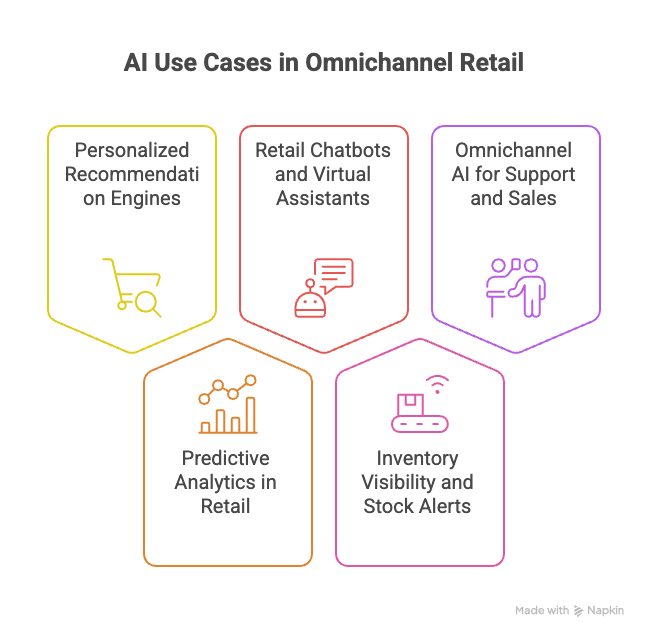
AI can suggest products using browsing history, cart activity, past purchases, and patterns pulled from similar shoppers. Personalised recommendation engines earn their keep when they stay consistent across web, app, email, and in-store; a suggestion that only shows up in one place loses most of its value.
Predictive Analytics in Retail
Predictive analytics in retail helps teams get ahead of demand instead of reacting to it: forecasting what a customer might want next, which products are about to move, and where stock is likely to run thin. That informs promotions, staffing, and how inventory gets distributed to begin with.
Retail Chatbots and Virtual Assistants
Retail chatbots handle the repetitive load, order status, store hours, and basic product questions, freeing up human agents for conversations that need a person. Done well, a chatbot also knows when to step aside and hand the conversation, along with its context, to a live associate.
Inventory Visibility and Stock Alerts
Few things frustrate customers more than finding out a product is out of stock after they’ve already made up their mind. AI keeps inventory data synced across channels and flags changes as they happen, which cuts down on both the frustration and the sales lost to it.
Omnichannel AI for Support and Sales
Beyond marketing, omnichannel AI also supports post-purchase service, product matching, and next-best-action suggestions for sales teams. At that point, it stops functioning as a marketing add-on and starts working as an operating layer for the whole customer journey.
Benefits of AI-Powered Omnichannel Retail
The advantage here is straightforward: every interaction gets more useful. Customers stop repeating themselves, and retailers respond faster and with more accuracy.
Better customer experience. Shoppers get quicker help and recommendations that reflect what they’ve already shown interest in, so moving between channels feels seamless rather than like starting over.
Higher conversion rates. When an associate can see what a customer looked at online, they can guide the sale far more effectively than working blind.
Stronger retention and loyalty. Customers stick around when a brand clearly remembers them, and that kind of continuity builds trust that’s hard to fake.
More efficient store operations. Less time spent hunting for information means staff can spend more of it actually helping people.
Better inventory planning. Predictive insight helps retailers put the right stock in the right locations, supporting unified commerce across the board.
Challenges Retailers Face
None of this comes free of friction. A few issues tend to surface regardless of how good the AI itself is.
Data silos. When e-commerce, CRM, POS, and inventory systems aren’t talking to each other, the customer picture stays incomplete, and AI can only work with what it’s given.
Privacy and trust. Personalization that feels helpful to one customer can feel invasive to another. Retailers need to be upfront about what data they’re using and why.
Integration headaches. A lot of retail infrastructure predates the AI tools now being layered on top of it, and connecting the two takes real planning rather than a quick plug-in.
Getting staff on board. Even the sharpest system fails if store teams don’t trust it or don’t know how to use it. Training isn’t optional here; it’s the difference between adoption and a tool nobody opens.
5 Ways to Improve Omnichannel Customer Experience
If you’re looking for a practical starting point, these five moves cover most of the ground.
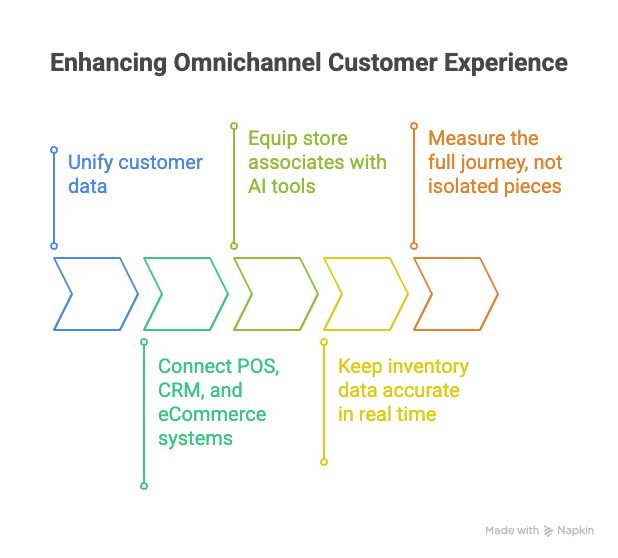
1. Unify customer data. Pull browsing history, purchases, cart activity, and service interactions into one profile, so AI has a full picture to work from rather than fragments.
2. Connect POS, CRM, and eCommerce systems. The tighter these systems are linked, the easier it is to carry context between digital and physical channels, which is close to non-negotiable for any serious omnichannel retail strategy.
3. Equip store associates with AI tools. Give staff visibility into customer preferences and history. This is what turns clienteling from a nice idea into something that happens on the floor.
4. Keep inventory data accurate in real time. A product showing available online while it’s missing in-store breaks the experience at the worst possible moment.
5. Measure the full journey, not isolated pieces. Track conversion, repeat visits, support resolution, and retention as connected outcomes instead of separate metrics that never talk to each other.
Find gaps in your retail journey and fix them faster.
Best Practices for Omnichannel Retail Strategy
A solid strategy comes down to consistency, speed, and context, with AI serving those goals rather than adding another layer of complexity on top.
Start by giving every team the same view of the customer. From there, make sure online and offline touchpoints are built to work together from the outset, not bolted on afterward. Apply AI where it moves a real outcome, personalization, recommendations, associate support, rather than everywhere it technically could be applied.
Roll changes out in phases where possible. It’s easier to test, catch problems, and adjust before scaling across the whole operation. And let cross-channel KPIs, rather than channel-specific ones, tell you whether it’s working.
Future of Omnichannel AI
The next stretch of retail is likely to lean further into prediction. Rather than reacting to what a customer does, AI will increasingly anticipate what they need before they’ve asked for it.
Store associates will get tools that push them closer to advisors than order-takers, which, done well, makes the in-store experience feel more human rather than less. Meanwhile, hyper-personalization keeps expanding across email, app, web, and store, narrowing the gap between how a brand behaves online and how it behaves in person.
As unified commerce matures, the line between online and offline shopping will keep blurring. Retailers investing in connected systems now are the ones who’ll be ready when that line disappears almost entirely.
Conclusion
AI is reshaping omnichannel retail by making the customer journey feel like one continuous conversation instead of a series of disconnected stops. What used to be an abandoned online cart becomes genuinely useful information for the person helping that customer in the store.
The real opportunity here goes beyond simply connecting channels. It’s building an experience where every interaction feels informed by the last one, and that’s what makes AI such a defining part of where omnichannel commerce is headed next.
FAQ
What is omnichannel retail?
Omnichannel retail is a connected retail strategy where website, app, social media, store, and support channels work together as one continuous customer experience.
How does AI improve omnichannel retail?
AI improves omnichannel retail by connecting customer data across channels, personalizing recommendations, improving inventory visibility, and helping store staff act on online shopping behavior.
How does AI connect the online cart to in-store staff?
AI tracks browsing behavior, cart activity, and purchase history, then makes that context available to store associates so they can offer more relevant help and recommendations.
What is unified commerce in retail?
Unified commerce is a retail model where sales, inventory, customer data, and fulfillment are managed through one connected system rather than separate channel systems.
What are the benefits of omnichannel customer experience?
The main benefits are better customer satisfaction, higher conversions, stronger loyalty, faster service, and more efficient retail operations.
What is retail clienteling?
Retail clienteling is the practice of using customer insights and history to deliver more personal, informed, and relationship-based in-store service.
Table of contents
- What Is Omnichannel Retail?
- Why AI Matters in Omnichannel Retail
- How AI Connects the Online Cart to In-Store Staff
- AI Use Cases in Omnichannel Retail
- Benefits of AI-Powered Omnichannel Retail
- Challenges Retailers Face
- 5 Ways to Improve Omnichannel Customer Experience
- Best Practices for Omnichannel Retail Strategy
- Future of Omnichannel AI
- Conclusion

Related Articles