
Greetings! I'm Aneesh Sreedharan, CEO of 2Hats Logic Solutions. At 2Hats Logic Solutions, we are dedicated to providing technical expertise and resolving your concerns in the world of technology. Our blog page serves as a resource where we share insights and experiences, offering valuable perspectives on your queries.
Quick Summary
This guide focuses specifically on how Shopware 6 performs in real-world large-scale e-commerce environments. It covers:
- Handling large product catalogs (1M+ products)
- Performance optimization techniques in Shopware
- Search and database scalability (ElasticSearch, caching, etc.)
- Real implementation insights from a demo store
- Comparison with other e-commerce platforms for large catalogs
This ensures a practical, engineering-focused understanding of Shopware’s scalability.
Managing millions of products in an e-commerce store presents a unique challenge: maintaining speed and performance as your catalog grows. The question on many enterprise retailers’ minds is simple but crucial: Can Shopware 6 Handle Millions of Products?
Yes, Shopware 6 is capable of handling extremely large product catalogs, including stores with over 1 million products.
However, this capability is not automatic. It depends on proper architecture, optimization strategies, and infrastructure setup.
In this article, we break down a real-world implementation where we optimized a Shopware demo store to handle 1 million+ products with high performance, fast search, and scalable infrastructure.
Through extensive testing and optimization, we’ve proven it can. We transformed a standard Shopware demo store into a high-performance platform capable of managing massive catalogs without sacrificing speed.
Ready to discover how? Let’s dive into the practical solutions that made this possible.
Can Shopware Handle Millions of Products?
Yes, Shopware can handle millions of products efficiently when properly optimized.
In our test implementation, we scaled a Shopware store to handle over 1 million products while maintaining:
- Fast page load times (1–4 seconds)
- Search response under 300ms
- Stable performance under concurrent users
However, achieving this level of performance depends on the right architecture, optimization techniques, and infrastructure.
Let’s break down how it works.
The Challenge: Managing 1 Million Products
Handling an e-commerce demo store with a catalog of over 1 million products comes with its challenges. Common issues faced include:

- Slow product search leads to a poor user experience.
- Database performance degradation occurs as the number of products increases.
- High server load occurs when multiple users access the store at the same time.
- Image and static file delivery delays are particularly problematic for global audiences.
Struggling to scale your Shopware store with a large product catalog?
Our mission was clear: optimize these key areas to ensure the demo store performs smoothly, even with a high volume of products.
How Shopware Handles Large Product Catalogs (1 Million+ Products)
Watch how we optimized a Shopware store to handle over 1 million products in this demo.
Database Optimization
To handle large product catalogs in Shopware, database optimization plays a critical role. A well-optimized database is the backbone of any large-scale e-commerce store. To handle millions of products efficiently, we focused on:
- Indexing frequently used fields to speed up data retrieval.
- Optimizing queries to minimize the strain on the database, ensuring faster product data loading.
ElasticSearch Integration
For large-scale Shopware stores, fast product search is essential to maintain performance. ElasticSearch was integrated to handle fast product searches and filtering. This powerful search engine has improved.
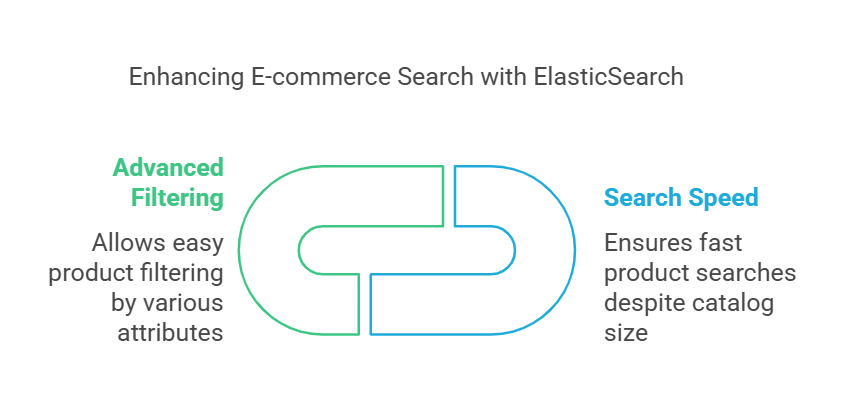
- Search speed: Product searches remain fast, no matter how large the catalog grows.
- Advanced filtering: Customers can easily filter products by attributes, categories, or price, improving the user experience.
Caching with Redis and Varnish
Implemented full-page and object caching to reduce server load and enhance performance. These caching systems ensured that:
- Static pages were delivered quickly to users without reloading the entire page.
- Reduced server load by caching frequently requested data.
Frontend Optimizations
Frontend performance is crucial for the user experience. To further enhance the site’s speed, we implemented:
- Image optimization: Compress images to reduce load times without sacrificing quality.
- Pagination: Instead of loading all products together, we implemented pagination to display smaller product sets, improving page responsiveness.
The Process: Steps for Optimization
Optimizing the Shopware demo store to handle over 1 million products involved several key steps:
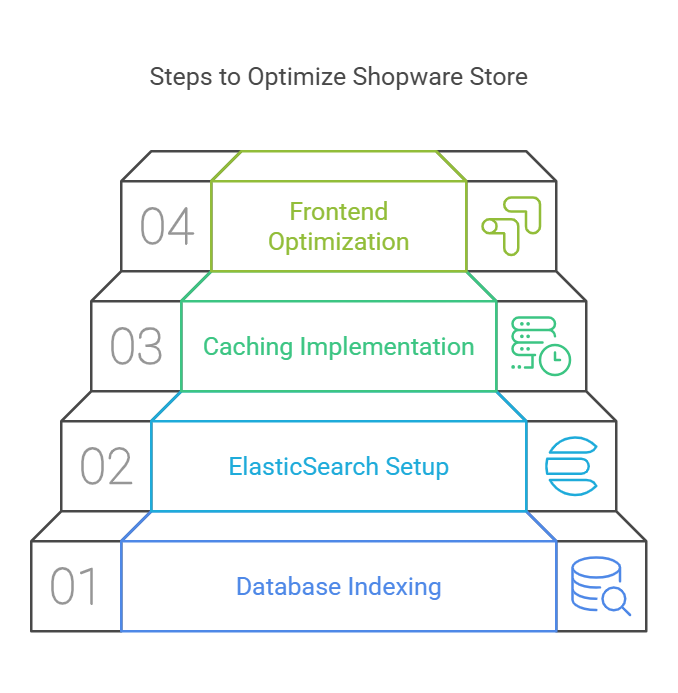
- Database Indexing: Added indexes to essential columns to speed up query performance.
- ElasticSearch Setup: Integrated to ensure fast and accurate product searches.
- Caching: Implemented Redis/Varnish for efficient full-page caching and object caching.
- Frontend Optimization: Minified CSS, JavaScript, and HTML files to improve load times and reduce browser render times.
Further Improvements for Better Performance
To enhance Shopware’s performance further, the following strategies can be implemented:
For a deeper understanding of improving performance and search visibility, explore our guide on optimizing your Shopware 6 store.
Further improvements that can be incorporated
- Queue Processing: Use Redis/RabbitMQ for efficient queue processing to handle background tasks.
- Scalable Hosting: Utilize hosting solutions with sufficient CPU, RAM, and SSD storage to ensure smooth operations.
- Monitor and Debug:
- Use tools like Blackfire or Tideways for performance profiling.
- Regularly monitor server performance and resolve bottlenecks.
- Shopware Updates: Always use the latest stable Shopware version to benefit from performance improvements and bug fixes.
- CDN and Lazy Loading: Optimize content delivery with a CDN and implement lazy loading to speed up page rendering.
- Horizontal Scaling: Distribute the workload across multiple servers to efficiently handle high traffic.
Want to implement the same setup for your store?
From Elasticsearch integration to caching and infrastructure planning, getting this right requires hands-on experience.
Performance Results: Shopware at 1 Million Products
After applying the optimizations, we performed several rounds of performance testing. The results were impressive:
- Load time: The demo store consistently loaded in 1-4 seconds, even with a million products.
- Search speed: Product searches were completed within 278 milliseconds, even with advanced filters.
- User experience: The store provided a smooth and fast browsing experience for all users, regardless of location.
Scaling a Shopware store to handle millions of products is absolutely possible, but it requires the right setup, tools, and expertise.
Shopware vs. Other Platforms for Large Catalogs
How does Shopware compare to other platforms like Magento, WooCommerce, or Shopify when handling large product catalogs? Here’s why Shopware excels:
- Modular Architecture: Shopware’s flexible, API-driven architecture allows it to scale effectively with minimal performance hits.
- ElasticSearch Integration: Out-of-the-box integration with ElasticSearch ensures fast search capabilities.
- Caching and CDN Support: Shopware supports Redis/Varnish caching and is easily integrated with CDN.
Future-Proofing with Shopware
The future of e-commerce is all about scaling effectively. Shopware’s latest versions, particularly Shopware 6, are designed for even greater performance and scalability. Shopware’s scalability also supports multi-store and international e-commerce setups, making it a strong choice for businesses planning global expansion. With enhanced features like:
- Optimized database management for large product catalogs.
- Advanced caching techniques.
- Improved API support for integrations.
What Affects Shopware Performance at Scale?
Shopware can handle large product catalogs, but performance depends on several factors:
- Hosting infrastructure (CPU, RAM, SSD)
- Proper caching implementation (Redis, Varnish)
- Search optimization (ElasticSearch)
- Database structure and indexing
- Traffic load and concurrent users
Without the right setup, even powerful platforms can slow down under scale.
Who Should Use Shopware for Large Catalogs?
Shopware is especially suitable for:
- Enterprise businesses with large product catalogs (100k+ products)
- Brands planning to scale across multiple regions or sales channels
- Businesses requiring high customization and flexibility
- Companies needing advanced search, filtering, and performance optimization
However, for small stores with limited products, simpler platforms may be easier to manage without heavy optimization.
Conclusion
Through extensive optimization, we’ve demonstrated that Shopware isn’t just capable of handling a million-product catalog but excels at it. However, achieving these results requires expertise. If you’re new to Shopware or want a complete understanding of its capabilities, check out our detailed Shopware 6 guide covering features, architecture, and use cases.
FAQ
Can Shopware handle 1 million products?
Yes, Shopware can efficiently manage a catalog of over 1 million products. Techniques like ElasticSearch integration, database optimization, and advanced caching significantly improve performance, ensuring smooth operations.
How does Shopware compare to other platforms for large product catalogs?
Shopware stands out due to its modular architecture, built-in ElasticSearch support, and seamless caching and CDN integration. These features make it a highly scalable and efficient choice for managing extensive product catalogs
Can these optimizations be applied to existing Shopware stores?
Yes, these optimization techniques can be implemented for both new and existing Shopware stores. Our team specializes in upgrading and optimizing stores to handle large-scale catalogs.
How can I start optimizing my Shopware store?
Contact us for a consultation! We’ll assess your store’s current performance, identify bottlenecks, and implement tailored solutions to ensure seamless performance, even with millions of products.
Table of contents
- Can Shopware Handle Millions of Products?
- The Challenge: Managing 1 Million Products
- How Shopware Handles Large Product Catalogs (1 Million+ Products)
- The Process: Steps for Optimization
- Performance Results: Shopware at 1 Million Products
- Future-Proofing with Shopware
- What Affects Shopware Performance at Scale?
- Who Should Use Shopware for Large Catalogs?
- Conclusion

Related Articles