Greetings! I'm Aneesh Sreedharan, CEO of 2Hats Logic Solutions. At 2Hats Logic Solutions, we are dedicated to providing technical expertise and resolving your concerns in the world of technology. Our blog page serves as a resource where we share insights and experiences, offering valuable perspectives on your queries.

Quick Summary
This blog highlights practical examples of computer vision in everyday life and how this technology quietly supports daily tasks and industries. From improving healthcare and retail experiences to enabling automation and smarter decision-making, discover how computer vision in AI is shaping the modern world.
Have you ever wondered how traffic cameras catch drivers not wearing their seat belts or how your phone automatically unlocks when it recognizes your face? These moments might seem like magic, but they’re all examples of computer vision. It is a fascinating branch of artificial intelligence (AI) that enables machines to see, understand, and respond to the world around them.
In simple terms, computer vision enables computers to interpret images and videos more accurately and continuously. From social media filters to visual search tools in e-commerce to computer vision, it’s all around us.
This blog explores some of the most exciting and practical applications of computer vision. This shows how this AI-driven technology quietly makes modern life smarter, safer, and more convenient.
What Is Computer Vision?
Computer vision is a field of artificial intelligence that enables computers to interpret and understand images and video. By analyzing visual data, computer vision systems can identify objects, recognize faces, detect actions, and support automated decision-making in areas such as healthcare, retail, transportation, and manufacturing.
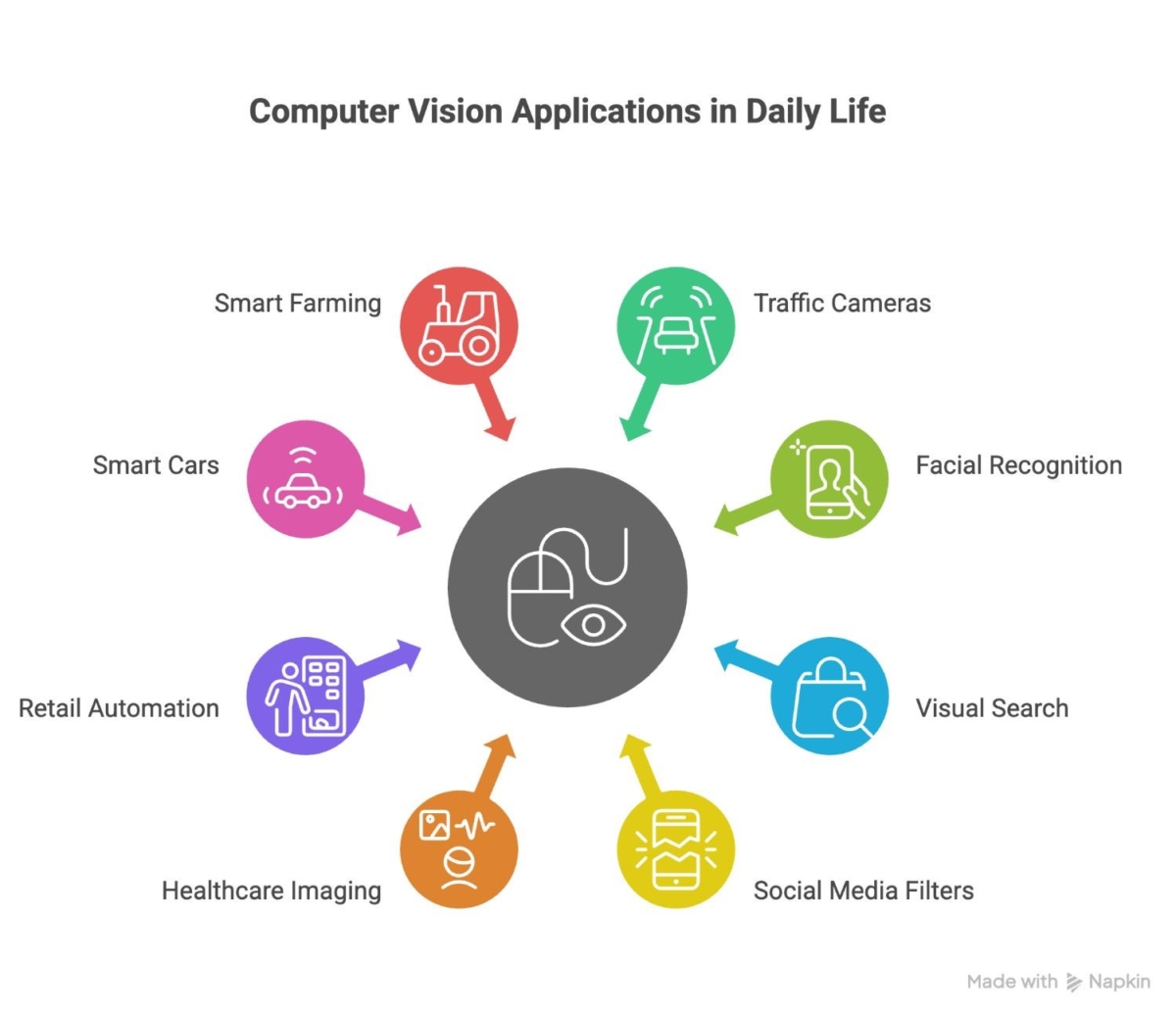
8 Examples of Computer Vision
Example 1: Traffic Cameras and Road Safety
If you’ve ever received a message or a fine for not wearing your seat belt or crossing a red light, you’ve already experienced computer vision in daily life. Modern traffic cameras use AI vision technology to analyze video footage. This detects rule violations such as speeding, not wearing helmets, or using mobile phones while driving.
Here’s how it works:
- Cameras continuously capture footage of roads and intersections.
- Computer vision algorithms process each frame, identifying vehicles, license plates, and even driver behavior.
- When the system detects a violation, like a missing seat belt, it automatically captures the image, logs the data, and sends a report without human intervention.
The use of computer vision in AI not only improves road safety but also reduces the workload for law enforcement. It ensures consistent monitoring, 24/7, with minimal human error.
Pro Tip: Computer vision becomes even more powerful when paired with analytics. You can track patterns, behaviors, and performance visually to make smarter business decisions.
Example 2: Facial Recognition in Smartphones
Unlocking your phone with just a glance is one of the most common examples of computer vision in everyday life. Behind that instant face scan is a complex process where computer vision in AI maps and analyzes your facial features to verify your identity.
Here’s how it happens in seconds:
- Your phone’s front camera captures your face.
- Computer vision algorithms identify unique patterns, like the distance between your eyes, the shape of your jawline, and other distinguishing points.
- The system compares this with stored facial data, granting access only when it finds a match.
This technology is now used for secure app logins, digital payments, and even access control in offices. It’s a perfect example of AI vision technology enhancing both convenience and security in our daily routines.
Example 3: Visual Search in e-commerce
Have you ever taken a picture of a product and used it to find similar items online? That’s computer vision at work, making shopping more intuitive and personalized. Visual search in e-commerce uses AI vision technology to help customers find products faster, simply by uploading or snapping a photo.
Here’s how it works:
- The e-commerce platform’s computer vision algorithm analyzes the image you upload.
- It identifies visual features such as color, shape, texture, or brand markings.
- Then it instantly shows you similar or matching products from the store’s catalog.
This is one of the most practical examples of computer vision in everyday life, blending convenience with personalization.
Retailers also benefit from this technology. It improves user experience, increases conversion rates, and supports better product tagging and categorization. This helps stores manage their vast inventory more efficiently.
Example 4: Social Media Filters and Tagging
Every time you use a dog-ear filter on Instagram, your phone automatically tags friends in a photo. That’s another fun and familiar example of computer vision in everyday life.
Social media platforms rely heavily on computer vision in AI to recognize faces, detect emotions, and apply filters in real time. The same technology is also behind automatic photo tagging, where the system identifies who’s in your picture by comparing facial features with existing profiles.
Here’s how it works:
- Computer vision algorithms analyze the pixels in an image to detect human faces and key landmarks (like eyes, nose, and mouth).
- Once detected, the system maps those points and applies AR effects or suggests tags.
- This process happens instantly, thanks to powerful AI vision technology.
Example 5: Healthcare and Medical Imaging
Imagine a doctor detecting diseases faster and more accurately, sometimes even before symptoms appear. That’s the power of computer vision in healthcare.
Hospitals and research centers use computer vision in AI to analyze medical images such as X-rays, CT scans, and MRIs. These systems can spot patterns or abnormalities that may go unnoticed by the human eye, assisting doctors in diagnosis and treatment planning.
Here’s how it works:
- Computer vision algorithms are trained on thousands of medical images.
- The AI learns to identify specific markers like tumors, fractures, or infections.
- It then highlights suspicious areas for doctors to review, improving both speed and accuracy.
Example 6: Self-Checkout and Retail Automation
Have you ever used an Amazon Go store or a supermarket self-checkout counter that doesn’t need a cashier? That is the example of computer vision in retail.
With computer vision in AI, cameras track what items you pick up and automatically add them to your virtual cart. When you walk out, payment is processed automatically.
In retail environments, computer vision algorithms can:
- Recognize products instantly, even without barcodes.
- Detect shelf stock levels and alert staff when items need restocking.
- Track customer movement to improve store layout and shopping experiences.
For online stores too, computer vision applications in e-commerce help automate product tagging, quality control, and even recommendation systems.
Example 7: Smart Cars and Traffic Systems
Computer vision in self-driving cars is one of the most advanced and visible real-world applications of AI today.
Cars equipped with computer vision systems use cameras and sensors to “see” their surroundings. This will help in identifying vehicles, road signs, traffic lights, and even unpredictable elements like cyclists or animals crossing.
Here’s what computer vision algorithms help with:
- Object detection: Recognizing nearby vehicles, pedestrians, and obstacles.
- Lane detection: Keeping the car centered and preventing lane departure.
- Traffic monitoring: Reading signs and signals to make real-time driving decisions.
Even in non-autonomous vehicles, AI plays a role in parking assistance, collision avoidance, and driver drowsiness detection.
Cities use computer vision in traffic systems to monitor congestion, manage signals dynamically, and enhance road safety.
Example 8: Agriculture and Smart Farming
Even farming is becoming smarter with computer vision in AI. Modern agriculture uses computer vision systems to monitor crops, detect diseases early, and improve overall yield, all without human supervision in the field.
Here’s how computer vision algorithms help farmers:
- Crop health monitoring: Drones and cameras scan large fields, spotting discoloration or pests that indicate problems.
- Weed detection: AI distinguishes weeds from crops, helping automated machines target them precisely.
- Harvest optimization: Vision-powered robots identify ripe fruits or vegetables and pick them at the perfect time.
These applications of computer vision allow farmers to save time, cut costs, and produce higher-quality food.
How Businesses Use Computer Vision
Businesses are increasingly adopting computer vision to automate processes, improve customer experiences, and gain actionable insights from visual data. While the technology powers many consumer applications, it also creates significant opportunities for organizations looking to improve efficiency and make smarter decisions.
Visual Search for e-commerce
Online shoppers often struggle to find products using text searches alone. Computer vision enables visual search, allowing customers to upload an image and instantly find similar products. This improves product discovery and can increase conversion rates by helping shoppers find what they want faster.
Automated Product Tagging and Catalog Management
Managing large product catalogs can be time-consuming. Computer vision can automatically identify product attributes such as color, style, category, and patterns, helping businesses organize inventory and improve search accuracy across their online stores.
Quality Inspection and Defect Detection
Manufacturers and retailers use computer vision to inspect products for defects before they reach customers. Automated visual inspections help maintain quality standards while reducing manual effort and human error.
Inventory Monitoring
Computer vision systems can track inventory levels using cameras and image analysis. Businesses gain real-time visibility into stock availability, helping prevent stockouts and improve inventory management.
Customer Behavior Analysis
Retailers can analyze customer movement and shopping patterns within physical stores. These insights help optimize store layouts, improve product placement, and create better shopping experiences.
As computer vision technology continues to evolve, businesses are discovering new ways to automate operations, improve customer satisfaction, and unlock value from visual data.
Get in Touch
Looking to automate your business with AI and computer vision?
Computer Vision Applications Across Industries
Computer vision applications extend across almost every industry. Businesses use computer vision to automate visual inspections, improve safety, enhance customer experiences, and make faster decisions using image and video data.
| Industry | Computer Vision Application |
|---|---|
| Healthcare | Medical image analysis and disease detection |
| Retail | Visual search and automated checkout |
| Manufacturing | Defect detection and quality inspection |
| Transportation | Traffic monitoring and autonomous driving |
| Agriculture | Crop monitoring and pest detection |
| Security | Facial recognition and surveillance |
Conclusion
Computer vision is transforming the way people and businesses interact with the world. From facial recognition and traffic monitoring to visual search and inventory management, its applications continue to expand across industries.
As AI technology becomes more accessible, organizations are increasingly using computer vision to automate processes, improve customer experiences, and make data-driven decisions. Whether it’s enhancing eCommerce product discovery, streamlining operations, or improving quality control, computer vision offers practical solutions to real business challenges.
If you’re exploring how computer vision can support your business goals, partnering with an experienced AI development team can help you identify the right opportunities and build solutions tailored to your needs.
FAQ
What is computer vision in artificial intelligence?
Computer vision in artificial intelligence is a technology that allows machines to interpret and understand visual information. It helps AI systems analyze images or videos to recognize objects, faces, or actions and make decisions.
How does computer vision work in AI?
Computer vision works in AI by using cameras and algorithms to capture and process visual data. The system identifies patterns, detects objects, and learns from examples using deep learning models.
What are some computer vision applications in e-commerce?
In e-commerce, computer vision applications include visual search, automated product tagging, virtual try-ons, and quality checks.
What are the most common computer vision applications?
Computer vision applications include facial recognition, visual search, medical image analysis, autonomous driving, traffic monitoring, quality inspection, surveillance systems, and crop health monitoring. These applications help organizations automate visual tasks and improve decision-making.

Related Articles