
Greetings! I'm Aneesh Sreedharan, CEO of 2Hats Logic Solutions. At 2Hats Logic Solutions, we are dedicated to providing technical expertise and resolving your concerns in the world of technology. Our blog page serves as a resource where we share insights and experiences, offering valuable perspectives on your queries.

Most AI vendor selection guides tell you what to look for. We’re going to tell you what actually happens when you get it wrong.
Failed Shopify integrations that take six months to fix. Inventory systems that can’t scale past 1,000 SKUs. Chatbots that frustrate customers more than help them. Support teams that disappear after go-live.
We’ve cleaned up these disasters for retailers who picked the wrong partner the first time.
At 2Hats Logic Solutions, we’ve implemented AI globally for stores ranging from startups to enterprise operations. This guide breaks down the evaluation process that works, based on real implementations, not marketing promises.
Why Your Retail Business Needs the Right AI Partner
Let’s start with reality: the demands on e-commerce operations have intensified dramatically. Customers expect personalized product recommendations, real-time inventory visibility, instant customer support, and increasingly, same-day delivery options. Traditional manual processes can’t scale to meet these expectations.
AI technologies, from predictive analytics to conversational chatbots to agentic automation systems, offer solutions to these challenges. But implementing them successfully requires more than just buying software. You need a partner who understands retail operations, can integrate with your existing systems, and delivers measurable business results.
The Cost of Getting It Wrong
When e-commerce managers choose AI vendors based solely on marketing promises or brand recognition, the results can be disastrous. Common problems include platforms that don’t integrate with your APIs, solutions designed for general business use rather than retail-specific workflows, and vendors without the regional expertise needed for GCC markets or global expansion.
PRO TIP: Companies with aligned AI partnerships see efficiency gains of up to 40% within the first year. The keyword here is ‘aligned’, which means the vendor has proven e-commerce expertise, not just AI capabilities.
Core Criteria for Evaluating AI Vendors
When you’re comparing potential AI partners, you need a structured framework. Here are the non-negotiable criteria that should guide your evaluation:
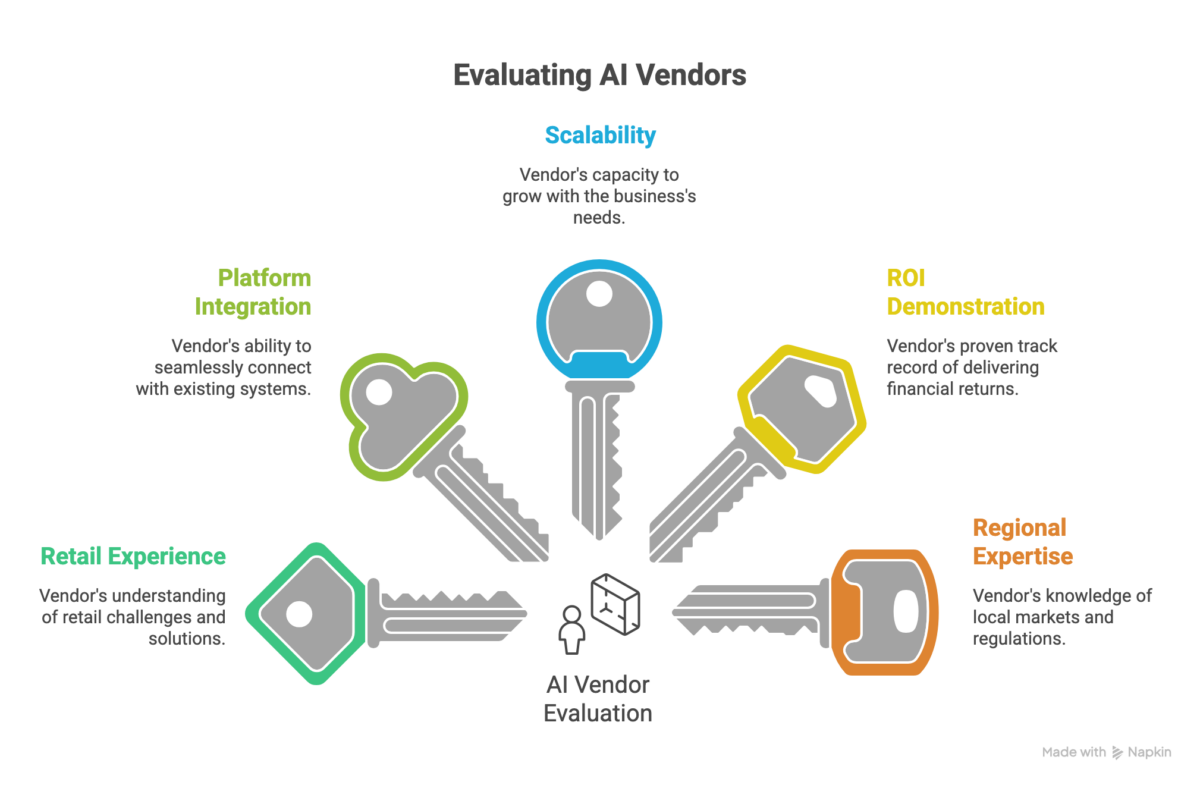
1. Retail-Specific Experience
Generic AI consultancies often struggle with retail’s unique requirements. Your ideal partner should demonstrate a deep understanding of inventory cycles, seasonal demand patterns, customer journey mapping in online stores, and the specific challenges of cart abandonment, product discovery, and conversion optimization.
Ask them: Can you show us three retail implementations you’ve completed in the past 18 months? How did you handle peak season traffic spikes in those projects?
2. Platform Integration Capabilities
Your AI solution needs to work with your current tech stack. Whether you’re on Shopify, WooCommerce, Magento, or using an ERP system like Business Central, Odoo, NetSuite, or SAP, the vendor should have proven integration experience and pre-built connectors where possible.
Technical must-haves:
• API compatibility with your e-commerce platform
• Documented integration timelines and requirements
• Real-time data synchronization capabilities
• Security compliance (PCI DSS for payment data, GDPR for customer information)
WARNING: If a vendor can’t provide detailed integration documentation or estimates within the first conversation, consider it a red flag. Retail systems are complex, and experienced partners know this upfront.
3. Scalability Proven in Production
Your business won’t stay the same size forever. The AI solution you implement today needs to handle 2x or 5x growth without requiring a complete rebuild. Look for evidence of scalability in the vendor’s track record.
What to verify:
• Have they worked with retailers managing similar transaction volumes?
• Can their systems handle Black Friday-level traffic spikes?
• What’s their approach to multi-region expansion if you’re planning global growth?
Shortlisting AI vendors? Avoid costly mistakes.
4. Demonstrated ROI with Case Studies
Any vendor can talk about AI’s potential benefits. The best partners back up their claims with concrete numbers from real implementations. Request detailed case studies that include baseline metrics, implementation timeline, and post-launch results measured in revenue impact, cost savings, or efficiency gains.
Key metrics to look for:
• Conversion rate improvements
• Average order value increases
• Customer service cost reductions
• Inventory turnover optimization
• Return on investment timeline
5. Regional Expertise and Support
If you’re planning international expansion, your AI partner needs to understand local market dynamics, data residency requirements, language and cultural considerations for customer-facing AI, and regional payment and logistics integrations.
POINT TO NOTICE: Time zone alignment matters more than you think. A partner in your region can provide real-time support during your business hours, which is critical during implementation and when issues arise.
Top AI Use Cases in Retail and E-commerce
Understanding which AI applications deliver the most value helps you evaluate whether a potential partner has relevant expertise. Here are the highest-impact use cases for online retail in 2026:
Personalized Product Recommendations
AI-powered recommendation engines analyze customer browsing behavior, purchase history, and similar shopper patterns to suggest relevant products. Leading retailers report conversion rate increases of 25% or more when personalization is implemented effectively. Your AI partner should demonstrate experience with collaborative filtering, real-time behavioral analysis, and A/B testing frameworks to optimize recommendation algorithms.
Inventory Optimization and Demand Forecasting
Predictive analytics help you maintain optimal stock levels by forecasting demand based on historical sales, seasonal patterns, market trends, and external factors. This reduces both stockouts (which cost sales) and overstock (which ties up capital). Look for partners with proven experience in time-series forecasting and integration with your existing inventory management system.
Not Sure Which AI Use Case Will Actually Work for Your Store?
PRO TIP: The most effective inventory AI systems learn continuously. Ask potential partners how their models adapt when you introduce new product lines or expand to new markets.
Implementation Roadmap: What to Expect
Understanding the implementation process helps you set realistic expectations and allocate resources appropriately. Here’s a typical timeline for AI integration in e-commerce:
Phase 1: RFP and Vendor Shortlisting
• Define your specific use cases and success criteria
• Issue requests for proposals to 3-5 vendors
• Conduct initial discovery calls and product demos
• Review proposals and narrow to 2 finalists
• Check references and verify case studies
Phase 2: Proof of Concept Testing
• Provide finalists with sample data (or access to sanitized production data)
• Define specific POC success metrics aligned with business goals
• Evaluate model performance, integration ease, and user experience
• Test scalability with realistic load scenarios
• Select final vendor based on POC results and total cost analysis
Phase 3: Implementation and Integration
• Conduct a detailed requirements workshop with the vendor team
• Set up development and staging environments
• Complete platform integrations (Shopify APIs, ERP connections, etc.)
• Train models on your historical data
• Conduct user acceptance testing with your team
• Develop monitoring dashboards and alert systems
Phase 4: Go-Live and Optimization (Ongoing)
• Soft launch with limited traffic or product subset
• Monitor key performance indicators daily
• Gradually increase scope as confidence builds
• Schedule regular optimization reviews (weekly initially, then monthly)
• Document learnings and refine models based on performance
Common Mistakes to Avoid
Learning from others’ missteps saves time and money. Here are the most frequent errors e-commerce managers make when selecting AI partners:
Mistake 1: Choosing Based on Hype Over Proof
It’s easy to be impressed by flashy demos and bold claims about revolutionary AI capabilities. But impressive technology doesn’t automatically translate to retail results. Always insist on seeing documented case studies from similar businesses, with real metrics and verifiable outcomes. If a vendor can’t show you proof, they’re asking you to be their proof-of-concept customer, which means you’re taking on significant risk.
Mistake 2: Underestimating Total Cost of Ownership
Many AI solutions advertise attractive licensing fees but hide substantial additional costs. Training data preparation and quality assurance can consume months of staff time. Ongoing model retraining and maintenance require continuous investment. Integration work often exceeds initial estimates, especially for complex ERP environments. Custom feature development adds up quickly. Calculate a realistic total cost, including these elements, before making your final decision.
WARNING: If a vendor won’t provide a detailed cost breakdown, including implementation, training, and first-year maintenance, push back. Hidden costs are the #1 source of buyer’s remorse in AI projects.
Mistake 3: Ignoring Post-Launch Support Quality
The AI system you deploy today will require ongoing support. Models need retraining as your product catalog or customer base evolves. Integrations break when platforms update their APIs. Business requirements change, necessitating feature modifications. Your vendor’s post-launch support quality is just as important as their implementation expertise. Ask detailed questions about support SLAs, escalation procedures, and whether you’ll have a dedicated account manager or be routed to a generic support queue.
Mistake 4: Skipping the Proof of Concept
Some organizations skip POC testing to accelerate implementation timelines. This almost always backfires. A proof of concept reveals integration challenges early, validates claimed performance metrics with your actual data, builds team confidence in the solution, and provides negotiating leverage on final pricing and terms. The 3-4 weeks invested in a POC can save months of struggling with an ill-fitting solution.
Mistake 5: Failing to Define Clear Success Metrics
Without clearly defined KPIs agreed upon before implementation, you have no objective way to measure whether the AI project succeeded. Before signing any contract, document specific metrics like conversion rate targets, inventory turnover improvements, customer service cost reductions, or average order value increases. Include these in your agreement and tie vendor payments to achieving milestones when possible.
Conclusion
Our team has delivered measurable results for retailers across the region and globally, with a focus on practical solutions that integrate seamlessly with your existing operations.
We’d be happy to provide a free AI readiness audit for your store, including a customized evaluation of which AI use cases would deliver the highest ROI for your specific business model, a technical assessment of integration requirements with your current platform, and a roadmap with realistic timelines and cost estimates.
Contact us today to schedule your personalized demo and see how the right AI partner can transform your retail operations.
FAQ
How do I know if my e-commerce business is ready for AI implementation?
If you're experiencing any of these challenges, you're ready: cart abandonment rates above 25%, frequent stockouts or overstock situations, customer service team overwhelmed with repetitive questions, difficulty managing inventory across multiple locations, or manual processes that can't scale with growth. Most retailers we work with start seeing ROI within 5-6 months when they implement the right solution.
Can I implement AI without disrupting my current operations?
Yes, if done correctly. The best implementations use a phased approach: start with a proof of concept on sample data, soft launch with limited traffic (10-20% of customers), gradually increase scope while monitoring performance, and run parallel systems during transition. Your operations shouldn't experience downtime if the vendor has proper retail experience.
How often does the AI need retraining or updates?
Depends on your business dynamics. Personalization models typically need retraining monthly or quarterly, inventory forecasting should retrain weekly or bi-weekly (more often during seasonal changes), fraud detection needs continuous learning with weekly updates, and chatbots require updates when you change products, policies, or seasonal offerings. Your vendor should handle this automatically with periodic review points.

Related Articles