Greetings! I'm Aneesh Sreedharan, CEO of 2Hats Logic Solutions. At 2Hats Logic Solutions, we are dedicated to providing technical expertise and resolving your concerns in the world of technology. Our blog page serves as a resource where we share insights and experiences, offering valuable perspectives on your queries.

Quick Summary
Order processing errors can lead to delays, increased costs, and dissatisfied customers. Common mistakes include wrong item selection, incorrect labels, address errors, inventory mismanagement, and shipping delays.
AI-driven automation resolves these issues by ensuring accurate order picking, real-time tracking, fraud detection, and optimised inventory control. AI enhances efficiency, reduces human error, and improves customer satisfaction, making it essential for e-commerce growth.
Every missed shipment, incorrect order, and inventory error costs more than just money; it costs customer trust. Today’s consumers expect Amazon-like efficiency from businesses of all sizes. Yet most ecommerce brands are still fighting the same order management issues day after day: wrong items picked, delayed shipments, poor communication, and returns handled badly.
The result? Cart abandonment, negative reviews, and customers who never come back.
The good news is that the same AI technology powering the world’s largest fulfilment operations is now accessible to businesses of every size. In this guide, we break down the 10 most common ecommerce order management mistakes and show exactly how AI-driven automation fixes each one.
What is Ecommerce Order Management?
Ecommerce order management is the end-to-end process of receiving, tracking, and fulfilling customer orders across all sales channels. It covers everything from the moment a customer clicks ‘Buy’ to the point the product is delivered, and beyond, including returns and refunds.
Order Management is the broader system that keeps all those moving parts connected: inventory visibility, fraud checks, customer communication, carrier selection, and post-order support.
When order management works well, customers get the right product on time with zero friction. When it breaks down, businesses face costly mistakes outlined below.
Why Order Management Mistakes Are Costly for Ecommerce
Order management challenges don’t just affect one department; they ripple across the entire business. A single picking error triggers a return, a replacement shipment, a support ticket, and a negative review. Multiply that by hundreds of orders, and the damage compounds quickly.
Here is what’s at stake when order management breaks down:
- Lost revenue from returns, refunds, and reshipments
- Increased customer acquisition costs when dissatisfied buyers don’t return
- Operational overhead from manual error correction
- Reputation damage from negative reviews and social complaints
- Inventory distortion caused by untracked returns and fulfilment errors
The businesses that scale efficiently are those that eliminate these failure points systematically, not by hiring more people, but by automating the processes that break most often.
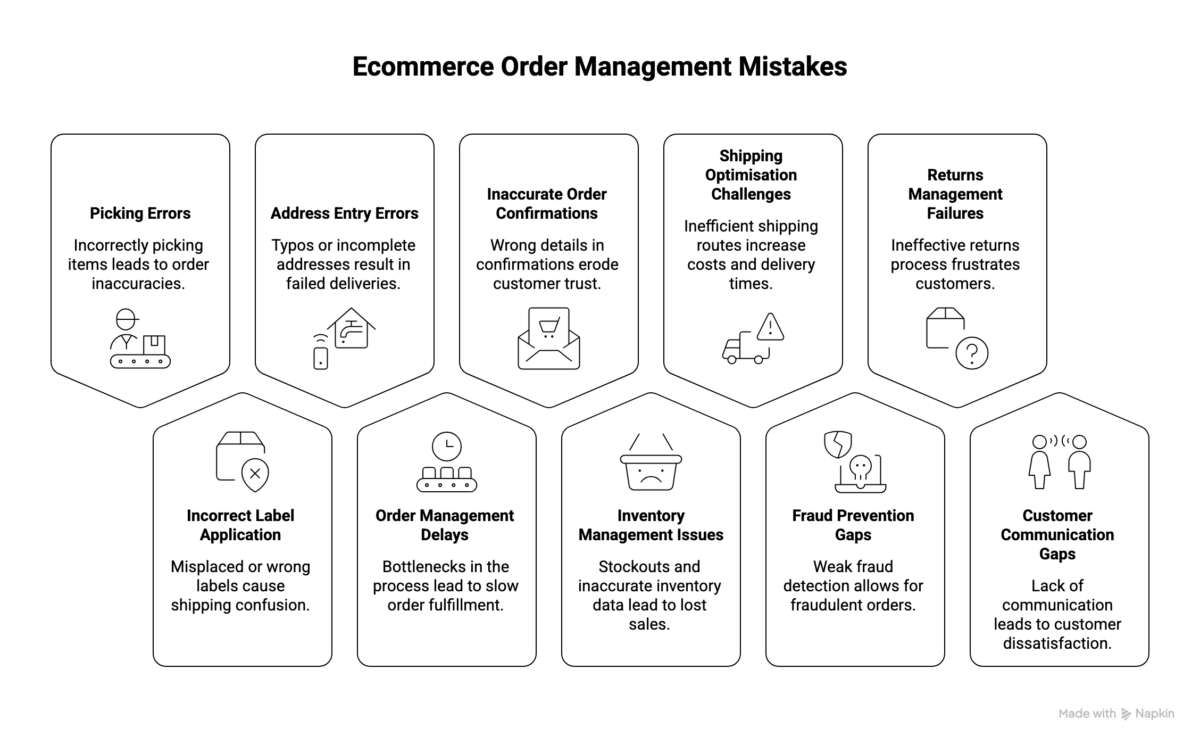
10 Common Ecommerce Order Management Mistakes (And How AI Fixes Them)
Efficient order management is crucial for e-commerce success. Errors can lead to delays, returns, and lost customers. AI-powered automation helps businesses minimise mistakes and improve efficiency. Let’s explore the most common order-processing mistakes and how AI can fix them.
1. Picking Errors That Damage Order Accuracy
Selecting the wrong product is one of the most common and costly order management mistakes. It leads to returns, negative reviews, replacement costs, and a direct hit to order accuracy metrics. For high-SKU catalogues, manual picking errors are almost inevitable at scale.
How AI Fixes It: AI-powered barcode scanning cross-checks every item picked against the original order. Vision recognition technology adds a second layer of verification, flagging mismatches before the item is packed. Colour-coded picking systems and automated double-check protocols ensure accuracy at every stage of fulfilment.
Pro Tip: Regularly audit AI picking systems against your return rate data. A spike in ‘wrong item’ returns is usually the first sign a verification rule needs updating.
2. Incorrect Label Application
Misapplied labels cause delivery failures, inflated shipping costs, and lost packages. When a parcel reaches the wrong address or carrier hub, the cost of recovery, redelivery, customer service, and replacement often exceeds the original order value.
How AI Fixes It: AI-based label verification tools cross-reference printed labels with order data in real time. Automated address validation and multi-stage verification catch mismatches before dispatch. Any discrepancy triggers an immediate correction alert, preventing the error from leaving the warehouse.
3. Address Entry Errors
Incorrect shipping addresses are responsible for a significant proportion of undelivered parcels. Whether caused by customer typos or manual data entry mistakes, address errors create failed deliveries, additional courier fees, and frustrated customers who blame the retailer.
How AI Fixes It: AI-driven address validation corrects errors at the point of entry, before the order is even confirmed. Geolocation technology verifies addresses against postal databases, auto-completing and standardising formats. Customers are prompted to confirm unusual addresses, reducing downstream errors significantly.
Warning: AI automation works best when combined with human oversight. Regularly audit AI picking systems to ensure accuracy.
4. Order Management Delays and Bottlenecks
Manual order handling slows fulfilment, frustrates customers, and increases the risk of cancellations. During peak seasons, Black Friday, and end-of-year sales, manual workflows collapse under volume, creating backlogs that can take days to clear.
How AI Fixes It: AI-driven order management automates every stage of the fulfilment workflow, from order receipt to dispatch. Predictive analytics identify bottlenecks before they occur and prioritise urgent orders automatically. Scalable automation handles volume spikes without additional headcount or manual intervention.
Warning: Rushing AI implementation without proper testing can create new bottlenecks. Always pilot automation on a subset of order types before full rollout.
5. Inaccurate Order Confirmations
Incorrect order confirmations, wrong product details, wrong delivery dates, and wrong totals erode customer trust immediately. When customers receive a confirmation that doesn’t match what they ordered, it triggers support contacts, cancellations, and a loss of confidence in the brand.
How AI Fixes It: AI-powered notification systems pull directly from order management data, ensuring confirmations are accurate and real-time. Multi-channel confirmation across email, SMS, and app reduces the chance of any single channel failing. Automated tracking links keep customers informed without relying on manual updates.
6. Inventory Management Issues and Stockouts
Inventory management issues are among the most damaging order management challenges for ecommerce growth. Stockouts mean lost sales. Overselling means fulfilling orders you can’t ship. Both erode customer trust, and both stem from the same root cause: poor inventory visibility.
How AI Fixes It: AI forecasting models analyse historical sales data, seasonal trends, and real-time demand signals to predict stock requirements accurately. Automated reorder triggers maintain optimal stock levels without manual intervention. Centralised inventory management across all sales channels eliminates overselling at the source.
Pro Tip: Start with AI-powered inventory management and fraud detection; these two areas typically deliver the fastest and most measurable ROI.
Want to start with inventory automation?
7. Shipping Optimisation Challenges
Inefficient carrier selection, poor route planning, and static shipping rules cost ecommerce businesses significantly in both direct spend and missed delivery windows. Customers expect fast, affordable delivery as a baseline, not a premium.
How AI Fixes It: AI-driven shipping optimisation compares carriers in real time based on cost, speed, reliability, and route efficiency. Intelligent route planning dynamically adjusts to traffic, weather, and carrier performance data. The result is lower shipping costs and consistently faster delivery windows.
8. Fraud Prevention Gaps in Order Management
Order fraud is a growing risk for ecommerce businesses of all sizes. Fraudulent transactions lead to chargebacks, reputational damage, and significant financial losses. Manual fraud checks are reactive by nature; they catch fraud after the damage is done.
How AI Fixes It: Advanced AI fraud detection analyses hundreds of order signals simultaneously, device data, purchase behaviour, shipping address patterns, and payment methods, to flag suspicious orders before they are processed. Multi-layer verification and real-time transaction monitoring reduce chargeback rates and protect margins.
9. Returns Management Failures
Returns management is one of the most under-optimised areas of ecommerce order management. Slow approvals, inconsistent refund timelines, and poor communication during the returns process frustrate customers and increase operational costs. A bad returns experience is often what prevents a one-time buyer from becoming a repeat customer.
How AI Fixes It: AI-driven returns management automates the entire RMA workflow, from return request to refund processing. Automated approval rules handle standard returns instantly, while exceptions are flagged for human review. Predictive return analysis identifies high-return products and customers, enabling proactive inventory and policy adjustments.
Warning: Rushing AI implementation without proper testing can lead to unexpected system failures. Always start with small-scale testing.
10. Customer Communication Gaps
A lack of proactive communication is one of the biggest drivers of inbound support tickets. When customers don’t know where their order is, they contact support. When they can’t get a quick answer, they escalate. Every avoidable support interaction is a cost and a risk.
How AI Fixes It: AI-powered order tracking provides customers with real-time shipment visibility across all channels. 24/7 AI chatbots handle common enquiries, order status, delivery windows, and return initiation, without human involvement. Personalised communication workflows trigger proactive updates at every key fulfilment milestone.
Manual vs AI-Powered Order Management
| Challenge | Manual Order Management | AI-Powered Order Management |
| Order Picking | Manual staff selection is prone to human error | Barcode scanning + vision recognition ensures accuracy |
| Label Application | Manual printing and application, mislabels common | Automated verification flags mismatches before dispatch |
| Address Validation | Errors are caught only after failed delivery | Real-time geolocation correction before shipping |
| Processing Speed | Bottlenecks during peak seasons | Predictive automation scales to order volume instantly |
| Order Confirmations | Manual notifications are often delayed or incorrect | Automated real-time multi-channel updates |
| Inventory Control | Spreadsheet-based, stockouts, and overselling are frequent | AI forecasting with automated reorder triggers |
| Shipping Optimisation | Single-carrier, fixed routes | Multi-carrier comparison + intelligent route planning |
| Fraud Detection | Reactive, flagged after loss occurs | Predictive analytics identify suspicious orders in real time |
| Returns Management | Manual approvals are slow and inconsistent | Automated RMA workflows with predictive return analysis |
| Customer Communication | Reactive support tickets | 24/7 AI chatbots with proactive shipment updates |
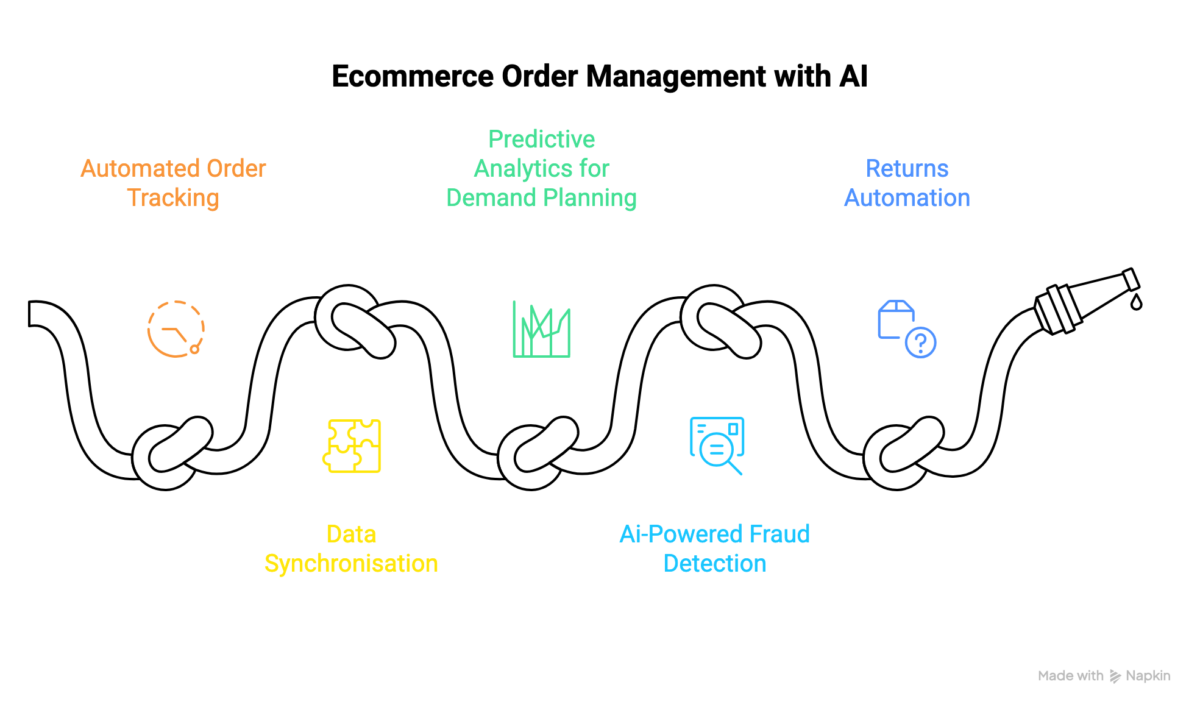
How AI Resolves Ecommerce Order Management Challenges
1. Automated Order Tracking
Real-time AI tracking keeps customers informed at every stage of fulfilment, from order confirmed to out for delivery. Automated tracking reduces inbound support requests and improves satisfaction without adding headcount.
Pro Tip: AI chatbots can be configured to proactively notify customers of any shipping delay before the customer notices, turning a negative into a managed experience.
2. Data Synchronisation Across Channels
AI ensures product information, inventory levels, and order status remain consistent across every sales channel, website, marketplace, mobile app, and in-store POS. Eliminating data silos is the foundation of accurate ecommerce order management.
3. Predictive Analytics for Demand Planning
AI analyses historical sales patterns, seasonal demand signals, and real-time market data to help businesses prepare for high-demand periods. Accurate demand planning prevents both stockouts and overstock situations, improving cash flow and fulfilment reliability.
4. AI-Powered Fraud Detection
Machine learning models continuously analyse transaction patterns to identify anomalies that indicate fraud. Unlike rule-based systems, AI fraud detection improves over time, learning from new fraud patterns and adapting without manual rule updates.
5. Returns Automation and Refund Workflows
Automated returns management reduces the processing time for refunds and exchanges from days to hours. Intelligent routing ensures straightforward returns are handled automatically, while complex cases are escalated appropriately, maintaining consistency and speed across the returns experience.
Why AI-Driven Order Management Is Essential for Ecommerce Growth
Businesses that rely on manual processes for order management face a compounding disadvantage as they scale. Every additional order adds more risk, more overhead, and more potential for error. AI-driven order management breaks that relationship, volume scales without proportional increases in error rate or cost.
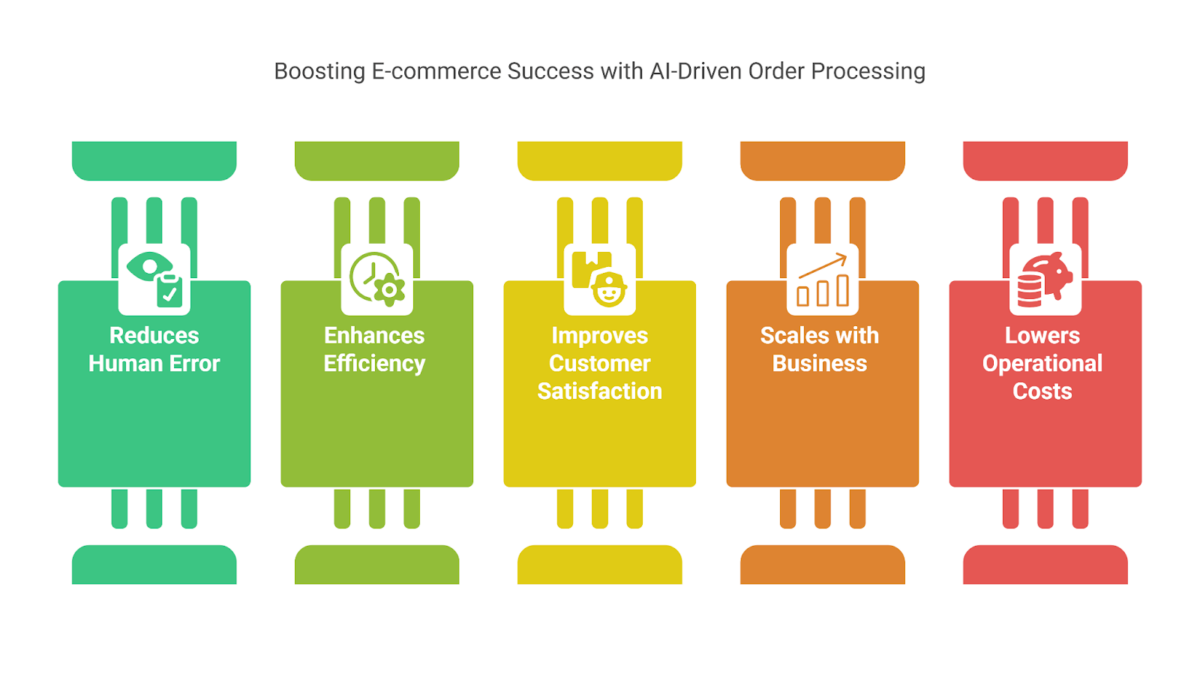
- Reduces human error: AI automates repetitive tasks, removing the variability of manual intervention
- Enhances efficiency: Orders are processed faster with fewer delays and exceptions
- Improves customer satisfaction: Accurate, fast delivery and proactive communication build loyalty
- Scales with your business: AI systems adapt to growing order volumes without additional headcount
- Lowers operational costs: Automation reduces manual labour costs and corrects shipping inefficiencies
- Strengthens fraud resilience: Continuous learning models stay ahead of evolving fraud patterns
Your competitors are already automating this.
Conclusion
Ecommerce order management mistakes are not inevitable; they are the predictable result of manual processes that haven’t scaled with business growth. Each of the ten challenges covered in this guide represents both a recurring cost and a recoverable opportunity.
AI-driven order management doesn’t just patch individual problems. It rebuilds the operational foundation that fulfilment accuracy, customer satisfaction, and business scalability all depend on. The businesses pulling ahead in ecommerce are those treating order management as a strategic asset, not a back-office function.
At 2Hats Logic, our AI integration services are built specifically for ecommerce businesses that are ready to move beyond manual workarounds. Whether you’re starting with inventory automation, fraud detection, or a full order management overhaul, we build solutions that scale with your growth.
FAQ
What are the most common ecommerce order management mistakes?
The most common mistakes include picking errors that affect order accuracy, address entry errors, inventory management issues leading to stockouts, poor returns management, and insufficient customer communication. All of these are addressable through AI-powered order management automation.
What is the difference between order processing and order management?
Order processing refers specifically to the operational steps of fulfilling an order, picking, packing, labelling, and shipping. Order management is the broader system encompassing the full order lifecycle, including inventory control, fraud detection, customer communication, and returns handling.
How does AI improve ecommerce order management?
AI improves order management by automating repetitive tasks, reducing human error, and enabling real-time decision-making across the fulfilment process. Key improvements include automated order tracking, predictive inventory management, AI fraud detection, and intelligent returns workflows.
What causes order fulfilment errors?
Order fulfilment errors are most commonly caused by manual picking processes, data entry mistakes, poor inventory visibility, and a lack of real-time synchronisation between sales channels and warehouse systems. AI-powered verification and automation address all four root causes directly.
How does AI detect fraudulent orders?
AI fraud detection analyses multiple data signals simultaneously, purchase behaviour, device fingerprinting, shipping address history, payment method patterns, to score transaction risk in real time. Orders exceeding a risk threshold are flagged for review or automatically declined before processing.
Can AI optimise inventory management?
Yes. AI forecasting models analyse historical sales data and demand signals to predict optimal stock levels and trigger automated reorders. This prevents both stockouts and overstock situations, improving cash flow and ensuring fulfilment reliability across peak and off-peak periods.
Is AI order management suitable for small businesses?
Yes. AI order management solutions are now available at price points and implementation scales that suit businesses of all sizes. For small ecommerce businesses, the highest-ROI starting points are typically inventory management automation and fraud detection, both of which deliver measurable results quickly.
Table of contents
- What is Ecommerce Order Management?
- Why Order Management Mistakes Are Costly for Ecommerce
- 10 Common Ecommerce Order Management Mistakes (And How AI Fixes Them)
- Manual vs AI-Powered Order Management
- How AI Resolves Ecommerce Order Management Challenges
- Why AI-Driven Order Management Is Essential for Ecommerce Growth
- Conclusion


Related Articles