Greetings! I'm Aneesh Sreedharan, CEO of 2Hats Logic Solutions. At 2Hats Logic Solutions, we are dedicated to providing technical expertise and resolving your concerns in the world of technology. Our blog page serves as a resource where we share insights and experiences, offering valuable perspectives on your queries.

We work with Shopware every day. We build stores on it, migrate businesses to it, and help brands scale with it. So, when someone asks us whether Shopware is a good alternative to Shopify, Magento, or WooCommerce, we don’t give the usual “it depends” answer.
Honestly? For a lot of the businesses we work with, Shopware just makes more sense. Not because the other platforms are bad, they’re not. Shopify is great for getting started. Magento can handle serious complexity. WooCommerce works well if your world already runs on WordPress. But each of them hits a ceiling at some point, and that’s usually when we see businesses start looking at Shopware.
This blog is our honest take on where Shopware fits, where it wins, and where the other platforms might still be the better call. No fluff, just what we’ve seen work.
Understanding the Platforms
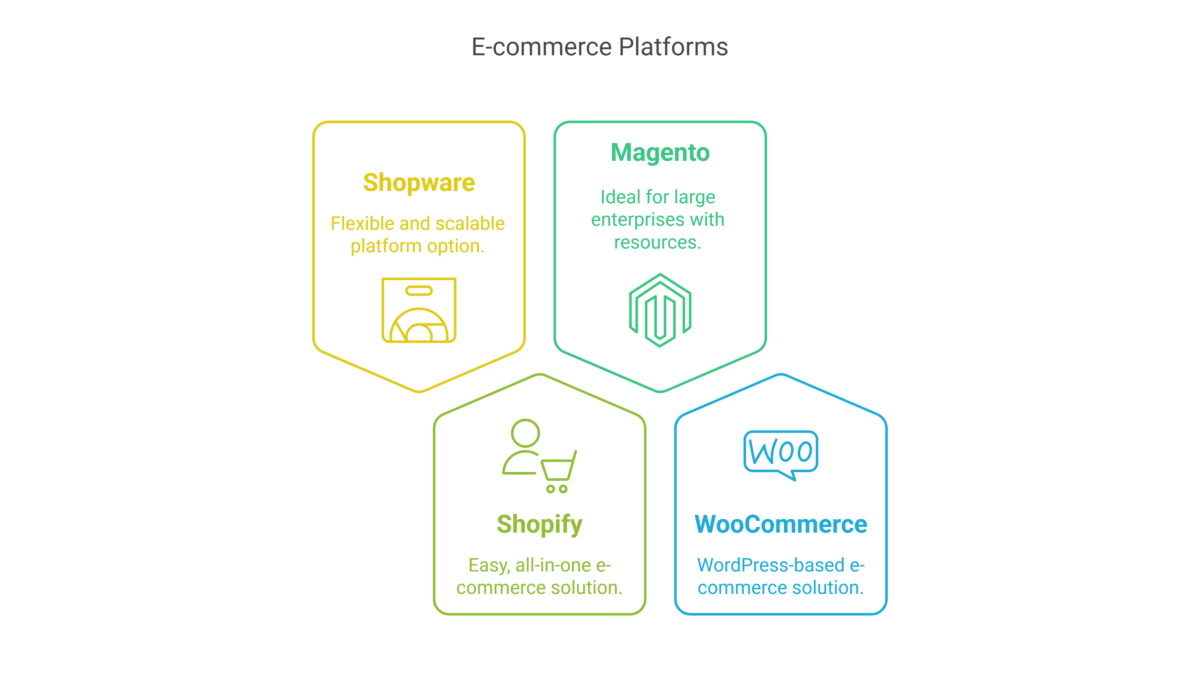
- Shopware: A flexible and scalable platform ideal for growing businesses.
- Magento: A powerful solution for large enterprises that requires technical expertise.
- Shopify: A beginner-friendly platform with a subscription-based model.
- WooCommerce: A customizable option for WordPress users.
What Is Shopware?
Shopware is a modern e-commerce platform designed to help businesses build scalable, flexible, and content-rich online stores. It gives merchants more control over the storefront experience while supporting features that suit both B2C and B2B commerce.
Unlike platforms that focus only on quick setup or heavy enterprise complexity, Shopware aims to strike a balance between usability and customisation. That makes it attractive for businesses that want more freedom than a hosted SaaS platform but less overhead than a highly complex enterprise system.
Why Shopware Is Becoming a Popular E-commerce Platform
One of the main reasons businesses look at Shopware is its flexibility. It is built for brands that want to tailor their storefront, workflows, and integrations without feeling restricted by a closed ecosystem.
Another major advantage is scalability. As product catalogs grow, customer demand increases, and business models evolve, Shopware can adapt more comfortably than simpler platforms. It also gives teams a more structured way to manage commerce operations, which becomes valuable as stores become more advanced.
Shopware is also appealing because it supports a more modern approach to commerce. Businesses can use it as a foundation for omnichannel selling, richer content experiences, and future-ready architecture.
Key Shopware Features
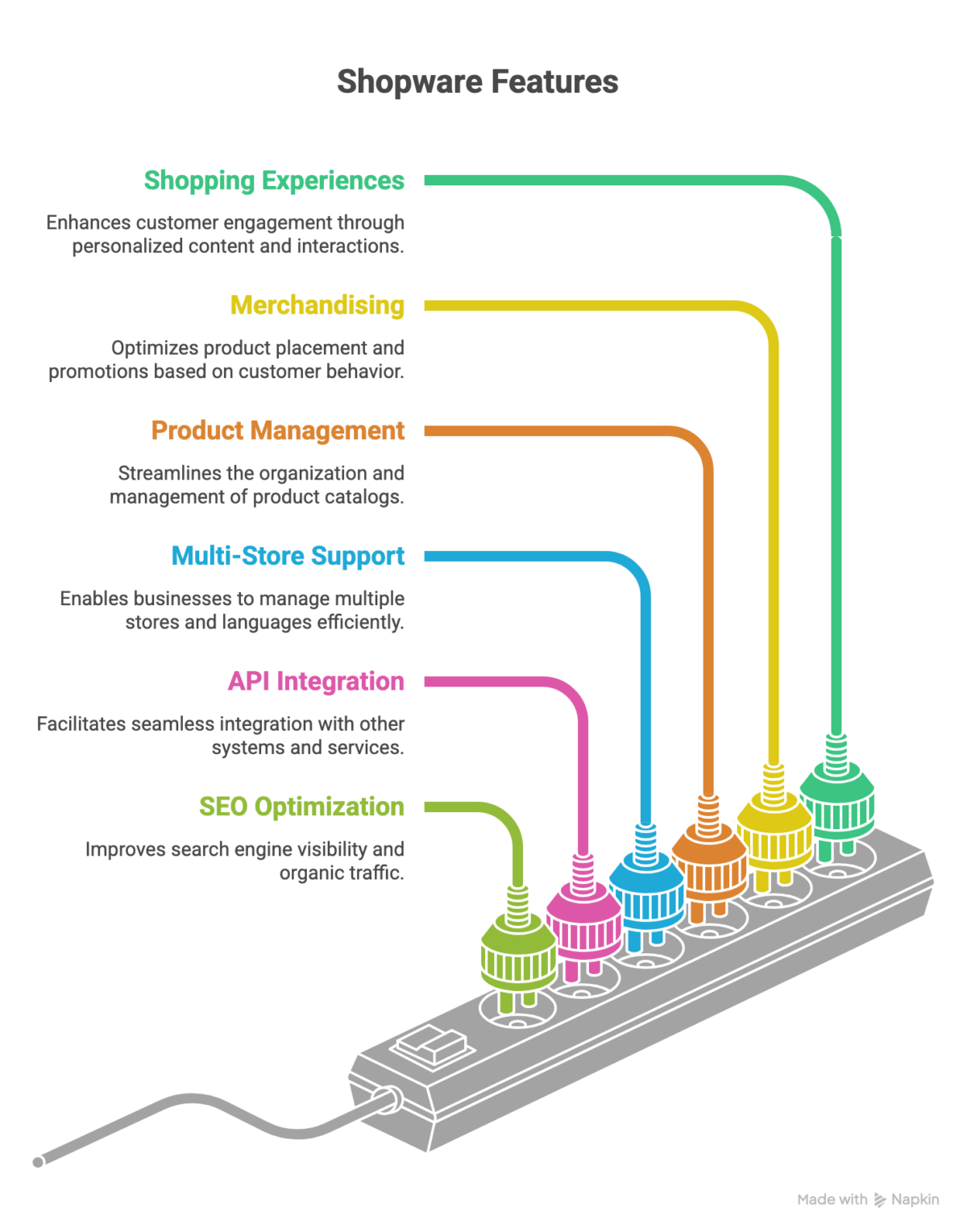
Shopware includes a set of features that make it a strong choice for businesses that need more than a basic online store.
Shopping experiences and content commerce
Shopware allows merchants to create more engaging storefronts by combining content and commerce. This helps businesses present products in a more editorial and brand-led way.
Rule-based merchandising and personalization
The platform supports rule-based logic that helps merchants tailor offers, product displays, and customer experiences based on different conditions. This is useful for businesses that want more targeted selling.
Product and catalog management
Shopware provides a structured way to manage products, categories, and store content. That becomes especially helpful when catalogs are large or when product data needs to stay consistent across multiple channels.
Multi-store and multilingual support
For businesses selling in different regions or managing multiple storefronts, Shopware is a practical option. It supports multi-store setups and multilingual selling without making the system feel fragmented.
SEO-friendly structure
Shopware is suitable for businesses that care about visibility in search results. Its structure supports SEO-friendly product pages, content management, and technical customization.
API-first and integration-friendly architecture
Shopware is also attractive because it is built with integration in mind. That makes it easier to connect with ERP, CRM, PIM, and other business systems.
Shopware for Different Business Models
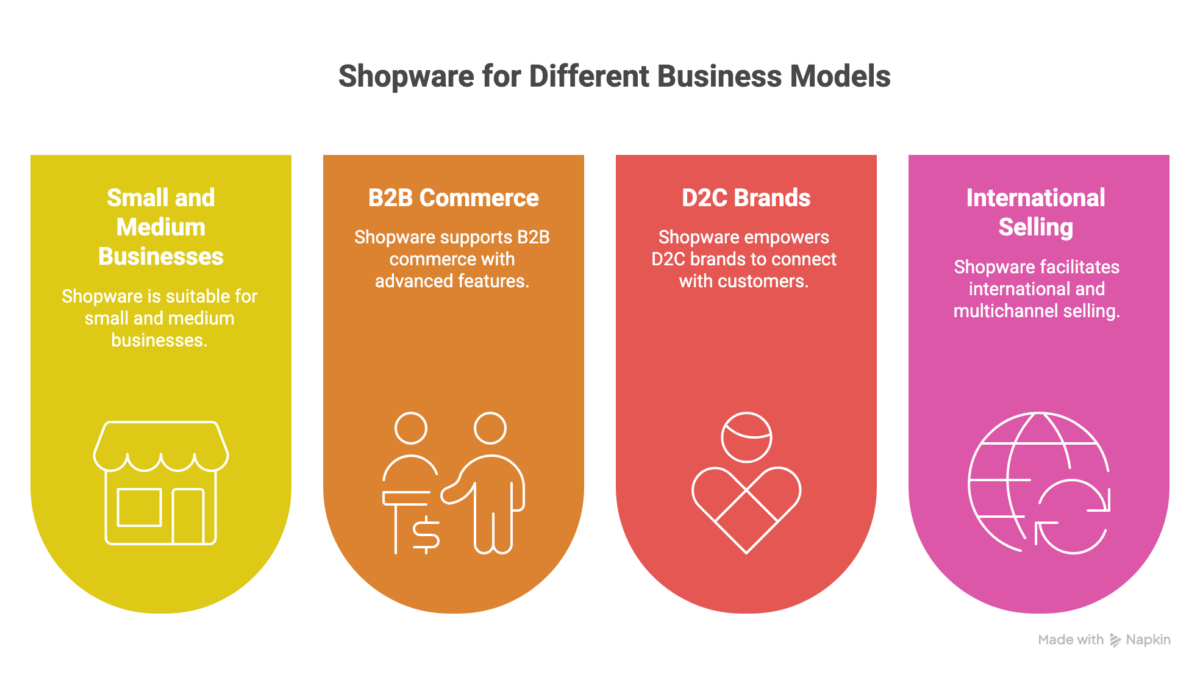
Shopware is not limited to one type of business. It can support different use cases depending on how a company sells and scales.
Shopware for small and medium businesses
SMBs that are growing quickly often need more flexibility than a plug-and-play platform can offer. Shopware gives them room to expand without forcing a migration too early.
Shopware for B2B commerce
B2B businesses often need pricing rules, account structures, workflows, and custom purchasing logic. Shopware is well-suited for that kind of complexity.
Shopware for D2C brands
Direct-to-consumer brands benefit from the platform’s focus on storefront experience, content-driven commerce, and customization.
Shopware for international and multichannel selling
If a business operates across markets or channels, Shopware can support that growth through multilingual and multi-store capabilities.
Shopware Scalability and Performance
Scalability is one of the strongest reasons to consider Shopware. Businesses that expect more products, more traffic, and more operational complexity need a platform that can grow with them.
Shopware is useful for stores that plan to expand catalog size, add more customer touchpoints, or support multiple sales channels. It is also more suitable for businesses that want to invest in a long-term commerce stack instead of rebuilding every few years.
Of course, performance also depends on hosting, implementation, and ongoing maintenance. A well-planned Shopware setup will perform much better than a rushed one, especially as traffic and order volume increase.
Need expert guidance?
Shopware and Headless Commerce
Headless commerce has become an important topic for businesses that want more front-end flexibility. In a headless setup, the storefront is separated from the back-end commerce engine, which allows for more creative and scalable digital experiences.
Shopware supports this direction well because of its modern architecture and API-first approach. That makes it useful for brands that want to build custom customer experiences across web, mobile, and other digital touchpoints.
A headless Shopware setup makes sense when a business wants a highly tailored user experience, has strong development support, or expects future expansion across multiple channels.
Shopware vs Other E-commerce Platforms
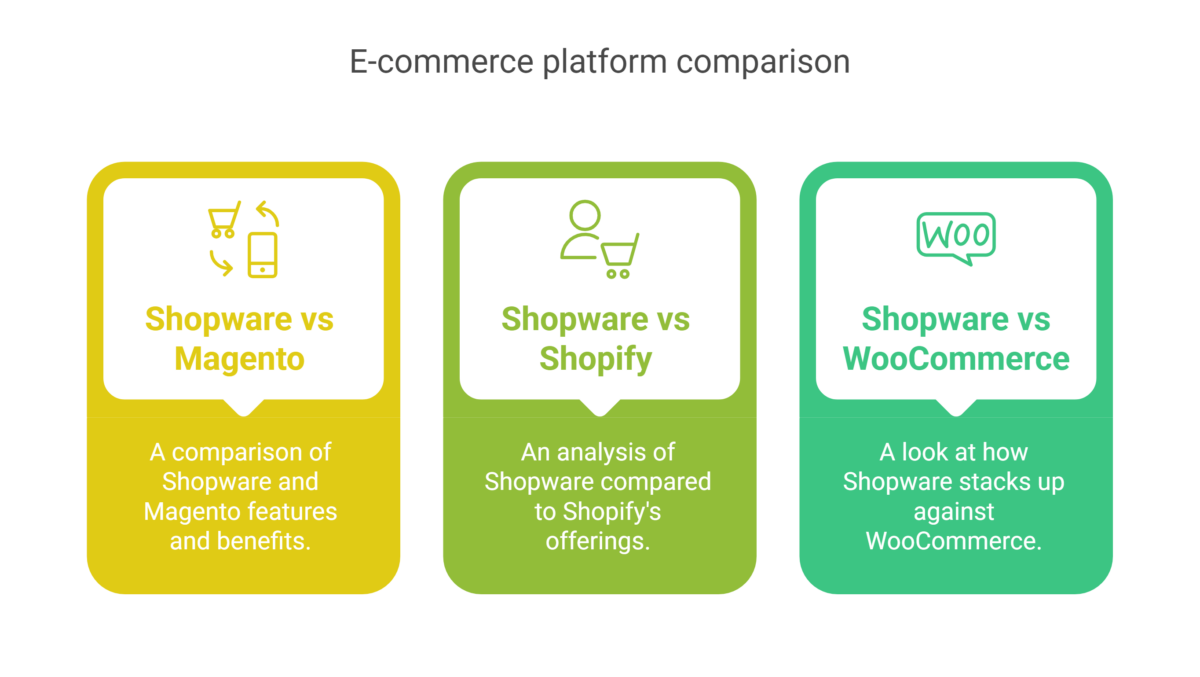
Choosing the right e-commerce platform is crucial for your business success. Here’s a detailed comparison of Shopware against Magento, Shopify, and WooCommerce to help you make an informed decision.
Shopware vs. Magento
- Customization: Both offer high flexibility, but Magento requires advanced development skills, whereas Shopware provides a more user-friendly experience.
- Scalability: Magento is enterprise-grade, ideal for large-scale stores, while Shopware scales efficiently without excessive development costs.
- Performance: Shopware’s API-first approach ensures faster performance compared to Magento’s resource-intensive nature.
- Ownership & Control: Magento offers full control but demands extensive development, whereas Shopware provides flexibility with easier management.
- Total Cost: Magento has high development and maintenance costs, while Shopware offers flexible pricing with a lower total cost of ownership.
Shopware vs. Shopify
- Customization: Shopify relies on apps for functionality, while Shopware allows deeper customization without heavy reliance on third-party tools.
- Scalability: Shopify scales easily but comes with higher transaction fees, whereas Shopware scales efficiently without additional hidden costs.
- Performance: Shopware delivers optimized performance, while Shopify may slow down with heavy customization and third-party apps.
- Ownership & Control: Shopify is a hosted solution with limited control, whereas Shopware offers more freedom in hosting and development.
- Total Cost: Shopify has subscription fees and additional costs for apps, while Shopware provides more cost-effective ownership with flexible pricing.
Shopware vs. WooCommerce
- Customization: WooCommerce is highly flexible as a WordPress plugin, but Shopware provides advanced customization without WordPress dependency.
- Scalability: WooCommerce requires optimization for large stores, while Shopware is designed to handle scalability efficiently.
- Performance: WooCommerce may slow down with large product catalogs, whereas Shopware is optimized for high performance.
- Ownership & Control: WooCommerce offers control through WordPress but relies on plugins, whereas Shopware provides a more structured and secure environment.
- Total Cost: WooCommerce may seem cheaper initially, but it requires ongoing expenses for hosting, plugins, and maintenance, while Shopware has a more predictable cost structure.
If you’re on WooCommerce but need better performance, Shopware could be a great choice.
When Shopware Is the Better Alternative
Shopware is a strong alternative when your business needs more than a basic store setup. It works especially well when flexibility, scalability, and control matter more than immediate simplicity.
It is a good fit if you are:
- Expanding into new markets.
- Managing a growing catalog.
- Looking for better storefront customization.
- Planning to integrate with ERP or CRM systems.
- Considering headless or omnichannel commerce.
- Moving beyond the limits of a hosted platform.
In these cases, Shopware can support both current operations and future growth more effectively.
When to Consider Migrating to Shopware
Many businesses consider migration when their current platform starts creating friction. Common signs include limited customization, slow performance, too many plugin dependencies, or difficulty scaling into new markets.
Migration to Shopware can make sense if you want a platform that supports more structured growth and more control over your commerce setup. It is especially relevant for businesses moving away from platforms that no longer match their operational needs.
A migration should always be planned carefully. Data, SEO structure, integrations, and customer experience all need attention before the move.
Shopware Development and Support
Shopware often benefits from proper implementation and ongoing technical support. That includes store setup, custom theme development, plugin configuration, and integration planning.
For businesses that depend on ERP, CRM, or other third-party systems, integration support becomes important. A good Shopware setup should work as part of a larger business ecosystem, not as a standalone tool.
Long-term maintenance is also part of the picture. Updates, performance monitoring, and security management help the platform stay stable as the business grows.
Need help setting up, customizing, or integrating Shopware?
Which Platform is Right for You?
- Choose Shopware for flexibility and scalability without heavy technical dependency.
- Choose Shopify for an easy, all-in-one solution.
- Choose Magento if you have a large enterprise with development resources.
- Choose WooCommerce if you prefer a WordPress-based solution.
Migration Insight: If your current platform isn’t meeting your needs, a well-planned migration to Shopware can improve performance and scalability.
Conclusion
Shopware is a strong alternative to Shopify, Magento, and WooCommerce for businesses that need flexibility, scalability, and better long-term control over their e-commerce setup. It is especially valuable for brands that are growing beyond simple store requirements and want a platform that can support more advanced commerce needs.
While Shopify may be easier to launch, Magento may be more enterprise-heavy, and WooCommerce may suit WordPress-based stores, Shopware offers a balanced middle ground for many businesses. If your focus is growth, structure, and adaptability, Shopware deserves serious consideration.
FAQ
How much does it cost to migrate from Magento to Shopware?
Migration costs vary based on data volume and customization needs. A typical Shopware migration ranges from €5,000 to €20,000, depending on complexity.
Is Shopware a good alternative to Shopify?
Yes. Shopware is often a better alternative when a business needs more customization, more control, and stronger scalability.
Is Shopware good for B2B commerce?
Yes. Shopware is well-suited for B2B businesses because it can support structured workflows, custom pricing logic, and scalable account management.
Is Shopware better than Magento for growing businesses?
In many cases, yes. Magento can be powerful, but Shopware is often easier to manage and more practical for teams that want flexibility without heavy complexity.
Is Shopware suitable for headless commerce?
Yes. Shopware’s architecture makes it a strong choice for headless setups and custom digital experiences.
Can Shopware handle multichannel selling?
Yes. Shopware can support multi-store and multichannel commerce, which makes it useful for growing and international businesses.
Table of contents
- Why Shopware Is Becoming a Popular E-commerce Platform
- Key Shopware Features
- Shopware for Different Business Models
- Shopware Scalability and Performance
- Shopware and Headless Commerce
- Shopware vs Other E-commerce Platforms
- When Shopware Is the Better Alternative
- When to Consider Migrating to Shopware
- Shopware Development and Support
- Which Platform is Right for You?
- Conclusion


Related Articles