
Greetings! I'm Aneesh Sreedharan, CEO of 2Hats Logic Solutions. At 2Hats Logic Solutions, we are dedicated to providing technical expertise and resolving your concerns in the world of technology. Our blog page serves as a resource where we share insights and experiences, offering valuable perspectives on your queries.

Quick Summary
Automation isn’t a single tool; it’s a spectrum. RPA handles repetitive, rule-based tasks (the hands). AI adds pattern recognition and predictions (the eyes). Agentic AI drives autonomous, goal-oriented outcomes (the brain). The smartest businesses don’t pick one; they layer all three into a hybrid stack. This guide cuts through the noise, walks through real case studies, and gives you a clear framework, so you invest in the right technology at the right time.
If you’ve been googling “RPA vs. AI” or “What even is agentic AI?” you’re in good company, and you’re probably a little frustrated.
Every vendor calls their platform “intelligent.” Every pitch deck promises “fully autonomous automation.” Every analyst report casually drops terms like hyperautomation and multi-agent orchestration as if you’ve been reading the same whitepapers they have.
Here’s the truth: most of that content is written for people who already know what they’re doing. You, on the other hand, just need a straight answer: What is this stuff? Does it actually work? And where do I start?
That’s exactly what this guide is for.
At 2HatsLogic, we’ve spent years helping mid-sized businesses cut through this noise and build automation strategies that actually hold up. We’ve watched companies burn through six-figure budgets on AI projects that simple RPA would’ve handled in a fraction of the time.
We’ve also seen the opposite: businesses that bet everything on RPA hit a wall within months and had no plan for what came next.
Both scenarios are expensive. Both are avoidable.
Here’s the core idea: automation is not one thing. It’s a spectrum. And where each technology sits on that spectrum determines everything, when to use it, what it costs, and what it can realistically do for your business.
The shorthand version:
– RPA = The Hands. Does what you tell it, exactly how you tell it. Click here, copy that, and paste it there. Every. Single. Time.
– AI = The Eyes. Spot patterns you’d never catch manually. Reads messy invoices, flags suspicious transactions, and tells you which customers are quietly heading for the exit.
– Agentic AI = The Brain. It understands goals, builds its own plan, works across systems, and course-corrects when things go sideways, without anyone telling it what to do next.
By the time you finish this guide, you’ll know exactly when each one makes sense, how they work together, and how to build an automation strategy that grows with you. Let’s get into it.
What Is the Automation Spectrum?
From Scheduled Reports to Autonomous Systems
Automation has come a long way since the days of Excel macros and 3 AM batch scripts. Back in the early 2000s, “automated” basically meant “scheduled.” You set up a report to run overnight so someone didn’t have to click the button. Revolutionary it was not.
Then RPA arrived in the early 2010s, and things genuinely changed. Suddenly, businesses had software bots that could move through applications the same way a human would, logging in, clicking around, copying data, and filling forms without needing expensive system integrations or dev teams to rebuild everything from scratch. For finance teams drowning in data entry, invoice processing, and legacy system workarounds, it was a genuine lifeline.
Then, somewhere around 2018–2020, AI matured enough to be genuinely useful at the enterprise level, not just in research labs. Automation stopped being about mimicking clicks and started being about understanding context. OCR could now read handwritten invoices. NLP could make sense of customer complaints. Predictive models could forecast demand weeks before your team felt the pressure.
And now, in 2026, we’re in the agentic era. Agentic AI doesn’t just execute tasks or analyze data; it reasons. It plans multi-step workflows, chooses the right tools for the job, makes real decisions based on goals rather than rigid rules, and adjusts when something doesn’t go as expected.
The journey in plain language: macros → RPA → intelligent automation → agentic AI. Each step didn’t replace the last; it built on top of it.
These Technologies Aren’t Fighting Each Other.
One of the most common mistakes we see is businesses treating RPA, AI, and agentic AI like they’re three different vendors pitching for the same contract. Like you have to pick a winner.
You don’t. And the businesses that try usually end up disappointed.
The most effective automation strategies layer all three. RPA handles the high-volume repetitive work. AI adds intelligence and judgment on top of that. Agentic AI then ties everything together into workflows that can run themselves.
The best analogy? A restaurant kitchen.
RPA is the prep cook; it’s reliable, efficient, and chops vegetables the exact same way every single time. AI is the sous chef who tastes the sauce and adjusts based on experience and instinct. Agentic AI is the head chef who designs the whole menu, coordinates the kitchen in real time, and makes the call when an ingredient runs out mid-service.
You need all three for a great meal. Take anyone away, and the kitchen starts to fall apart.
Three Real Scenarios to Keep in Mind
Here are three workflows we’ll come back to throughout this guide; they show how all three layers work together in practice:
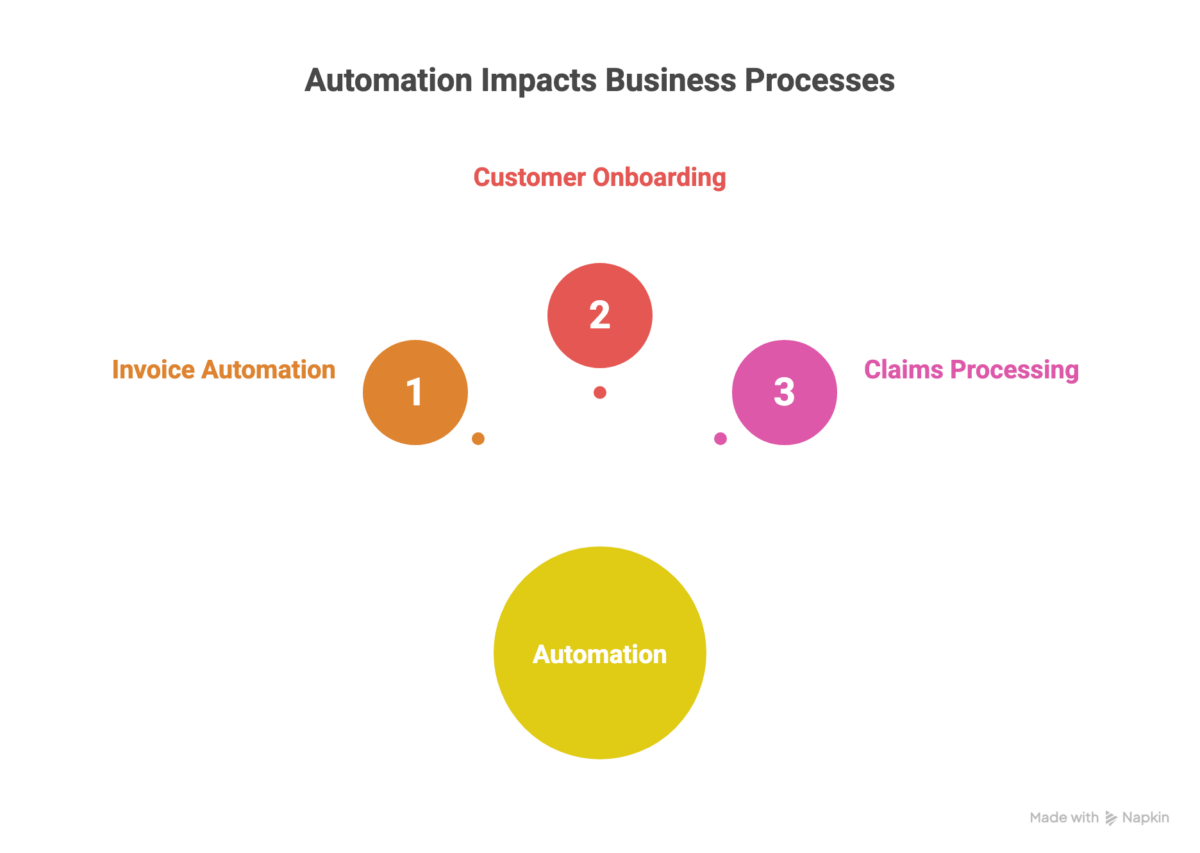
– Invoice Automation: RPA picks up invoices from the inbox. AI reads and categorizes them regardless of format. Agentic AI resolves discrepancies, routes approvals, and handles exceptions, all without a human touching it.
– Customer Onboarding: RPA creates the account and triggers welcome emails. AI verifies identity documents using OCR. Agentic AI manages the full onboarding journey, adapting in real time depending on how each customer responds.
– Claims Processing: RPA pulls claim forms from the portal. AI scores the denial risk before submission. Agentic AI investigates denied claims, collects supporting evidence, and resubmits autonomously.
What Is Robotic Process Automation (RPA)?
RPA is software that does what a human does on a computer, just faster, more accurately, and without ever needing a lunch break.
It can log into systems, click through menus, copy and paste data, fill in forms, move files, pull information from emails, and generate reports, all based on a set of rules you define upfront. The keyword there is “rules.” RPA doesn’t learn. It doesn’t adapt. It doesn’t make judgment calls. It does exactly what you tell it, in exactly the order you tell it, every single time.
And for many tasks? That’s precisely what you need.
Tell an RPA bot to log into your ERP system, pull yesterday’s sales report, format it into your standard template, and email it to the leadership team at 7 AM every morning, and it’ll do that perfectly. Without fail. Without being asked twice.
When RPA Is the Right Call
RPA thrives when a task ticks most of these boxes:
– The data is structured and predictable (spreadsheets, databases, standard forms).
– The work is high-volume and repeats constantly.
– The logic is clear, defined if-then rules with no gray areas.
– No real judgment or interpretation is required.
The other thing that makes RPA so practical? It doesn’t require you to touch your existing systems. It sits on top of whatever you already have, interacting with your applications the same way a human would. No expensive integrations. No waiting for IT to rebuild your stack.
Where Businesses See the Strongest Returns
Based on our work with clients across the globe, these are the RPA use cases that consistently deliver the fastest ROI:
– Data entry and migration between systems
– Payroll processing and HR onboarding paperwork
– Scheduled report generation and distribution
– Invoice data capture from standardized templates
– Legacy system integration (especially ERP migrations; NAV to Business Central is one we see constantly)
– Regulatory compliance reporting with fixed formats
The global RPA market sat at around $28 billion in 2025 and is projected to surpass $247 billion by 2035. That kind of sustained growth isn’t an accident; it reflects just how much repetitive, rule-based work still exists inside every business at every level.
Start here for the fastest wins. Look for any process where someone on your team spends more than two hours a day on copy-paste or manual data entry. Those are your prime RPA candidates, and most well-scoped projects deliver ROI within three to six months.
See how we've helped businesses automate high-volume processes
What Is AI in Business Automation?
When we talk about AI in a business automation context, we’re not talking about robots that think for themselves or systems that will one day take over the office. We’re talking about machine learning models, natural language processing, computer vision, and predictive analytics, software that can understand, interpret, and learn from data in ways traditional rule-based tools simply can’t.
AI is what makes automation smart.
While RPA follows the rules you write, AI finds the patterns you didn’t know were there. It can read a handwritten invoice that would completely break an RPA bot. It can scan thousands of customer support tickets and surface the three issues driving most of your complaints. It can.
Look at two years of sales history and give you a pretty accurate picture of what the next quarter looks like before you feel it in the numbers.
What AI Actually Brings to the Table
Here’s how the main AI capabilities show up in real business workflows:
– Natural Language Processing (NLP): Makes sense of human language. The difference between a chatbot that frustrates customers and one that actually helps them. Also, it routes your support tickets to the right team automatically.
– Optical Character Recognition (OCR): Reads text from images and documents, printed, handwritten, scanned, and photographed. Essential for invoice processing, receipt digitization, and document extraction workflows.
– Predictive Analytics: Uses historical data to forecast what happens next. Powers churn prediction, demand forecasting, and financial projections that get more accurate the more data they see.
– Computer Vision: Interprets images and video. Quality control on production lines, visual stock counts in warehouses, and security verification, anywhere a human eye was previously the only option.
Where AI Earns Its Place
AI genuinely shines where data is messy, inconsistent, or requires some level of judgment: fraud detection in financial transactions, customer sentiment analysis, demand and inventory forecasting, intelligent document processing across variable formats, quality inspection in manufacturing, and automatic classification of incoming emails and tickets.
Here’s a real example. A logistics client in the GCC region was manually handling over 5,000 shipping documents every month, each arriving in a slightly different format from different carriers. RPA couldn’t cope with that level of variation. By layering in AI-powered OCR and NLP, we cut their processing time by 73% and got data entry errors down to nearly zero.
What Is Agentic AI?
Agentic AI is where most of the excitement (and confusion) in automation right now is concentrated. And understandably so, it’s genuinely different from anything that came before it.
Here’s the core distinction: traditional AI analyzes data and gives you insights. A human then decides what to do with those insights. Agentic AI skips that step. It takes the action itself.
You hand it a goal, “Handle this denied insurance claim” or “Optimize our warehouse picking routes before the holiday rush kicks in,” and it figures out the steps, picks the right tools, works across the systems it needs to, and gets it done. No step-by-step instructions required.
These are goal-driven autonomous systems that can plan, reason, execute, and, critically, self-correct when something doesn’t go as expected.
The growth numbers tell their own story. The agentic AI market was valued at around $7.5 billion in 2025 and is projected to hit nearly $171 billion by 2034, growing at roughly 41% annually. More than 60% of new enterprise AI deployments in 2025 are expected to include agentic capabilities. This isn’t a niche experiment; it’s quickly becoming the new baseline.
What Makes Agentic AI Different in Practice
Planning and decision-making. Agentic AI breaks a complex goal into actionable steps on its own. You don’t need to build a flowchart; it builds one itself.
Memory and context. Unlike traditional automation that forgets everything the moment a workflow ends, agentic systems remember. They carry context across long, multi-stage processes and pick up exactly where they left off.
Tool use across systems. These agents can hit APIs, query databases, draft and send emails, update your CRM, and pull documents, all in service of a single goal, across as many platforms as the task requires.
Self-correction. This is the big one. When something unexpected happens, agentic AI doesn’t crash or wait for someone to restart it. It reassesses, tries a different path, and keeps moving toward the outcome. Traditional automation just stops. That difference alone changes what’s possible.
Where Agentic AI Makes the Biggest Difference
Agentic AI is built for complex, multi-step workflows where exceptions are the rule, not the exception: end-to-end supply chain orchestration, customer support that actually resolves issues rather than just routing tickets, denied claims investigation and resubmission, multi-platform marketing execution, financial audit preparation, and warehouse operations at scale.
The clearest way to frame all three layers together:
– With RPA, you automate tasks.
– With AI, you automate decisions.
– With agentic AI, you automate outcomes.
One important caution before you jump in. The most common reason agentic AI projects stumble isn’t the technology; it’s what’s underneath it. Fragmented data, locked-down APIs, poor system governance. Before you invest in autonomous agents, make sure your data is clean, accessible, and well-organized. No amount of intelligence compensates for bad foundations.
RPA vs. AI vs. Agentic AI: What’s Different?
| Feature | RPA | AI | Agentic AI |
| Logic | Rule-based scripts | Machine learning models | Goal-driven LLM reasoning |
| Action Type | Executes predefined tasks | Analyzes and predicts | Plans, decides, and acts |
| Data Handling | Structured only | Semi/unstructured | Complex,multi-source context |
| Flexibility | Fragile (breaks with UI changes) | Adaptable to patterns | Highly adaptive, self-correcting |
| Core Focus | Efficiency and speed | Insight and intelligence | End-to-end outcomes |
The Version You’ll Actually Remember
– RPA = Doing. Executes what you define. Nothing more, nothing less.
– AI = Thinking. Analyzes data, spots patterns, and makes predictions.
– Agentic AI = Achieving. Understands what success looks like and drives toward it.
Think about it in the context of accounts payable. Ask the RPA to process 100 invoices; it processes 100 invoices. Ask AI to check those invoices for anomalies; it flags the ones that look off. Ask agentic AI to handle accounts payable; it processes the invoices, flags the anomalies, investigates discrepancies, routes approvals by value, and follows up on anything overdue. All of it. Without a human touching it.
That’s not a small difference. That’s a fundamentally different scope of what automation can take off your plate.
Why Adaptability Is the One to Watch
RPA is brittle. Move a button in your ERP interface, rename a field, or update the layout of a form, and your bot breaks. You’ll know because someone will find out the hard way at 7 AM on a Monday.
AI is more resilient; it learns patterns rather than positions, so it handles data variation without falling over. Agentic AI takes it further; it can navigate genuinely unexpected situations, try a different approach if the first one doesn’t work, and still reach the goal.
For businesses dealing with shifting regulations, varied customer requirements, or just the general messiness of real-world operations, that adaptability stops being a nice-to-have and becomes essential.
How RPA, AI, and Agentic AI Work Together
The real magic doesn’t happen inside any single technology; it happens when you stack them.
We call it the Hybrid Automation Stack, and it’s the architecture behind every high-performing automation program we’ve helped build:
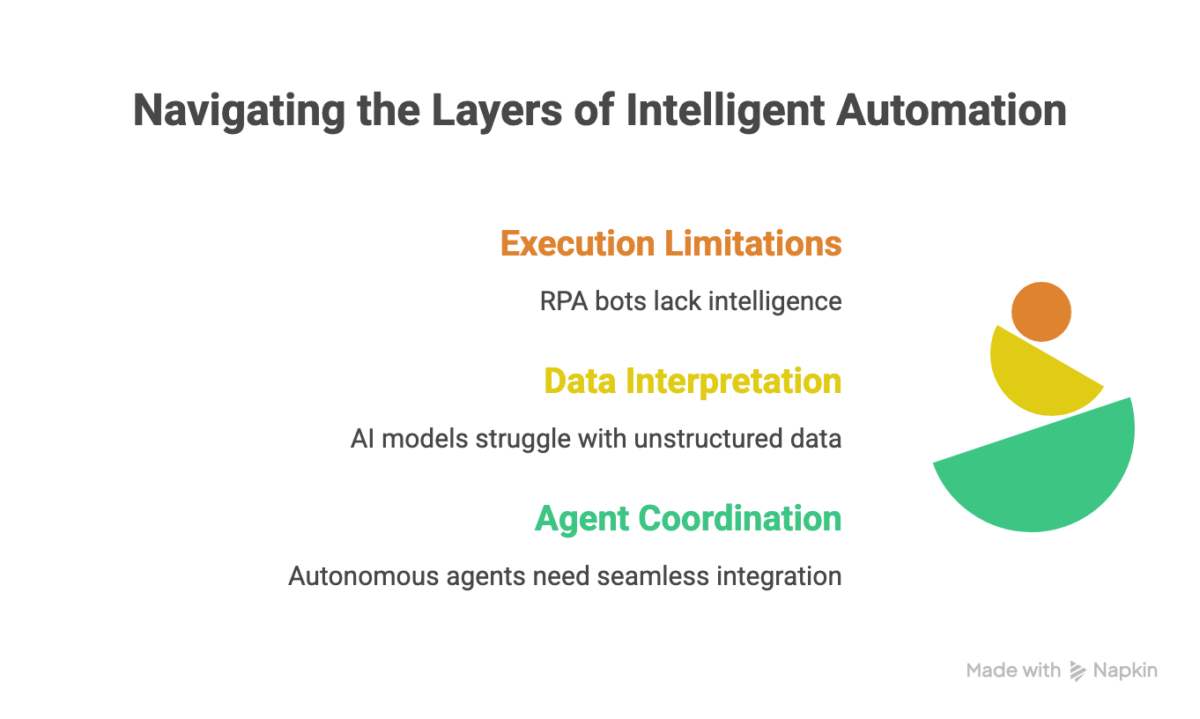
– Layer 1: Execution (RPA): The bots that handle the actual clicks, keystrokes, data movement, and system interactions. Your digital workforce.
– Layer 2: Intelligence (AI): The models that interpret unstructured data, classify information, and generate predictions your bots couldn’t make on their own.
– Layer 3: Orchestration (Agentic AI): The autonomous agents that tie it all together, coordinating workflows, making decisions, handling exceptions, and driving toward the outcome.
A Real Workflow, Step by Step
Let’s make it concrete. Here’s what a purchase order looks like moving through all three layers:
1. RPA monitors the shared inbox and pulls down every incoming PO (Purchase Order) attachment as it arrives.
2. AI reads each PO, regardless of format or carrier; extracts vendor name, line items, quantities, and amounts; then cross-references against existing contracts using NLP.
3. Agentic AI validates the PO against budget thresholds, flags any pricing discrepancies, routes the approval to the right person based on value, auto-negotiates terms for recurring vendors, and triggers payment, handling every exception along the way without escalating unless it genuinely needs a human.
Take any layer out, and the whole thing starts to break down. No RPA means nothing is actually interacting with your systems. No AI means variable-format documents cause constant failures. No agentic AI means every exception lands on someone’s desk.
Why Hybrid Isn’t a Compromise
Hyperautomation is already a strategic priority for 90% of large enterprises, according to Gartner. The companies that pull ahead won’t be the ones that found the single best tool. They’ll be the ones who built the most cohesive stack.
Build from the bottom up, always. Get your high-volume processes running cleanly on RPA first. Layer in AI where data gets messy. Then bring in agentic AI for the workflows that need real orchestration. Skipping layers costs more in the long run.
Real-World Case Studies
Healthcare: From Billing Backlog to $1.4M Recovered
A mid-sized healthcare provider had twelve billing specialists spending 60% of their day on manual data entry and claim status checks. Denied claims were piling up, costing the practice an estimated $2.1 million annually in lost revenue.
Phase 1 RPA: Bots took over data extraction from patient portals, insurance verification, and claim submission. The billing team recovered 40% of their time almost immediately.
Phase 2 AI: A model trained on two years of claims data began flagging claims likely to be denied before submission, catching missing documentation and coding errors upstream.
Initial denial rates dropped by 35%.
Phase 3 Agentic AI: An autonomous system took over the denied claims queue entirely, analyzing denial reasons, gathering EHR documentation, drafting appeal letters, and resubmitting, only escalating genuinely complex cases to a human.
Results after year one:
– 52% reduction in claim processing time
– 35% fewer initial denials
– 28% higher successful appeal rate
– $1.4 million in recovered revenue
Finance: Fraud Detection That Scales
A financial services company processing 200,000+ transactions daily had a detection rate of less than 15% on fraudulent transactions. False positives were burying the investigation team.
Phase 1 RPA: Bots aggregated transaction data into a unified monitoring dashboard and auto-generated daily audit reports.
Phase 2 AI: ML models identified suspicious behavior in real time with 94% accuracy. False positives dropped by 60%.
Phase 3 Agentic AI: Autonomous agents investigated every flagged transaction, cross-referencing customer history, device fingerprints, geolocation, and velocity, then generated reports, froze accounts where warranted, and notified compliance, all within minutes.
Results:
– Detection rate: 15% → 89%
– Investigation time: 4 hours → 12 minutes per case
– $8.2 million in prevented fraud losses annually
More Industries, Same Pattern
– Retail: RPA for order capture, AI for demand forecasting, agentic AI for dynamic pricing and inventory rebalancing.
– Telecom: RPA for ticket creation, AI routing by sentiment, and agentic AI resolving complex billing disputes without human handoffs.
– Manufacturing: RPA for supplier data aggregation, AI for predictive maintenance, agentic AI for autonomous procurement and logistics.
We build stacks like these for mid-sized businesses.
Cost and ROI
What You’re Actually Paying For
RPA is typically the most affordable entry point. Costs vary based on the number of bots you deploy and the complexity of the processes being automated, but compared to other automation layers, it’s the fastest to scope, build, and justify.
AI carries a higher upfront investment, mainly because of data preparation and model training. That said, ongoing costs tend to decrease as models mature and require less intervention over time.
Agentic AI is increasingly usage-based; you pay for what agents actually do, rather than maintaining fixed infrastructure. Because agents adapt rather than break, maintenance overhead stays lower over time.
ROI Looks Different at Each Layer
RPA ROI is straightforward: it’s primarily labor savings. You’re replacing manual, repetitive hours with automated execution; the math is direct and measurable from day one.
AI ROI shows up in accuracy, consistency, and the ability to handle data at a scale no team could manage manually. Returns build as models improve.
Agentic AI ROI is about capacity expansion, not just cost reduction. You’re enabling outcomes that weren’t possible before, recovering revenue, preventing losses, and managing complexity at scale. The equation shifts from saving money to generating it.
When to Expect Returns
- RPA: Fastest – typically within the first few months of deployment
- AI: In the medium-term, returns build as models learn and improve
- Agentic AI: Longer ramp-up to full ROI, but meaningful early results are achievable within the first six months
The smartest path: use RPA quick wins to fund your AI and agentic investments. Your first wave of automation literally pays for the next.
When to Use Which Technology: Your Decision Framework
Reach for RPA when:
– The task is repetitive, and the rules are clear.
– Data is structured and predictable.
– You need to connect legacy systems without modern APIs.
– Volume is high, and complexity is low
– You want fast, low-risk returns.
Reach for AI when:
– Data is messy, variable, or unstructured.
– You need to classify, predict, or find patterns at scale.
– Document formats vary across sources.
– Customer interactions involve natural language.
– Quality control previously required human eyes
Reach for Agentic AI when:
– Workflows span multiple systems and require real decision-making.
– Exceptions are frequent and varied, the norm, not the edge case.
– Outcomes matter more than following a fixed process.
– You want autonomous operation with defined human escalation points.
The Automation Maturity Model
Level 1: Scripts and Macros: Basic scheduling. Most businesses are past this.
Level 2: RPA Deployment: High-volume repetitive tasks automated. The quick-wins phase.
Level 3: Intelligent Automation: AI layered onto RPA for document processing, predictions, and classification.
Level 4: Agentic Automation: Autonomous agents orchestrating end-to-end workflows. The competitive frontier in 2025.
Level 5: Autonomous Enterprise: Multi-agent systems running business functions; humans focused on strategy and governance.
Most mid-sized businesses sit between Levels 2 and 3. The window to reach Level 4 is open right now.
Use the 80/20 rule. Identify the 20% of processes consuming 80% of your team’s manual time. Map each one against this framework. You’ll almost always find a mix, and that mix tells you exactly where to start.
Technical Prerequisites Before You Go Agentic
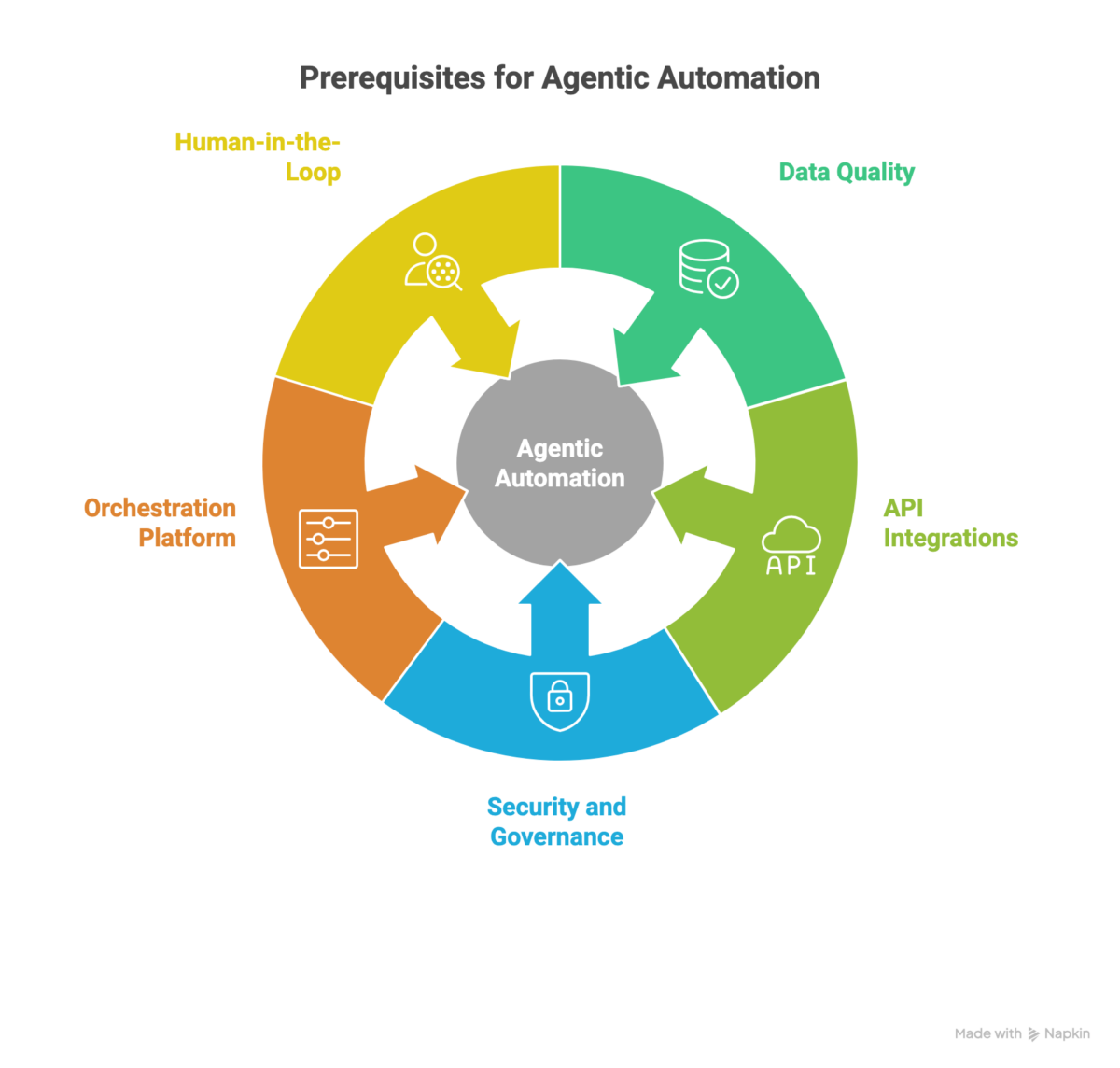
Data quality and accessibility: Clean, well-organized, API-accessible data is non-negotiable. Siloed data doesn’t get better with intelligence on top; it gets worse.
API integrations: Your agents need to interact with your real systems. No robust APIs means no real autonomy.
Security and governance: Define what agents can do without human sign-off, what triggers escalation, and how you audit decisions before deployment.
An orchestration platform: UiPath, Automation Anywhere, and Microsoft are all building agentic capabilities into their existing platforms.
Human-in-the-loop by design: Clear escalation paths aren’t a weakness; they’re good governance, and they’re what makes stakeholders comfortable letting agents run.
Common Mistakes and How to Not Make Them
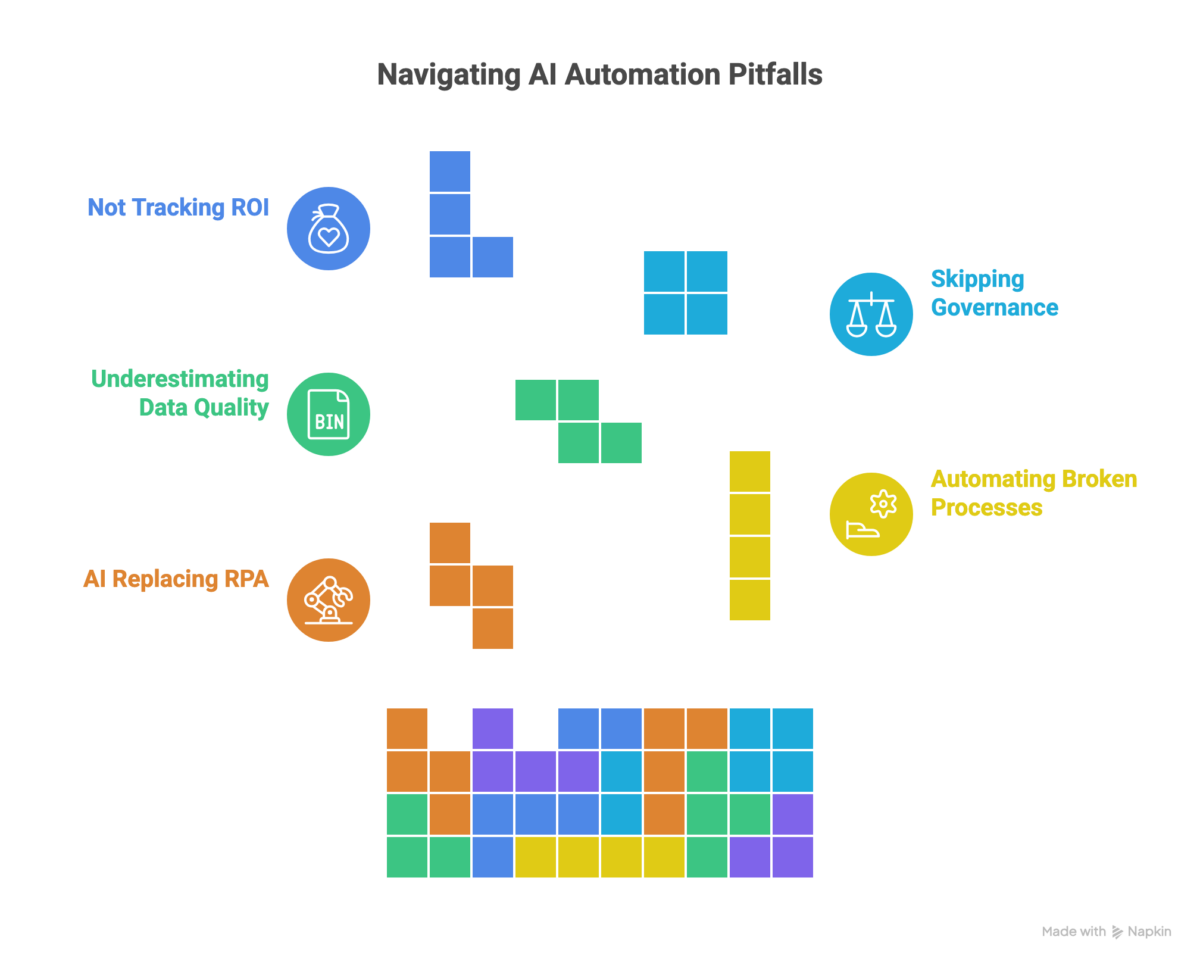
Mistake 1: Expecting AI to replace RPA. AI doesn’t click buttons or navigate legacy UIs. Keep your RPA layer for execution. Add AI on top.
Mistake 2: Automating a broken process. Automating an inefficient process makes the inefficiency faster. Fix the process first.
Mistake 3: Underestimating data quality. AI and agentic AI reflect the data you feed them. Invest in cleansing and governance before layering intelligence.
Mistake 4: Skipping governance. Gartner warns that over 40% of agentic AI projects may be cancelled by 2027 due to governance failures. Define permissions, audit trails, and escalation paths from day one.
Mistake 5: Not tracking ROI from the start. Fewer than 20% of organizations have mastered measuring their automation initiatives (Gartner). Set your baselines before you start, then track consistently.
The Future of Automation
Hyperautomation Isn’t a Buzzword Anymore
Gartner forecasts the hyperautomation-enabling software market to approach $1 trillion by 2026. The question is no longer whether to build a cohesive automation stack; it’s how fast.
Multi-Agent Systems Are Coming Fast
Multiple specialized agents working together, one handling customer communications, another managing inventory, and a third optimizing pricing, coordinating in real time like a high-functioning team. Multi-agent architectures already account for 53% of agentic AI deployments, and that share is climbing.
Your RPA Investment Isn’t Becoming Obsolete
UiPath, Automation Anywhere, and Microsoft Power Automate are embedding large language models directly into their bot frameworks. Your existing RPA bots aren’t getting retired; they’re getting smarter. UiPath’s Maestro orchestration platform, launched in 2025, is the clearest signal yet: RPA execution powered by LLM reasoning in the tools you’re already using.
The Autonomous Enterprise: A Realistic Picture
By 2030, the enterprise agentic AI market alone could reach $24-$42 billion. In 2025, roughly 72% of enterprises already adopted autonomous AI systems, boosting productivity by an estimated 35%.
This isn’t about replacing people. The businesses getting this right are redirecting their teams away from repetitive execution and toward the work that genuinely benefits from human judgment.
How to Build Your Automation Strategy
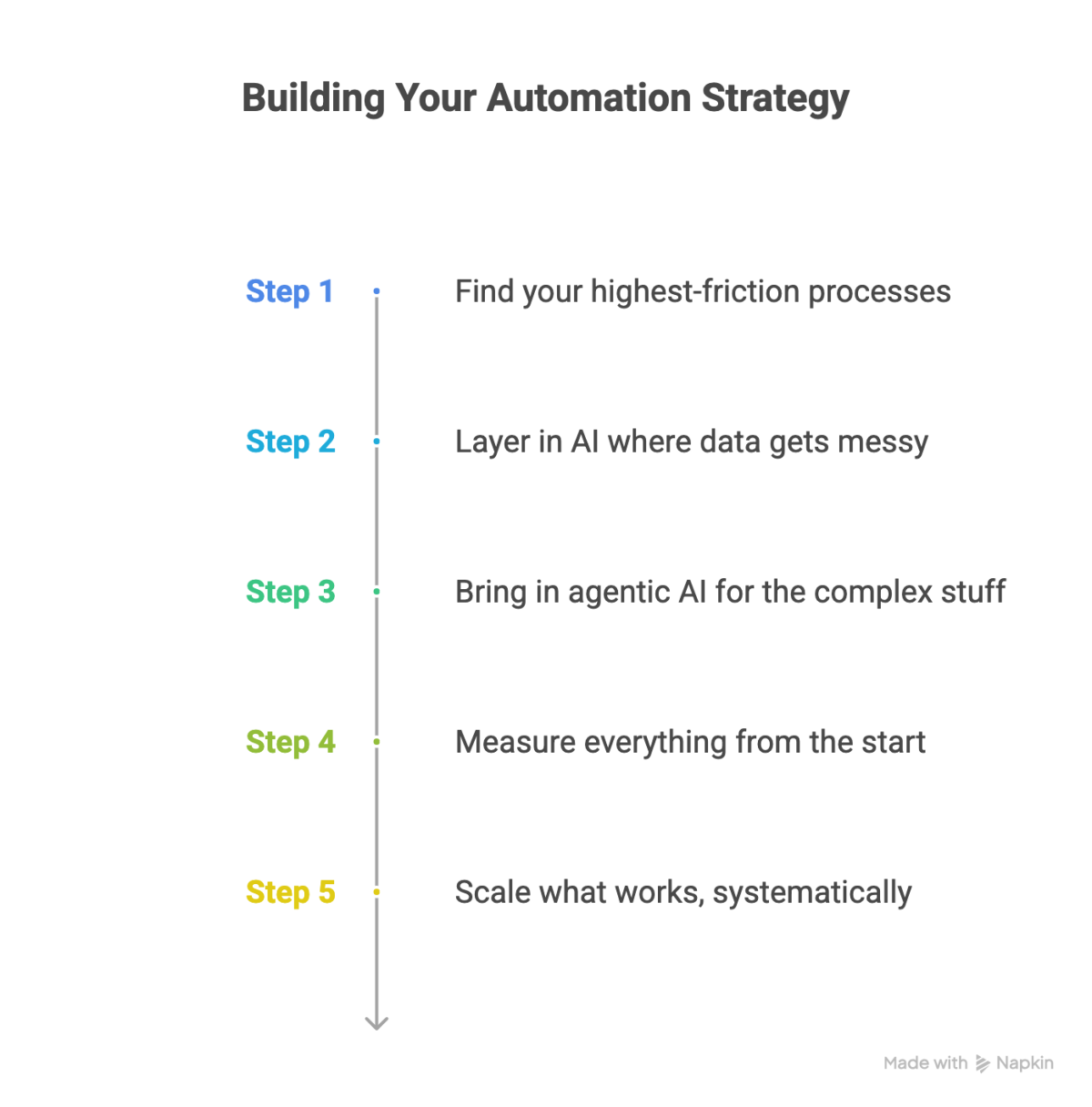
Step 1: Find your highest-friction processes. Look for manual, repetitive, time-consuming work. High volume, clear rules, predictable data. These are your RPA candidates and your fastest path to a win.
Step 2: Layer in AI where data gets messy. Variable invoice formats, inconsistent documents, and natural language inputs; these are your AI candidates. The cleaner your RPA outputs, the better your AI models perform.
Step 3: Bring in agentic AI for the complex stuff. Workflows where exceptions are the norm. Processes that require real judgment calls. Multi-system workflows with no clean flowchart. These are your agentic AI candidates.
Step 4: Measure everything from the start. Capture baselines before you automate anything: processing time, error rates, cost per transaction, and hours per week. Track the same metrics after deployment.
Step 5: Scale what works, systematically. Expand successful automations to adjacent workflows. Build internal capability. The businesses that automate best don’t launch the biggest projects first; they get good at building automation and then do it repeatedly.
Now let's build it for your business.
Key Takeaways
Automation is a spectrum, not a product. RPA, AI, and agentic AI solve different problems at different levels of complexity.
RPA handles execution. Fast to deploy, quick ROI, and the right starting point for almost every business.
AI adds intelligence. Handles messy, variable data that breaks rule-based systems. Gets better over time.
Agentic AI drives outcomes. Plans, decides, executes, and self-corrects. Doesn’t wait to be told what to do next.
The stack beats any single layer. The most durable automation results come from businesses that built all three layers into a coherent system.
The companies that come out ahead in the next decade won’t be the biggest or best-funded. They’ll be the ones who figured out how to deploy human judgment where it actually matters and let intelligent automation handle everything else.
Conclusion
At 2HatsLogic, we’ve helped businesses across Europe and the GCC region build automation strategies that actually work, scoped to real processes, sized to real budgets, and designed to grow.
Whether you’re just getting started with RPA or ready to explore what agentic AI could do for your most complex workflows, we’ll help you figure out the right path, not the most expensive one.
Book a Free Automation Consultation
FAQ
Is agentic AI going to replace RPA?
No. Agentic AI builds on top of RPA, not instead of it. RPA handles the execution layer, the actual system interactions. Agentic AI adds reasoning and orchestration. Think of it less as a replacement and more as a promotion. Your RPA bots don't get made redundant; they get a smarter manager.
Do small businesses actually need AI or agentic AI?
Honestly? If you're a small business, start with RPA and only RPA. Automate your data entry, invoice processing, and report generation first. As you grow and your processes become more complex, that's when AI and eventually agentic AI start to earn their place.
What skills does my team need?
For RPA: process analysis skills and familiarity with UiPath or Power Automate. For AI: data preparation and model management. For agentic AI: orchestration frameworks, API management, and governance. You don't need all of this in-house from day one; that's what implementation partners are for.
Is automation actually secure?
Security is a design decision, not a feature. Done right, automation improves your security posture because human error is the leading cause of data breaches, and automation removes a significant source of it. For agentic AI specifically: clear permission boundaries, full audit trails, and human review for sensitive decisions are non-negotiable architecture, not optional add-ons.
Table of contents
- What Is the Automation Spectrum?
- What Is Robotic Process Automation (RPA)?
- What Is AI in Business Automation?
- What Is Agentic AI?
- RPA vs. AI vs. Agentic AI: What's Different?
- How RPA, AI, and Agentic AI Work Together
- Real-World Case Studies
- Cost and ROI
- When to Use Which Technology: Your Decision Framework
- Technical Prerequisites Before You Go Agentic
- Common Mistakes and How to Not Make Them
- The Future of Automation
- How to Build Your Automation Strategy
- Conclusion

Related Articles