
Greetings! I'm Aneesh Sreedharan, CEO of 2Hats Logic Solutions. At 2Hats Logic Solutions, we are dedicated to providing technical expertise and resolving your concerns in the world of technology. Our blog page serves as a resource where we share insights and experiences, offering valuable perspectives on your queries.

What if your busiest day of the year became your easiest?
That’s the reality for e-commerce businesses running automated order processing. While their competitors scramble through Christmas chaos, manually entering orders, checking inventory on spreadsheets, and desperately trying to prevent shipping errors, automated operations process thousands of orders with a few mouse clicks.
The scale of peak season makes manual processing impossible. Adobe Analytics reports that 2023 holiday e-commerce sales reached $221.8 billion, with peak days generating 600% volume spikes. Small to medium businesses face a critical choice: automate or get left behind.
Consider this: automated systems process orders in 45 seconds versus 8-12 minutes manually, achieve 99% accuracy versus 1-3% error rates, and scale instantly without hiring temporary staff or paying overtime. Businesses implementing automation report handling 10x volume increases with the same team and actually increasing customer satisfaction during their busiest periods.
Benefits of Automated Order Processing
Automation transforms fulfillment chaos into a competitive advantage. Here’s what it delivers:
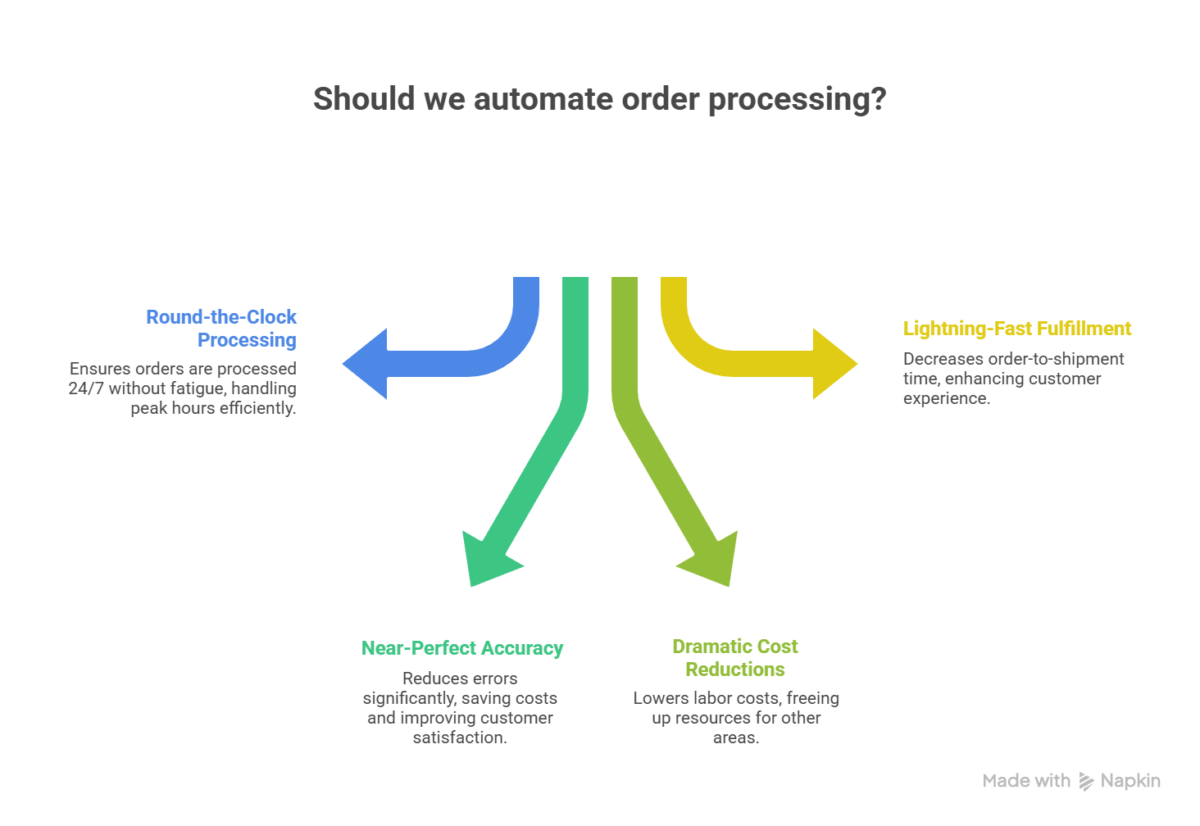
Round-the-Clock Processing: Automated systems process orders 24/7 without fatigue. During 2023 Cyber Monday peak hours (9 PM-midnight EST), automated systems handled 3.2 million orders per hour industry-wide, while manual operations created backlogs extending into January.
Near-Perfect Accuracy: Manual entry averages 1-3% error rates. Automated systems achieve 99%+ accuracy through validation rules and real-time inventory checks. Each order error costs $17 on average, reducing errors from 2% to 0.1% across 50,000 orders saves $42,500.
Cost Reductions: Businesses report 30-50% reductions in order processing labor costs. A typical SMB with $2M annual e-commerce revenue saves $45,000-$75,000 annually.
PRO TIP: Automation doesn’t eliminate jobs, it elevates them. Redeploy your team from data entry to customer experience, quality control, and strategic planning during peak season.
Fast Fulfillment: Automated processing cuts order-to-shipment time from 48-72 hours to 4-8 hours. Real-time tracking increases customer satisfaction scores by 28% while reducing “where’s my order?” inquiries by 67%.
Scalability: Process 100 orders or 100,000 orders with the same system configuration, no hiring, training, or infrastructure changes needed.
Schedule a free consultation where we'll listen to your specific concerns and provide honest advice about what makes sense for your situation.
Key Automation Technologies
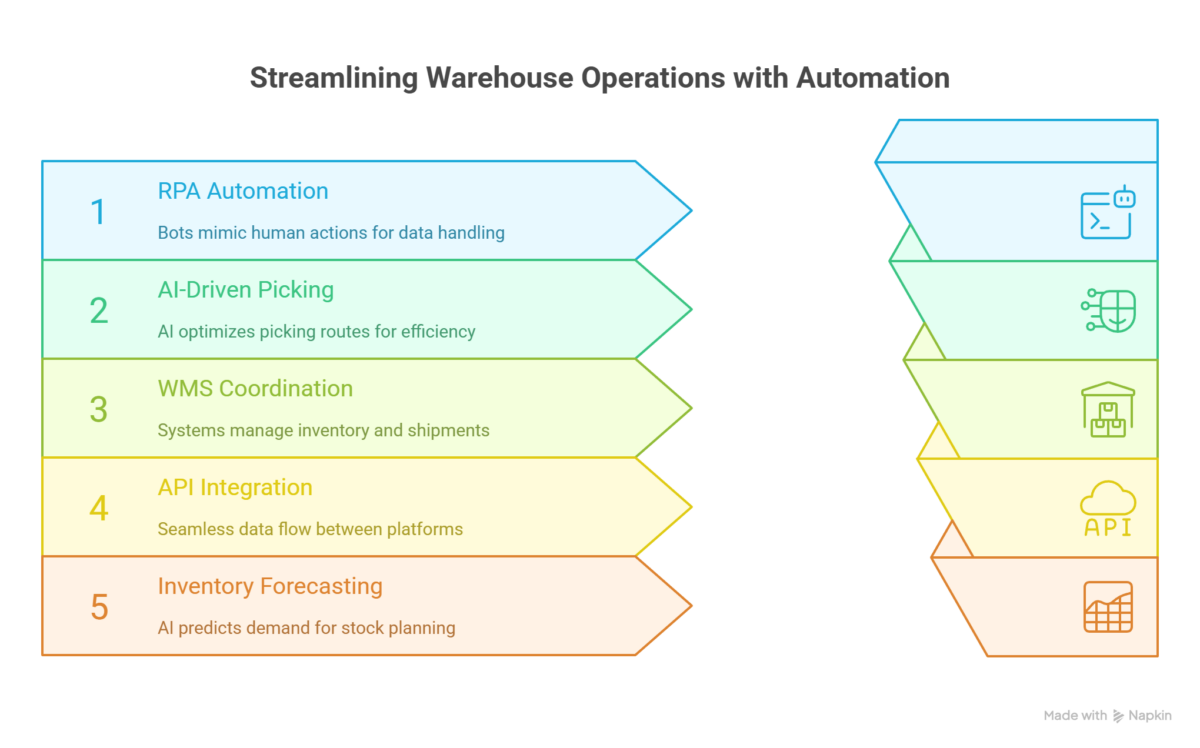
Robotic Process Automation (RPA): Bots mimic human actions, copying order data, entering it into warehouse systems, updating inventory, and generating shipping labels automatically. Best for businesses needing quick wins without major overhauls.
Top tools: UiPath, Automation Anywhere, Microsoft Power Automate.
WARNING: RPA bots can break when websites or software interfaces change. Build in monitoring and have fallback procedures ready.
AI-Driven Picking: AI algorithms optimize warehouse workflows by analyzing order patterns, predicting product combinations, and creating optimal picking routes, reducing fulfillment time by 35-40%.
Warehouse Management Systems (WMS): Platforms like ShipStation and ShipBob act as command centers, coordinating inventory, orders, and shipments across multiple channels with multi-channel consolidation, real-time inventory sync, and automated carrier routing.
API Integrations: Enable seamless data flow between e-commerce platforms (Shopify, WooCommerce), payment processors, and shipping carriers without manual transfer.
Inventory Forecasting: AI-powered forecasting analyzes historical sales, seasonal trends, and external factors to predict demand with 85-92% accuracy, critical for peak season stock planning.
PRO TIP: Choose a WMS with pre-built integrations for your existing e-commerce platform.
Success Stories
Fashion Retailer Handles 5x Volume Spike: A boutique processing 300-400 daily orders faced 2,000+ during holiday sales. After implementing WMS and RPA ($18,000 investment), they achieved 525% capacity increase, 79% faster proSuccess Storiescessing, 92% error reduction, and saved $47,000 in the first peak season. ROI in 4.5 months.
Electronics Distributor Achieves 99.7% Accuracy: Processing 1,500 daily orders with 2.3% error rates costing $180,000 annually, they deployed AI-powered picking ($55,000 investment). Results: 99.7% accuracy, 43% faster picking, $159,000 error savings, $34,000 overtime savings. ROI: 3.5x in first year.
Best Practices for Success
Start Hybrid: Run simple orders through automation while complex orders (customizations, international) receive manual attention. Set rules by order characteristics: orders under $200, domestic standard shipping, and no gift messages auto-process.
Build Error Protocols: Establish clear escalation for payment failures, inventory discrepancies, address validation failures, and system downtime. Your exception-handling process is as important as your main workflow.
Test Scalability: Simulate peak loads before they happen. Process 3x your highest historical daily volume in tests, simulate order surges (500 orders/hour), and verify backup systems trigger correctly.
PRO TIP: Talk to 3-5 current customers at similar company sizes before choosing vendors. Ask specifically about peak season performance and support quality.
Common Pitfalls to Avoid:
- Over-automating before understanding manual workflows
- Neglecting change management and staff buy-in
- Ignoring data quality, automation amplifies bad data
- Choosing the cheapest vs. the best fit solutions
- Assuming “set it and forget it”, automation requires ongoing monitoring
Future Trends to Watch
AI Predictive Analytics: Next-gen AI incorporates weather forecasts, social media sentiment, and competitive pricing to predict demand surges within 6-hour windows for just-in-time inventory positioning.
Voice-Activated Picking: Warehouse workers receive verbal instructions through headsets, reducing picking time by 15-25%. SMB-friendly solutions emerging at $8,000-$20,000.
Blockchain Tracking: Immutable tracking records from manufacturer to customer, particularly valuable for high-value products and fraud prevention during high-volume periods.
Sustainability Integration: Route optimization reduces shipping emissions by 20-30% while maintaining speeds. 73% of consumers say environmental practices influence purchase decisions.
Conclusion
Whether you’re just discovering automation or you’ve been researching for months, you’re part of a massive shift in how e-commerce fulfillment works. Every day, more businesses join the automation community. Every day, the tools get better, the costs get lower, and the implementation gets easier.
The businesses that thrive during peak season aren’t special. They’re not bigger, better funded, or more talented. They simply made the decision to stop accepting chaos as inevitable and joined the growing community of retailers who’ve chosen automation over exhaustion.
Schedule a consultation with community members who've implemented your exact e-commerce platform.

Related Articles