Greetings! I'm Aneesh Sreedharan, CEO of 2Hats Logic Solutions. At 2Hats Logic Solutions, we are dedicated to providing technical expertise and resolving your concerns in the world of technology. Our blog page serves as a resource where we share insights and experiences, offering valuable perspectives on your queries.

Automation has become a practical way for businesses to reduce manual labor, enhance accuracy, and scale their operations. From processing orders to updating customer records, ERP automation helps teams work faster and more efficiently.
However, as businesses automate more processes, compliance risks in ERP automation are often overlooked. When data is automatically transferred between systems, especially from unstructured sources such as emails, the risk of privacy issues, incorrect records, or audit gaps increases.
This is why compliance should not be an afterthought. Secure and compliant ERP automation ensures that efficiency does not come at the cost of data protection, financial accuracy, or regulatory obligations.
Why Compliance Matters in ERP Automation
ERP systems store some of the most critical business data, customer information, invoices, payments, and operational records. When automation is introduced, these systems start receiving data without manual review at every step.
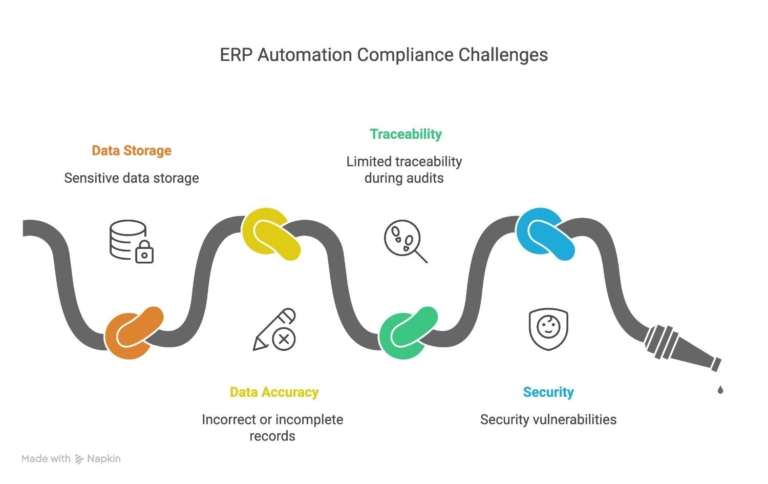
Without proper controls, ERP automation can lead to:
- Accidental storage of sensitive personal data
- Incorrect or incomplete records
- Limited traceability during audits
- Security vulnerabilities
For businesses operating in regions with strict data protection laws, such as the EU, these risks can result in legal issues, penalties, and loss of customer trust.
Addressing ERP automation compliance risks early helps businesses build automation workflows that are not only efficient but also reliable and audit-ready.
What ERP Automation Means in Real Business Scenarios
ERP automation is often not a single process. It usually includes multiple workflows working together, such as:
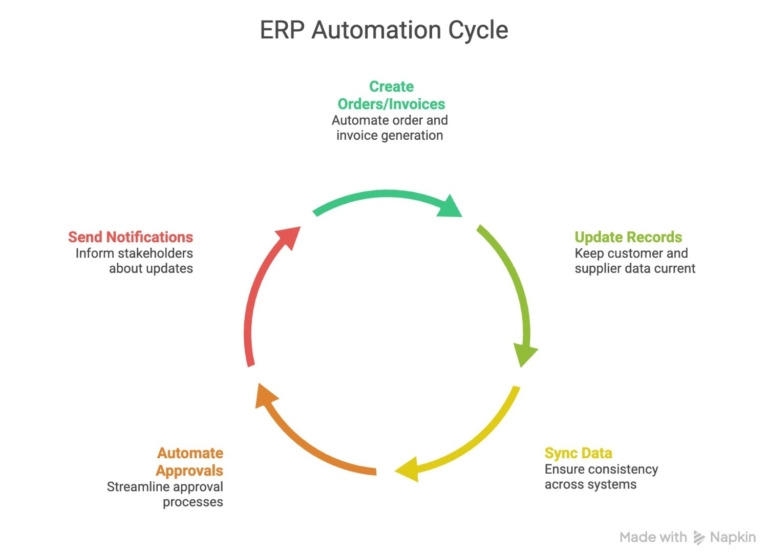
- Creating orders or invoices automatically
- Updating customer or supplier records
- Syncing data between ERP, CRM, and email systems
- Automating approvals or notifications
In many cases, data enters the ERP from sources that are not structured, such as emails or attachments. This is where email-based ERP automation risks typically arise.
When automation reads and processes this data without validation or filtering, compliance challenges become more likely, especially around data accuracy and privacy.
Key Compliance Risks in ERP Automation
Data Privacy and Personal Data Handling
One of the most common compliance challenges in ERP automation is handling personal data correctly. Emails may contain sensitive information, such as names, phone numbers, addresses, or payment details, that should not always be stored in the ERP.
Risk:
Storing unnecessary personal data or exposing it to unauthorized users can violate data protection regulations such as GDPR.
How to reduce the risk:
- Extract only the data required for the process
- Avoid storing full email content in the ERP
- Apply role-based access to sensitive data
Incorrect or Unvalidated Data Entry
Automation of email orders to ERP relies on predefined rules. If incoming data is unclear or incomplete, the ERP may still accept it.
Risk:
Incorrect order quantities, wrong customer mapping, or duplicate records can create financial and audit issues.
How to reduce the risk:
- Apply validation checks before data is saved
- Use approval steps for high-value or first-time transactions
- Maintain clear error-handling rules
Missing Audit Trails and Traceability
Compliance is not just about doing things correctly; it’s also about being able to prove it.
Risk:
If automated ERP entries cannot be traced back to their source, audits become difficult and risky.
How to reduce the risk:
- Maintain logs for all automated actions
- Store references to source data (without storing sensitive content)
- Ensure audit logs are easy to access
Unauthorized Access and Security Gaps
ERP automation often requires access to multiple systems, including email inboxes, ERP platforms, and sometimes CRM or accounting tools. If these integrations are not properly secured, they can become an easy entry point for unauthorized access.
Risk:
Poorly configured permissions or shared credentials can expose sensitive business and customer data, increasing both security and compliance risks in ERP automation.
How to reduce the risk:
- Limit automation access to specific mailboxes and ERP roles
- Use secure authentication methods such as OAuth or API-based access
- Regularly review user roles and integration permissions
- Monitor automation activity for unusual behavior
Over-Automation of Regulated Processes
Not every ERP process should be fully automated. Certain actions, such as invoice approval, refunds, credit notes, or financial adjustments, often require human review for legal or compliance reasons.
Risk:
Fully automating regulated processes can lead to compliance violations, especially in finance-related workflows.
How to reduce the risk:
- Automate data preparation, not final approvals
- Define clear thresholds where human approval is mandatory
- Use conditional automation based on transaction value or customer type
This approach enables businesses to leverage automation while maintaining control over sensitive operations.
Data Retention and Deletion Challenges
Automated workflows can unintentionally store more data than necessary, especially when emails or attachments are saved along with ERP records.
Risk:
Retaining data longer than required or storing duplicate information can violate data protection rules and internal policies.
How to reduce the risk:
- Define clear data retention policies for automated workflows
- Avoid storing complete email bodies in ERP systems
- Regularly clean up logs and temporary data
- Align ERP data storage with regulatory requirements
How Email-Based Workflows Increase Compliance Complexity
Emails are designed for communication, not structured data processing. When businesses automate ERP processes based on emails, the risk of misinterpretation increases.
Emails may include:
- Free-text content
- Attachments in different formats
- Mixed personal and business data
This makes email-based ERP automation risks more complex than structured integrations. Without proper filtering and validation, automation may extract unnecessary or sensitive information, increasing compliance exposure.
Regulatory Considerations Businesses Should Be Aware Of
While compliance requirements vary by region and industry, most businesses need to consider:
- Data protection regulations such as GDPR
- Industry-specific compliance rules
- Internal governance and audit policies
Even businesses outside the EU often work with EU customers, making data protection a shared responsibility. Understanding these requirements helps reduce ERP automation compliance risks before they become operational problems.
Best Practices for Compliant ERP Automation
Building compliant automation is less about adding complexity and more about applying the right controls.
Key best practices include:
- Defining clear automation boundaries
- Using validation and approval workflows
- Applying role-based access controls
- Maintaining detailed but minimal audit logs
- Regularly reviewing and updating automation rules
These practices help ensure secure ERP automation without slowing down day-to-day operations.
The Role of AI and Intelligent Automation in Reducing Risk
AI and intelligent automation can improve ERP workflows when used responsibly. Instead of blindly pushing data into systems, AI can help interpret unstructured inputs more accurately.
Used correctly, AI can:
- Extract only relevant data fields
- Flag unclear or risky inputs for review
- Support human-in-the-loop automation
- Improve consistency across workflows
This makes compliance in intelligent automation achievable, especially when dealing with complex inputs like emails.
Industries Where Compliance-First Automation Is Critical
Some industries face stricter compliance requirements than others, making responsible ERP automation essential.
Examples include:
- eCommerce and retail handling customer data
- Manufacturing and logistics manage supply chain records
- Finance and accounting process invoices and payments
- Healthcare and regulated sectors handling sensitive information
In these industries, compliance-first ERP automation reduces operational risk while supporting growth.
How to Assess Compliance Readiness Before Automating ERP Processes
Before automating ERP workflows, businesses should ask:
- What data is being captured and stored?
- Who has access to automated processes?
- Which steps require human approval?
- Are audit logs available and easy to review?
If these questions are difficult to answer, it may be a sign that expert guidance is needed before scaling automation.
Get in Touch with Automation Experts
Conclusion
ERP automation delivers real value when it is implemented with care. By identifying compliance risks in ERP automation early and applying the right controls, businesses can achieve efficiency without sacrificing data protection, accuracy, or trust. Responsible automation is not about doing less; it’s about doing it right. Get your business’s data automated with AI-driven ERP automation experts.
FAQ
What are the main compliance risks in ERP automation?
The main risks include improper handling of personal data, incorrect or unvalidated data entry, missing audit trails, and unauthorized system access. These risks usually occur when automation is implemented without clear controls or validation steps.
Is ERP automation compliant with GDPR and data protection laws?
ERP automation can be GDPR compliant if it is designed correctly. This means processing only required data, limiting access, maintaining audit logs, and avoiding unnecessary storage of personal information from sources like emails.
How can businesses automate ERP processes securely without slowing down operations?
By applying validation rules, role-based access controls, and human approvals for sensitive steps, businesses can automate ERP workflows securely while maintaining efficiency and compliance.
Table of contents
- Why Compliance Matters in ERP Automation
- What ERP Automation Means in Real Business Scenarios
- Key Compliance Risks in ERP Automation
- How Email-Based Workflows Increase Compliance Complexity
- Regulatory Considerations Businesses Should Be Aware Of
- Best Practices for Compliant ERP Automation
- The Role of AI and Intelligent Automation in Reducing Risk
- Industries Where Compliance-First Automation Is Critical
- How to Assess Compliance Readiness Before Automating ERP Processes
- Conclusion


Related Articles