
Greetings! I'm Aneesh Sreedharan, CEO of 2Hats Logic Solutions. At 2Hats Logic Solutions, we are dedicated to providing technical expertise and resolving your concerns in the world of technology. Our blog page serves as a resource where we share insights and experiences, offering valuable perspectives on your queries.

If you’ve ever watched your order processing team manually type customer orders from emails and PDFs into your ERP system, you know the frustration. It’s tedious, time-consuming, and honestly, nobody enjoys it.
A typical B2B order takes 10-15 minutes to process manually. When you’re handling dozens or hundreds of orders each week, those minutes add up fast. The good news? Automated order capture can give your team those hours back while reducing errors and getting orders out faster.
Curious if automated order capture would work for your specific order formats and ERP system?
What Is Automated Order Capture?
Automated order capture is a technology that extracts order information. This is done from incoming documents such as emails, PDFs, scanned papers, or electronic data files. It automatically enters them into your order management or ERP system.
Here’s how it works in practice: A customer sends you an order via email with a PDF attachment. Instead of someone on your team opening that PDF, reading through it, and manually entering each line item into SAP or your ERP system, the automation software reads the document, identifies the relevant data (customer info, product codes, quantities, prices), and populates your system automatically. The whole process takes seconds instead of minutes.
Supported Order Formats
Modern automated order capture handles multiple input types:
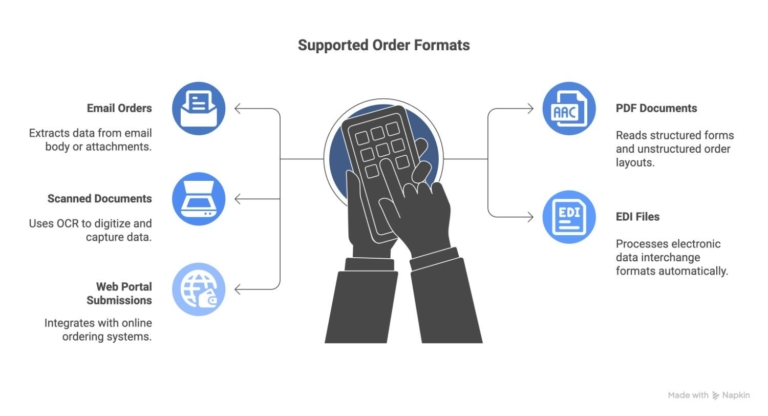
- Email orders: Extracts data directly from email body text or attachments
- PDF documents: Reads both structured forms and unstructured order layouts
- Scanned paper documents: Uses OCR (Optical Character Recognition) to digitize and capture data
- EDI files: Processes electronic data interchange formats automatically
- Web portal submissions: Integrates with online ordering systems
Key Ways Automated Order Capture Saves Time
Automated order capture doesn’t just save time in one area. It eliminates bottlenecks throughout your entire order processing workflow. Here’s where your team gets those hours back.
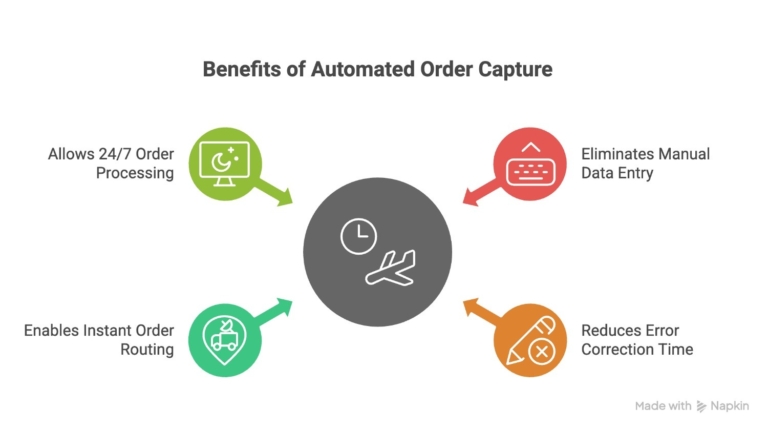
Eliminates Manual Data Entry
This is the most obvious time saver. Your team no longer needs to read through order documents and manually type customer details, product codes, quantities, and prices into your ERP system.
The automation software extracts this information directly from emails, PDFs, or scanned documents and populates your system fields automatically. What used to take 10-15 minutes per order now happens in 30 seconds. For a company processing 100 orders per week, that’s recovering 20+ hours of productive time.
Reduces Error Correction Time
Manual data entry inevitably leads to typos, wrong product codes, transposed numbers, and incorrect quantities. These errors don’t just create problems; they eat up significant time when your team has to:
- Track down why an order doesn’t make sense
- Call or email the customer for clarification
- Correct the order in the system
- Re-process shipping or invoicing
Automated systems drastically reduce these errors by eliminating the human typing element.
Removes Order Follow-Up Delays
How often does your team have to chase down missing information on an order? “The customer didn’t specify the delivery address,” or “We need clarification on this line item.”
Automated order capture systems can flag incomplete orders immediately with built-in validation rules. Instead of discovering the missing information hours later when someone finally gets to that order in the queue, the system alerts you right away or even auto-responds to the customer asking for the missing details.
Enables Instant Order Routing to Fulfillment
In manual processing, there’s often a delay between when an order is entered and when it reaches your warehouse or fulfillment team. Someone has to finish entering it, review it, assign it, and notify the next department.
With automation, orders flow directly from capture to your fulfillment system the moment they’re validated. Your warehouse team can start picking and packing, while your order entry person would still be typing line items in a manual process.
For time-sensitive B2B orders, especially in manufacturing or distribution, where delivery windows are tight, this acceleration can be the difference between meeting or missing customer expectations.
Allows 24/7 Order Processing Without Staff
Orders don’t only arrive during business hours. Customers send orders at 7 PM, on weekends, and during holidays. With manual processing, those orders sit in the inbox until Monday morning or after the holiday.
Automated order capture processes orders the moment they arrive, regardless of time or day. A customer order submitted Friday evening is already in your system and ready for fulfillment first thing Monday morning; no waiting for someone to manually enter it.
This is particularly valuable for international B2B companies dealing with customers across different time zones. Orders from Asia can be processed overnight and ready for your European team in the morning.
Need help evaluating if automation makes sense for your order volume?
Next Steps
If your team is spending hours each week manually entering orders from emails, PDFs, and paper documents, you now know there’s a better way. Automated order capture isn’t futuristic technology—it’s working right now for B2B companies across Germany and Europe, saving time, reducing errors, and letting teams focus on work that actually matters.
- Audit your current process: Track how much time your team actually spends on order entry for one week. Count the orders, note the time per order, and calculate the weekly total. This gives you a baseline to measure potential savings against.
- Identify your pain points: Beyond just time, what else frustrates your team? Error rates? After-hours orders sitting unprocessed? Seasonal volume spikes? Understanding your specific challenges helps you evaluate solutions more effectively.
- Research solutions: Look for automation vendors with experience in your industry and proven integration with your ERP system. Request demos, ask about GDPR compliance, and talk to current customers if possible.
- Run the numbers: Compare your current labor costs for order processing against automation implementation and subscription costs. Most companies find a clear ROI within 6-12 months.
Conclusion
Manual order processing made sense 20 years ago. Today, it’s simply leaving money and productivity on the table.
The B2B companies that have automated their order capture aren’t just saving 10-15 hours per week. They’re improving accuracy, scaling without adding headcount, and giving their teams more satisfying work than repetitive data entry. The technology is proven, the integration is straightforward, and the ROI is measurable within months.
If your order processing team is drowning in emails and PDFs, or if you’re turning down business because you can’t handle the volume, automation isn’t a nice-to-have anymore. It’s how modern B2B operations stay competitive.
The question isn’t whether automated order capture works; the examples and data prove it does. The question is how much longer you want your team spending their days typing orders when software can do it faster, more accurately, and around the clock.


Related Articles