
Greetings! I'm Aneesh Sreedharan, CEO of 2Hats Logic Solutions. At 2Hats Logic Solutions, we are dedicated to providing technical expertise and resolving your concerns in the world of technology. Our blog page serves as a resource where we share insights and experiences, offering valuable perspectives on your queries.

If you’re selling the same products across Amazon, Shopify, eBay, and your wholesale portal, you know this problem intimately: every platform uses different SKU codes for identical products.
Same product. Five different identifiers.
Your blue cotton t-shirt in size medium exists as:
- BTSH-BLU-M-001 on Amazon
- blue-tshirt-medium on Shopify
- T001-BLUE-MED on eBay
- APRL-BTSH-M-BL in your wholesale system
- SKU-20240315-BLU-M in your ERP
Someone has to manually track which codes match which products. Every. Single. Day.
This isn’t just annoying; it’s expensive. For businesses doing $5M+ annually across multiple channels, poor SKU optimization typically costs $150K-$300 per year in wasted time, inventory errors, and missed opportunities.
The solution? AI-powered SKU optimization that automatically standardizes product data across all your sales channels, eliminating manual work and giving you a single source of truth for inventory management.
Here’s how it works and what results actually look like.
The Real Cost of Poor SKU Optimization
Let’s break down what inconsistent SKU management actually costs:
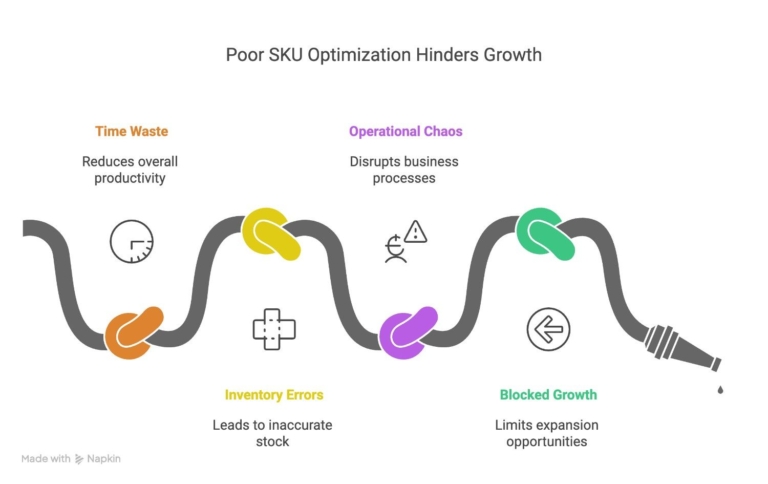
Time Waste
Your team spends 10-15 hours weekly mapping SKUs manually. That’s $25K-$50 annually just on data entry. This time can be used effectively for other growth activities.
Inventory Errors
When systems don’t sync properly, you oversell on one channel while products sit stocked out on another. Each overselling incident costs $50-$150 in refunds, customer service time, and lost customer trust. At 15-20 incidents monthly, that’s $9K-$36 yearly.
Operational Chaos
Returns get misrouted. Reorders go to the wrong channels. Warehouse staff ship incorrect items because the SKU codes don’t match. These “small” errors compound into massive inefficiency.
Blocked Growth
The highest hidden cost? You can’t expand to new marketplaces because your team is already drowning in SKU management. Every new channel means exponentially more manual mapping work.
Mid-sized e-commerce businesses lose 5-8% of revenue annually to SKU-related inefficiencies. For a $5M business, that’s $250K-$400 left on the table.
Why Traditional SKU Standardization Methods Fail
Most businesses try three approaches before finding what actually works:
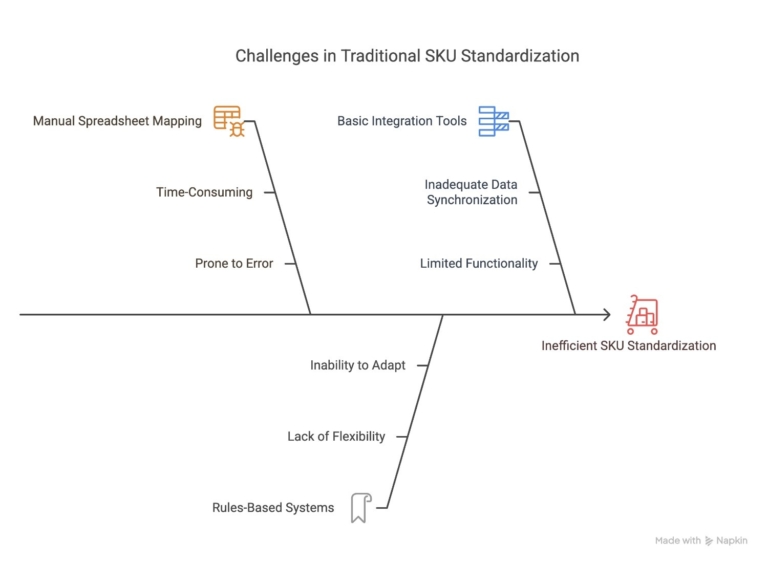
Manual Spreadsheet Mapping
You create a master spreadsheet linking each channel’s SKU to your internal code. This works for 50 products but collapses at 500. Every new product, variant, or channel requires manual updates. One person quits, and institutional knowledge walks out the door.
Rules-Based Systems
You build logic: “If the description contains ‘blue’ AND ‘medium,’ map to master SKU-123.” This handles simple cases but breaks with:
- Product bundles (“Blue Shirt + Cap Gift Set”)
- Typos and inconsistent data entry
- Regional variations (UK “colour” vs US “color”)
- New product categories that don’t fit existing rules
You spend more time maintaining rules than the rules save you.
Basic Integration Tools
ETL (Extract-Transform-Load) software moves data between systems but requires constant manual configuration. These tools don’t understand products. They only follow rigid instructions. When Amazon changes its data format, or you add a new supplier, everything breaks.
The fundamental problem? These approaches treat SKU optimization as a static mapping exercise. But e-commerce product data is messy, inconsistent, and constantly changing. You need a system that learns and adapts.
How AI-Powered SKU Optimization Works
AI approaches SKU standardization fundamentally differently. Instead of following rigid rules, it understands your products and intelligently matches them across channels, even with messy, incomplete data.
Intelligent Product Matching Natural Language Processing (NLP) analyzes product titles, descriptions, and attributes to understand what each product actually is, not just match text strings.
Example: These three listings are recognized as the same product:
- “Men’s Classic Fit Blue Cotton Crew Neck T-Shirt – Medium”
- “Blue Tee M Cotton Men’s Crewneck”
- “BTSH-M-BLU”
The AI understands synonyms (tee = t-shirt), context (crew neck is a style), implied information (classic fit suggests men’s), and standard abbreviations (M = medium).
Pattern Recognition at Scale
Machine learning identifies how your business structures SKUs, then applies those patterns consistently. It recognizes your naming conventions, understands variant relationships (size, color, style), and learns channel-specific patterns. The system improves continuously through corrections and new products.
Automated Data Normalization
AI doesn’t just match products; it creates a standardized master catalog with consistent attribute formatting, unified product hierarchies, and clean enriched data. You get a single source of truth feeding all channels.
Handling Complexity
Where AI truly shines: product bundles that link to multiple master SKUs, regional variations with different compliance requirements, supplier inconsistencies, and legacy data from acquisitions. These scenarios would require countless manual rules, but AI handles them automatically.
The result? 95-98% matching accuracy with minimal human intervention, learning and improving over time as your catalog grows.
Choosing the Right AI SKU Optimization Solution
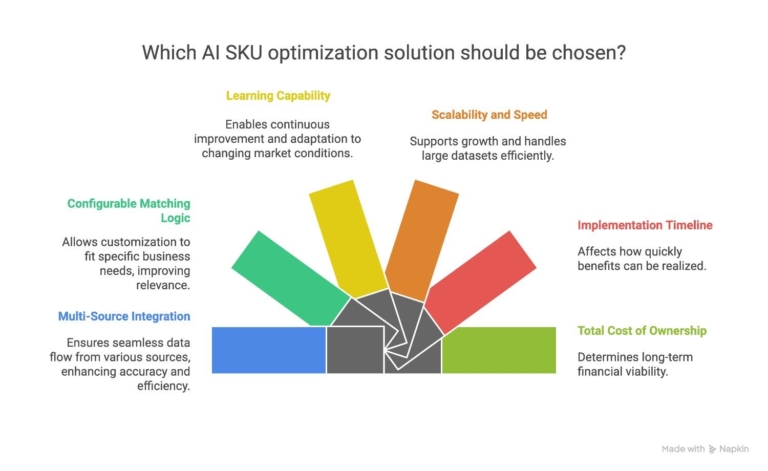
If you’re evaluating AI solutions, focus on these critical capabilities:
Multi-Source Integration
The system must connect seamlessly to all your sales channels, marketplaces, e-commerce platforms, ERP, and PIM systems. Look for pre-built connectors to major platforms (Shopify, Amazon, WooCommerce) and flexible API integration for custom systems.
Configurable Matching Logic
You should control confidence thresholds, deciding when to auto-match versus flagging for human review. The best solutions support fuzzy matching, similarity scoring, and multiple product identifiers (UPC, EAN, GTIN, and manufacturer SKUs).
Learning Capability
The AI must improve from your feedback. When you correct a match, the system learns and applies that knowledge to similar products. This is what separates true AI from glorified rules engines.
Scalability and Speed
Will it handle growth from 1,000 to 10,000 SKUs without performance degradation? Can it process new products in real time, or does it batch everything overnight? Speed matters when launching products across multiple channels simultaneously.
Implementation Timeline
Best-in-class solutions go live in 4-8 weeks, not 6-12 months. Longer implementations usually mean the solution isn’t truly designed for e-commerce or requires extensive custom development.
Total Cost of Ownership
Look beyond licensing fees. Factor in implementation costs, ongoing maintenance, training requirements, and the cost of keeping your current broken system. ROI should be clear within 4-6 months.
Strategic Benefits Beyond SKU Standardization
Once you have optimized SKUs powered by AI, you unlock capabilities that weren’t possible before:
Unified Multi-Channel Analytics
See what’s actually selling where. Identify trends across channels, optimize inventory allocation by region or platform, and make data-driven decisions with confidence. No more reconciling five different reports to understand product performance.
Dynamic Pricing Across Sales Channels
Adjust prices in real time based on demand, competition, and inventory levels. All of these are tied to your master SKU. Execute channel-specific promotions without creating inventory confusion or overselling risks.
Smarter Procurement and Forecasting
Forecast demand accurately across all channels combined. Optimize purchase orders and reduce stockouts and overstock situations. Your purchasing team finally has reliable data to work with.
Faster Marketplace Expansion
Launch on new marketplaces in days instead of weeks. The AI handles product mapping automatically; no more delaying growth because your team can’t handle the operational complexity.
Foundation for Product Information Management: Build a scalable system for enriched, consistent product content across all customer touchpoints. Add new attributes, improve descriptions, update images, and sync everywhere instantly.
Conclusion
Every e-commerce operation is unique. Your product catalog, channel mix, existing systems, and growth plans all shape the right solution for your business.
We specialize in building custom AI solutions for e-commerce companies. From SKU optimization to inventory management, demand forecasting, and beyond. Our approach focuses on rapid value delivery with measurable ROI, typically within the first 4-6 months.
Schedule a 30-minute discovery call. We’ll:
- Assess your current SKU management challenges
- Identify quick wins and ROI opportunities
- Outline a practical implementation approach
- Answer your questions about AI solutions for multi-channel ecommerce
Contact us today to start optimizing your SKUs across multiple sales channels.
FAQ
How long does it take to implement AI SKU optimization?
Most implementations take 4-8 weeks from start to full rollout. You'll typically see results within the first 2-3 weeks during the pilot phase. The timeline depends on your number of SKUs, sales channels, and existing system integrations.
What's the typical ROI and payback period?
Most e-commerce businesses see 4-6 month payback periods. ROI comes from reduced labor costs (85-95% less manual work), fewer inventory errors, and the ability to expand to new sales channels faster.
Do I need to replace my existing ecommerce systems?
No. AI SKU optimization solutions integrate with your current platforms like Shopify, Amazon, ERP, warehouse management systems, etc.


Related Articles