
Greetings! I'm Aneesh Sreedharan, CEO of 2Hats Logic Solutions. At 2Hats Logic Solutions, we are dedicated to providing technical expertise and resolving your concerns in the world of technology. Our blog page serves as a resource where we share insights and experiences, offering valuable perspectives on your queries.

If you’re managing inventory for a retail store in Dubai, Riyadh, or Doha, you already know the headache: tons of unsold winter coats after seasonal demand drops, or empty shelves during Ramadan when everyone’s shopping. This isn’t just frustrating, it’s expensive.
Here’s the good news: AI forecasting can reduce stockouts by 30-50% and slash overstock waste dramatically. With Saudi Arabia’s ZATCA e-invoicing requirements tightening and events like Expo 2030 driving unpredictable demand spikes, retailers can’t afford to guess anymore. This guide shows you exactly how AI forecasting works, which tools fit GCC businesses, and how to implement them without breaking the bank.
GCC Retail Forecasting Challenges
Running a retail business in the GCC isn’t like managing a store in London or New York. You’re dealing with unique challenges that make old-school spreadsheet forecasting almost useless.
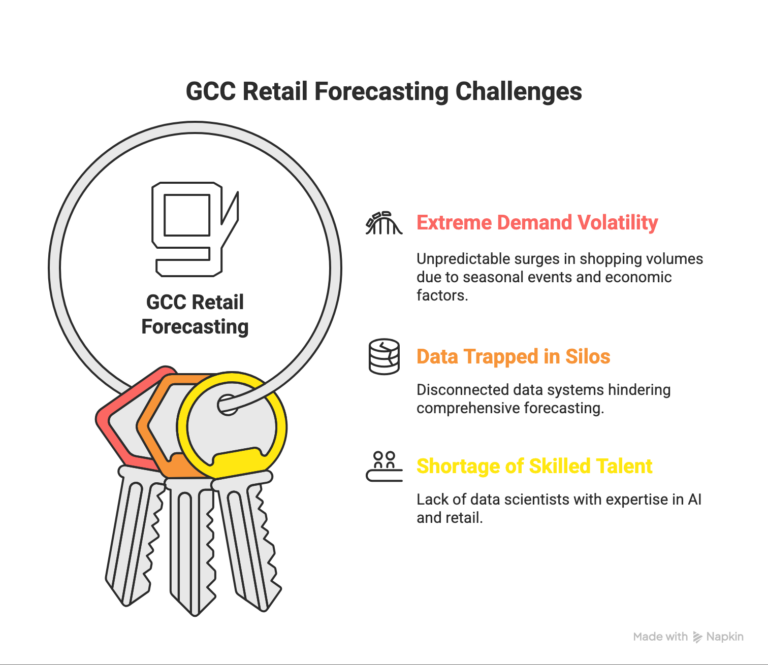
Extreme Demand Volatility
Ramadan sees shopping volumes triple in some categories, then crash afterward. Tourism spikes during the Dubai Shopping Festival or Qatar National Day create unpredictable surges. Even oil price swings affect consumer spending patterns within weeks.
A UAE hypermarket manager said they once overstocked electronics by 35% ahead of a tourism slump, which left a significant amount of capital sitting in the warehouse rather than in the bank.
Data Trapped in Silos
Your sales data lives in one system, supplier delivery times in another, and online orders in a third platform. Without connecting these dots, you’re forecasting blind.
One Saudi fashion retailer we worked with had point-of-sale systems that didn’t talk to their e-commerce platform; they were essentially running two separate businesses with zero visibility.
Shortage of Skilled Talent
Finding data scientists who understand both AI and retail operations in the GCC is tough. Even if you hire them, training takes months. A recent McKinsey study found that 84% of GCC companies adopted AI, but most struggle to extract real value because they lack the expertise to use these tools properly.
Warning: Ignoring these challenges means you’ll keep losing 20-30% of potential revenue to stockouts during peak seasons while paying storage costs for dead inventory the rest of the year.
How AI Forecasting Works in Retail (The Simple Explanation)
Think of AI forecasting like having a super-smart assistant who learns from your past sales, watches current trends, and predicts what customers will want next week or next month.
The 4-Step Process
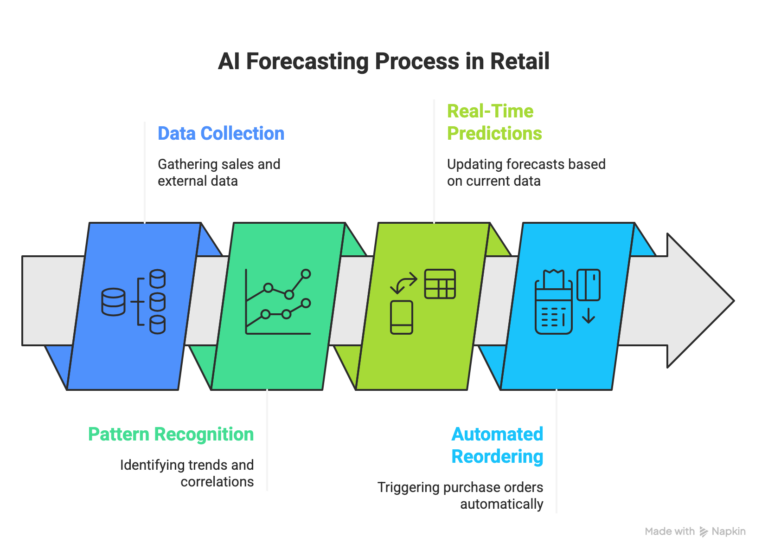
Step 1: Data Collection
The AI pulls information from your POS systems, online store, supplier databases, even weather forecasts and local events calendars. For a Dubai retailer, this might include Expo 2030 visitor projections.
Step 2: Pattern Recognition
Machine learning models analyze this data to spot patterns humans miss. For example, it might notice that abaya sales spike 3 weeks before Ramadan every year, or that sunglasses sell 40% more when temperatures hit 42°C.
Step 3: Real-Time Predictions
Instead of static monthly forecasts, AI updates predictions daily or hourly based on actual sales, web traffic, and external factors. If a UAE influencer posts about your product, the system catches the demand surge instantly.
Step 4: Automated Reordering
The best systems connect directly to your ERP (like Odoo or SAP) to trigger purchase orders automatically, adjusting quantities based on confidence levels.
Traditional vs. AI Forecasting: The Reality Check
| Method | Accuracy Rate | Update Frequency | Handles Unexpected Events | Setup Complexity |
| Excel Spreadsheets | 60-70% | Monthly | No | Low |
| Basic ERP Forecasting | 70-80% | Weekly | Poorly | Medium |
| AI-Powered Systems | 85-95% | Real-time | Yes | Medium-High |
Pro Tip: Start by tracking your current forecasting accuracy. Calculate: (Actual Sales ÷ Forecasted Sales) × 100. If you’re below 75%, AI forecasting will deliver immediate ROI.
GCC Case Studies: Proof That AI Forecasting Works
Case Study 1: Dubai Hypermarket Cuts Stockouts by 35%
A mid-sized hypermarket chain with 8 locations across the UAE faced constant stockouts in fresh produce and household essentials during weekends and holidays. After implementing an AI forecasting solution integrated with their existing Odoo ERP:
- Stockouts dropped from 22% to 8% within 3 months
- Overstock waste reduced by 28%, especially in perishables
- ROI achieved in 8 months through improved sales and reduced waste
- The system predicted a 45% surge in demand for specific brands during Diwali celebrations, something their manual forecasts completely missed
The Secret Sauce: The AI analyzed foot traffic patterns from mall management data, correlating them with sales to predict hourly demand fluctuations.
Top AI Tools Comparison: What Works for GCC Retailers
Here’s an honest breakdown of your options, including realistic costs and what you’re actually getting:
| Tool/Service | Key Forecasting Features | GCC Compliance (ZATCA/UAE) | Setup Time | Best For |
| Odoo AI | ERP-integrated ML, multi-channel tracking | High (Saudi-ready modules) | 4-6 weeks | SME retailers with existing Odoo |
| Blue Yonder | Real-time demand sensing, event integration | Medium (requires customization) | 8-12 weeks | Mid-large chains with complex supply chains |
| Custom AI Services | Low-code platforms + ERP agents, full customization | Full ZATCA/Dubai compliance | 2-4 weeks | Businesses needing tailored solutions |
Pro Tip: Don’t choose based on features alone. A cheaper tool that integrates smoothly with your existing ERP will deliver ROI faster than an expensive system that requires ripping out your current infrastructure.
See AI Forecasting in Action
Implementation Steps for GCC Retailers: Your 5-Step Roadmap
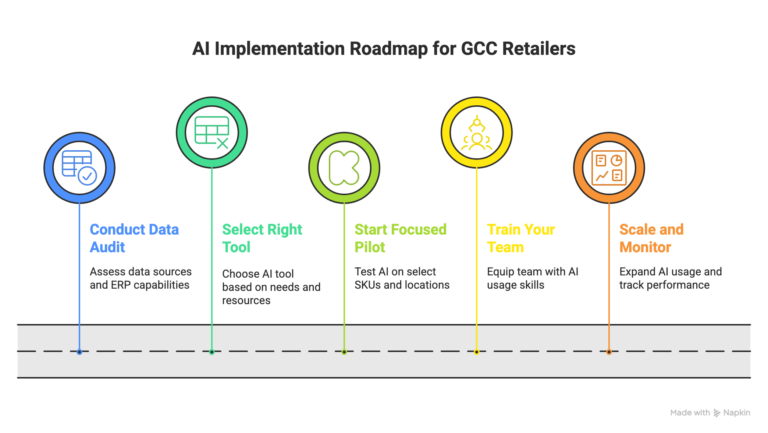
Step 1: Conduct a Data Audit and ERP Health Check
Before buying any AI tool, understand what you’re working with:
- List all data sources (POS, e-commerce, suppliers, warehouses)
- Check your ERP’s API capabilities (can it talk to external systems?)
- Calculate the current forecast accuracy as your baseline
- Identify compliance requirements (ZATCA for Saudi Arabia, UAE VAT regulations)
Step 2: Select the Right Tool Based on Your Reality
Match tools to your actual situation:
- Already using Odoo? Start with Odoo AI modules
- Need ZATCA compliance ASAP? Prioritize tools with proven Saudi implementations
- Limited IT resources? Choose cloud-based options like Tblocks
- Complex supply chain? Invest in Blue Yonder or RELEX despite higher costs
Ask vendors for GCC-specific references, not just global case studies.
Step 3: Start with a Focused Pilot
Don’t try to forecast everything at once:
- Pick 50-100 high-value or high-volatility SKUs
- Choose one location or channel for testing
- Run AI forecasts parallel to your current method for 4-6 weeks
- Compare actual sales against both predictions
One Abu Dhabi retailer tested AI on their electronics category first, proving a 40% accuracy improvement, then secured the budget to expand chain-wide.
Step 4: Train Your Team (Don’t Skip This!)
AI tools are only as good as the people using them:
- Designate 2-3 “AI champions” for hands-on training
- Create simple dashboards for store managers (they don’t need to see the math)
- Set up alert thresholds so the system flags unusual predictions
- Schedule weekly review sessions for the first month
Pro Tip: Have your vendor train your team on YOUR actual data, not generic examples. You’ll catch edge cases faster.
Step 5: Scale and Monitor Continuously
Once the pilot proves ROI:
- Expand to additional product categories monthly
- Integrate with automatic reordering (with human approval initially)
- Set KPIs: forecast accuracy, stockout rate, inventory turnover, emergency shipping costs
- Review AI model performance quarterly, and demand patterns change
Not sure where to start?
What Expert Partners Actually Deliver
Faster Time-to-Value: Implementation in 2-4 weeks vs. 3-6 months DIY
GCC-Specific Customization: Pre-built models for Ramadan, Hajj shopping patterns, and regional holidays
Compliance Confidence: ZATCA integration handled correctly from day one
Ongoing Support: When the AI predicts something weird (and it will), you have experts to call
Training That Sticks: Your team learns not just how to click buttons, but how to interpret predictions
Conclusion
GCC retail is at an inflection point. The retailers who implement AI forecasting in 2025 won’t just save money on inventory; they’ll gain a competitive edge that’s hard to replicate. When your competitor is stuck with stockouts during peak season or drowning in unsold inventory, you’ll have the right products in the right quantities at the right time.
The technology is proven. The ROI is measurable. The only question is: will you lead the transformation or scramble to catch up later?
FAQ
Will AI forecasting work with my existing ERP system?
Most modern AI tools integrate with major ERPs (Odoo, SAP, Microsoft Dynamics) through APIs. However, very old legacy systems might need middleware. During your data audit (Step 1 above), check your ERP's API documentation or ask your vendor directly.
What if the AI predictions are wrong?
AI improves accuracy from 70% to 85-95%, but isn't perfect. That's why you always keep human oversight for the first few months, especially for new products or unprecedented events. The system learns from corrections—every time you override a prediction, it gets smarter.
What happens during system downtime or if the AI platform fails?
Professional implementations include fallback mechanisms. Your historical data remains accessible, and most systems can revert to rule-based forecasting if ML models fail. This is why pilot programs run parallel to existing methods initially, you maintain your safety net.


Related Articles