
Greetings! I'm Aneesh Sreedharan, CEO of 2Hats Logic Solutions. At 2Hats Logic Solutions, we are dedicated to providing technical expertise and resolving your concerns in the world of technology. Our blog page serves as a resource where we share insights and experiences, offering valuable perspectives on your queries.

Here’s something most Shopify store owners in the US don’t realize yet: a growing number of their potential customers are no longer starting product searches on Google.
They’re opening ChatGPT and asking, “What’s the best standing desk under $400 right now?” They’re typing into Perplexity, “Compare the top Shopify stores for eco-friendly pet supplies in the US.” And they’re getting direct answers with product recommendations and clickable links without ever seeing a search results page.
This is AI commerce visibility. If you don’t structure your Shopify store for AI commerce visibility, you won’t be present in that conversation.
The good news? Most Shopify merchants haven’t figured this out yet. That means the window to get ahead is still open, but it won’t stay that way for long. This blog breaks down exactly what agentic storefronts are, how Shopify ChatGPT integration works in practice, what it takes to show up in Perplexity AI searches, and the concrete steps US-based merchants can take to stop being invisible in AI search.
What Exactly Is an Agentic Storefront and Why Should Shopify Merchants Care?
An agentic storefront is a Shopify store that’s been built or optimized to be understood, navigated, and recommended by AI agents.
Your traditional Shopify store is designed for human eyes. Visual layouts, image galleries, hover effects, and flashy banners. That’s all fine for a human shopper. But when ChatGPT or Perplexity reads your store or reads content about your store, it’s not admiring your design. It’s extracting information, evaluating relevance, and deciding whether to recommend you.
An agentic storefront is built to pass that evaluation. It speaks the language that AI agents understand: structured data, semantic product descriptions, schema markup, and clean content that directly answers specific questions.
Think of it like this: your current Shopify store might be a beautiful physical showroom. An agentic storefront is that same showroom, but with every product labeled, catalogued, and indexed in a way that an AI assistant can read and confidently recommend to a buyer.
For US Shopify merchants competing in crowded niches like home goods, apparel, supplements, electronics, and B2B wholesale, this is quickly becoming a real differentiator. The stores that show up in AI-generated recommendations are going to capture buyers that traditional SEO-driven stores simply won’t see.
Why Shopify ChatGPT Integration Is Becoming a Real Business Problem for US Merchants
Let’s be specific about what “Shopify ChatGPT integration” actually means because it’s not a plugin you install. It’s a strategic and technical orientation that determines whether ChatGPT can find, understand, and recommend your store.
ChatGPT’s newer models, especially those with browsing capabilities and shopping features, can access the web in real time. When a user asks for product recommendations, ChatGPT scans the web, reads product pages, parses structured data, and synthesizes a response. The stores that appear in that response aren’t necessarily the biggest or the most established. They’re the ones whose pages are most clearly structured for machine comprehension.
Here’s what determines whether your Shopify store gets surfaced:
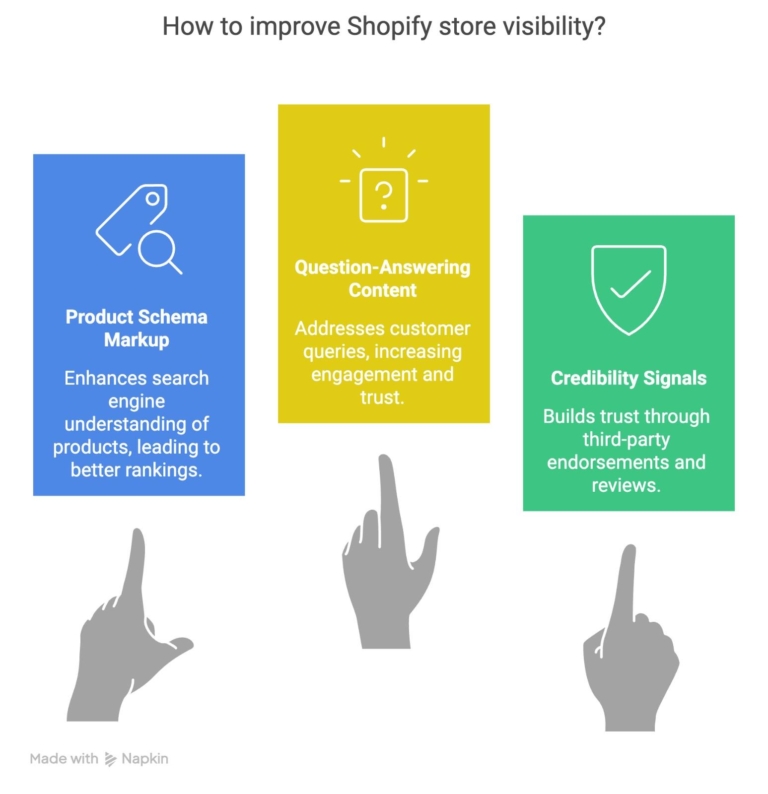
Product schema markup
Does your store use structured data, specifically Product, Offer, and Review schema, so that AI models can instantly understand what you sell, at what price, and how customers rate it? Without this, ChatGPT is reading your page the way someone reads a foreign language: picking up fragments but missing meaning.
Question-answering content
AI models surface stores whose content directly answers the questions buyers are asking. A Shopify store selling skincare products in the US needs content that answers, “Which US Shopify skincare brands are cruelty-free and ship within 2 days?” This is not just a product title and a vague description.
Credibility signals from third-party sources
ChatGPT learns from and retrieves content that references your store. If authoritative blogs, review platforms, and industry sources mention and link to you, your store becomes part of the trusted information ecosystem that AI models draw from.
Most US Shopify merchants are sitting on a real problem here: their stores are technically functional and visually polished, but completely unreadable to AI agents. The structured data is missing or incomplete, the product descriptions are written for conversions rather than comprehension, and no content layer answers the specific questions AI-powered buyers are asking.
Fix your Shopify store for AI search readiness with the right technical foundation.
How Perplexity AI Searches Shopify Stores and What You’re Missing If You’re Not Optimized for It
Perplexity is growing fast, especially among research-driven buyers in the US, the kind of shoppers who don’t just click the first result; they investigate before they buy. And Perplexity works differently from ChatGPT in a way that creates a distinct opportunity for Shopify merchants.
When someone searches on Perplexity, the engine performs a real-time web search, reads the top results, synthesizes an answer, and, crucially, cites its sources with clickable links. If your Shopify store or related content is cited, you get traffic from a buyer who has already read a recommendation and clicked through with intent. That’s a significantly warmer lead than most SEO-driven traffic.
To show up in Perplexity’s cited sources, your Shopify store and the content around it need to do three things well:
Go deep on specific topics
Perplexity favors sources that provide real depth and specificity. A detailed comparison page, “Best Shopify stores for wholesale office supplies in the US: price, shipping, and minimum order comparison,” is far more likely to be cited than a generic homepage or a shallow product listing.
Stay current
Perplexity is retrieved in real time, which means recently updated pages outperform stale ones. Regular content refreshes, current pricing, and up-to-date product information all matter. If your Shopify store hasn’t been meaningfully updated in months, Perplexity notices.
Match the way buyers actually ask questions
Perplexity users ask longer, more conversational queries than traditional Google users. “Which Shopify brands offer free returns on furniture in the US?” is a real Perplexity query. Your content, FAQs, blog posts, and product descriptions need to mirror that natural language so the engine can match your page to those questions.
The Real Reason Most US Shopify Stores Are Invisible to AI Search Engines
Here’s the uncomfortable truth that most Shopify merchants discover too late: the reason your store isn’t showing up in ChatGPT or Perplexity usually isn’t your product quality or your brand. It’s the technical and content foundation underneath your store.
The most common gaps we see when we look at US Shopify stores from an AI readiness perspective:
Missing or broken structured data. Many Shopify themes include basic schema markup, but it’s often incomplete, outdated, or incorrectly implemented. AI models rely on this data to understand what you sell. Broken schema means broken AI visibility.
Product descriptions are written for conversion, not comprehension.
Short, punchy descriptions designed to drive clicks work fine for human shoppers on your site. But AI agents need specificity, dimensions, materials, use cases, comparisons, and compatibility notes. Without that, your products don’t match the detailed queries AI-powered buyers are asking.
No content that answers real questions.
If the only content on your Shopify domain is product pages and a basic About page, you have almost no surface area for AI retrieval. Blog posts, FAQs, comparison guides, and use-case content create the question-answering layer that AI engines actually read and cite.
Disconnected product data. For B2B Shopify merchants using ERP systems like Microsoft Dynamics 365 Business Central, unsynced product data is a serious problem. AI agents that retrieve outdated pricing or out-of-stock inventory from your store won’t recommend you, and buyers who click through to find wrong information won’t come back.
What Agentic Storefronts Look Like in Practice: The Technical Checklist
Let’s get concrete. Here’s what the technical foundation of an AI-ready Shopify store actually looks like for US merchants:
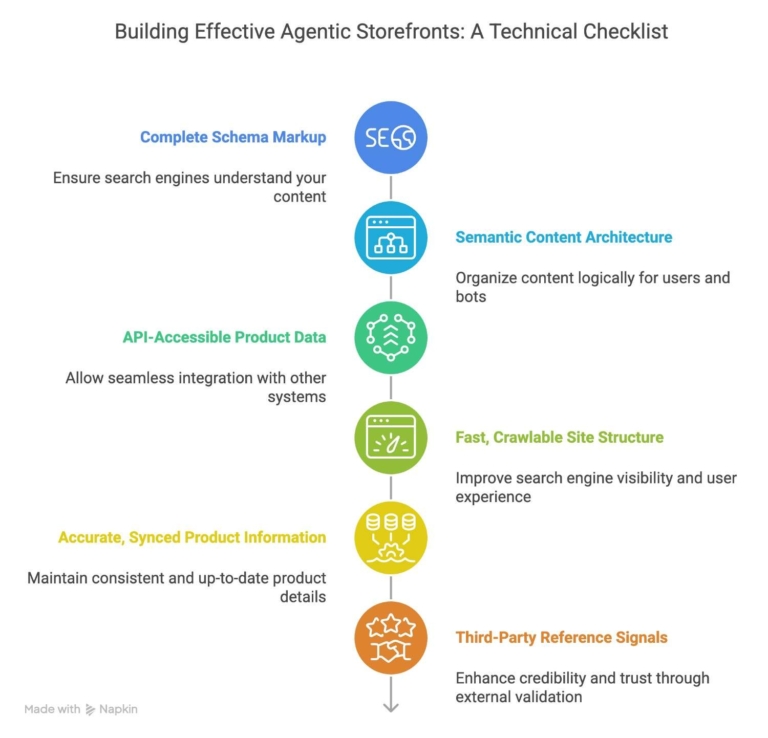
Complete Schema Markup
Product, Offer, Organization, Review, and BreadcrumbList schema, correctly implemented across every product page, collection page, and the homepage. This is the baseline. Without it, AI models are guessing at what you sell.
Semantic Content Architecture
FAQ sections that use natural language questions. Blog content that targets specific, long-tail buyer questions. Product description copy that includes specifications, comparisons, and use cases. This content layer is what AI agents read and retrieve.
API-Accessible Product Data
Shopify’s Storefront API allows AI tools to query your inventory and product information in real time. Stores configured for API access are more likely to be surfaced by AI agents that retrieve live product data.
Fast, Crawlable Site Structure
A clean sitemap, logical internal linking, and fast load times aren’t just good SEO practice. They’re prerequisites for comprehensive AI indexing. If a crawler can’t navigate your site cleanly, an AI agent can’t either.
Accurate, Synced Product Information
For B2B Shopify merchants, this means your product data, pricing, and inventory need to be synchronized with your backend systems. If you’re running Business Central or another ERP, that data pipeline needs to be airtight.
Third-Party Reference Signals
Being mentioned, reviewed, or cited in authoritative external sources like industry blogs, review platforms, and trade publications increases the likelihood that AI models include your store in recommendations for relevant queries.
Not sure where your store stands? Get an AI readiness audit with clear insights and next steps.
How 2Hats Logic Helps US Shopify Merchants Win in AI Search
2Hats Logic Solutions is a Shopify development and AI services company that works specifically at the intersection of e-commerce and AI integration. We’ve built Shopify stores, managed complex ERP integrations, and developed AI automation solutions for merchants across the US, DACH, and GCC markets.
When it comes to agentic storefront optimization, we focus on what actually drives AI visibility. That is the structured data, semantic content, API-ready product data, and accurate ERP sync. Combined with an AI-aligned content strategy, this ensures your Shopify store is not just discoverable, but recommendable across AI search platforms.
We work as a hands-on Shopify technical partner, not a hands-off agency. When you engage us on AI readiness, we’re in your Shopify backend, fixing the actual gaps, not just delivering a report.
Conclusion
Right now, AI search visibility for Shopify stores is wide open whitespace. Most merchants haven’t optimized for it. Most agencies aren’t even talking about it seriously. That means the US Shopify merchants who move now, who structure their stores for AI comprehension, build the right content layer, and implement the technical foundations, are going to establish authority signals that AI models will rely on for years. The ones who wait will find that space already claimed.
If you want to know exactly where your Shopify store stands in terms of AI search readiness, and what it would take to become genuinely visible in ChatGPT, Perplexity, and the AI commerce layer that’s building on top of the web, the next step is simple.
FAQ
What is an agentic storefront for Shopify, and how is it different from a regular Shopify store?
A regular Shopify store is built for human visitors with great design and smooth browsing. An agentic storefront goes a step further by structuring your store so AI tools like ChatGPT can actually read, understand, and recommend it. Think schema markup, semantic product data, and API-accessible content. Same store, but built for both humans and AI agents.
How do I get my Shopify store to show up in ChatGPT product recommendations in the US?
Three things matter most: proper schema markup on your product pages, content that answers the specific questions buyers are asking AI tools, and mentions from credible external sources. ChatGPT recommends stores it can clearly understand. So the clearer and more structured your product data, the better your chances.
Does optimizing for Perplexity AI search help Shopify stores get more traffic from US buyers?
Yes, and it's still low competition. Perplexity cites sources with clickable links, so appearing in an answer sends you warm, pre-qualified traffic. Focus on specific, in-depth content and keep your product information current. Buyers who click through on Perplexity already trust the recommendation.
What is AI commerce visibility and why does it matter for Shopify merchants in the US?
It's how easily AI tools like ChatGPT and Perplexity can find and recommend your store. It matters because AI-referred buyers arrive with much higher purchase intent than typical search traffic; they've already been pointed to you before they click. As more US shoppers research AI tools, this visibility gap will only grow.
Table of contents
- Why Shopify ChatGPT Integration Is Becoming a Real Business Problem for US Merchants
- How Perplexity AI Searches Shopify Stores and What You're Missing If You're Not Optimized for It
- The Real Reason Most US Shopify Stores Are Invisible to AI Search Engines
- What Agentic Storefronts Look Like in Practice: The Technical Checklist
- Conclusion


Related Articles