Greetings! I'm Aneesh Sreedharan, CEO of 2Hats Logic Solutions. At 2Hats Logic Solutions, we are dedicated to providing technical expertise and resolving your concerns in the world of technology. Our blog page serves as a resource where we share insights and experiences, offering valuable perspectives on your queries.

Is Your Business Data Ready for AI? A Checklist for Retailers and Wholesalers
Want a Quick Summary?


Table of contents
AI can help retailers and wholesalers forecast demand, manage inventory, automate order processing, and make better purchasing decisions. But the quality of these results depends heavily on the underlying data.
Many businesses already store large amounts of information in ERP systems, e-commerce platforms, warehouse management software, and spreadsheets. However, having data available does not necessarily mean it is ready for AI.
Product records may be inconsistent, inventory figures may not reflect actual stock, and sales information may be scattered across different systems. When AI tools work with incomplete or outdated information, their recommendations and predictions can become unreliable. Before investing in Artificial Intelligence solutions, retailers and wholesalers need to understand whether their existing business data can support them. This checklist covers the key areas to review before introducing AI into your business operations.
1. Product Data Consistency
Product data is one of the most important requirements for successful AI adoption in retail and wholesale businesses. AI systems rely on accurate product information to identify items, understand product attributes, generate recommendations, and support purchasing decisions.
However, product information is often inconsistent across business systems. The same product may have different names, descriptions, SKU formats, or attributes in the ERP, e-commerce platform, and inventory system.
Before introducing AI, businesses should check:
- Consistent product names and SKUs: Each product should have a clearly identifiable name and unique SKU across connected systems.
- Complete product attributes: Important details such as size, colour, material, dimensions, and specifications should be available.
- Accurate product descriptions: Descriptions should reflect the actual product and avoid conflicting or outdated information.
- Standardised product categories: Products should follow a consistent category structure across business platforms.
- Updated product information: Discontinued products, outdated prices, and incorrect specifications should be addressed.
For retailers and wholesalers, improving product data consistency creates a more reliable foundation for AI applications such as product recommendations, intelligent search, product matching, and automated order processing.
2. Inventory Data Accuracy
Inventory data plays an important role in AI-driven demand forecasting, stock planning, and purchasing decisions. If stock levels in your systems do not reflect actual inventory, AI applications may produce unreliable forecasts and recommendations.
Retailers and wholesalers should check whether their inventory data is accurate, consistent, and regularly updated across their business systems.
Key areas to review include:
- Real-time stock levels: Check whether inventory records reflect actual stock across warehouses, stores and sales channels.
- Stock movement records: Ensure incoming goods, sales, returns, transfers, and adjustments are recorded correctly.
- Warehouse-level inventory: Maintain clear stock information for each warehouse or storage location.
- Reserved and available stock: Distinguish between physical inventory, reserved quantities, and stock available for sale.
- Historical inventory records: Maintain reliable historical data to help AI identify stock patterns and support demand forecasting.
Accurate inventory data gives AI systems a better foundation for forecasting demand, identifying stock shortages, and supporting inventory planning.
3. Sales and Order Data Quality
Sales and order data help AI systems understand purchasing patterns, customer demand, and changes in product performance. Retailers and wholesalers can use this information for demand forecasting, sales analysis, and purchase planning.
However, incomplete order records, inconsistent sales information, or missing transaction details can affect the quality of AI-generated insights.
Check the following areas before using sales data for AI:
- Complete order records: Ensure orders include product details, quantities, prices, order dates, and customer information.
- Accurate sales history: Maintain reliable records of completed, cancelled, and returned orders.
- Consistent order statuses: Use standardised statuses across systems to distinguish between pending, processed, shipped, and completed orders.
- Historical sales trends: Keep sufficient historical records to help AI identify seasonal demand and purchasing patterns.
- Returns and cancellations: Record returns, refunds, and cancellations accurately so they do not distort sales analysis.
Reliable sales and order data help AI applications identify demand patterns, support purchasing decisions, and improve business planning.
4. Supplier Data Quality
Supplier data is important for businesses that use AI to support purchasing, supplier management, and supply chain planning. Incomplete or outdated supplier records can affect purchasing decisions, delivery planning, and cost comparisons.
Retailers and wholesalers should review whether their supplier information is accurate and consistently maintained across their business systems.
Key areas to check include:
- Supplier information: Maintain accurate supplier names, contact details, addresses, and account references.
- Product-supplier mapping: Ensure products are correctly linked to their respective suppliers, including supplier-specific product codes.
- Pricing information: Keep supplier prices, discounts, and pricing conditions updated.
- Lead times: Record actual supplier delivery timelines to support purchasing and inventory planning.
- Order history: Maintain records of previous purchase orders, deliveries, delays, and supplier performance.
Reliable supplier data helps AI applications compare supplier information, support purchasing decisions, and improve supply chain planning.
5. Customer Data Quality
Customer data helps AI systems understand buying behaviour, identify purchasing patterns, and support more relevant customer interactions. For retailers and wholesalers, this information can support customer segmentation, personalised product recommendations and sales forecasting.
However, customer records are often spread across CRM platforms, ERP systems and ecommerce stores. Duplicate accounts, outdated contact details and inconsistent customer information can affect the quality of AI-generated insights.
Check the following areas:
- Complete customer records: Maintain accurate customer names, contact details, account IDs, and billing information.
- Duplicate customer profiles: Identify and merge duplicate records to maintain a consistent customer history.
- Purchase history: Ensure customer orders, repeat purchases, returns, and transaction details are recorded correctly.
- Customer segmentation: Organise customer records using relevant categories, such as business type, location, or purchasing behaviour.
- Updated customer information: Regularly review outdated or incorrect customer details across connected systems.
Clean and consistent customer data gives AI applications a more reliable foundation for customer analysis, product recommendations, and personalised sales experiences.
6. System Integration and Data Accessibility
Business data is often spread across multiple platforms, including ERP systems, ecommerce stores, warehouse management software, and CRM applications. If these systems operate independently, important information may remain disconnected or become difficult to access.
For AI applications to work effectively, relevant business data needs to be accessible across the systems involved in a workflow.
Businesses should check the following:
- System connectivity: Ensure that key business systems can exchange information through APIs or other integration methods.
- Consistent data formats: Standardise how information is structured and shared between connected systems.
- Data synchronisation: Check whether updates to products, inventory, orders, and customer records are reflected across platforms.
- Access permissions: Define which systems and AI applications can access specific business information.
- Integration reliability: Monitor data transfers to identify failed synchronisations, missing records, and integration errors.
Connecting business systems creates a more consistent data environment for AI applications. It also helps businesses avoid relying on outdated or isolated information when automating workflows.
7. Data Security and Access Permissions
Making business data accessible to AI applications does not mean giving every system unrestricted access. Retailers and wholesalers need to ensure that sensitive business information is protected and accessed only by authorised users and applications.
Before adopting AI, review the following:
- Role-based access: Define which employees and applications can view, modify, or use specific data.
- Sensitive information: Identify confidential customer, supplier, financial, and business records that require additional protection.
- Data access controls: Ensure AI applications only access the information required for their intended tasks.
- Data protection policies: Establish clear rules for storing, processing, and sharing business information.
- Access monitoring: Regularly review permissions and monitor how business data is accessed and used.
Strong access controls help businesses introduce AI while maintaining better control over their operational and customer information.
For businesses connecting AI applications with ERP and ecommerce platforms, security and access permissions should be considered during the integration process, not added as an afterthought.
8. Data Synchronisation and Maintenance
Preparing business data for AI is not a one-time task. Product details, inventory levels, supplier prices, and customer records change regularly. If these updates are not reflected across connected systems, AI applications may continue working with outdated information.
Businesses should establish processes to keep their data accurate and up to date.
Key areas to review include:
- Regular data updates: Ensure changes to products, prices, inventory, and customer records are reflected in relevant systems.
- Automated synchronisation: Use integrations to transfer updates between ERP, ecommerce and other business platforms.
- Data validation: Check incoming information for missing fields, incorrect values, and inconsistencies.
- Duplicate detection: Identify duplicate records that may accumulate as data moves between systems.
- Ongoing monitoring: Regularly review data quality and resolve synchronisation errors before they affect business operations.
Consistent data maintenance helps AI applications work with current and reliable business information. It also provides a stronger foundation for expanding AI adoption across different business processes.
AI Data Readiness Checklist for Retailers and Wholesalers
Before implementing AI, businesses should review whether their existing data meets the basic requirements for reliable use. Use this checklist to identify areas that need attention.
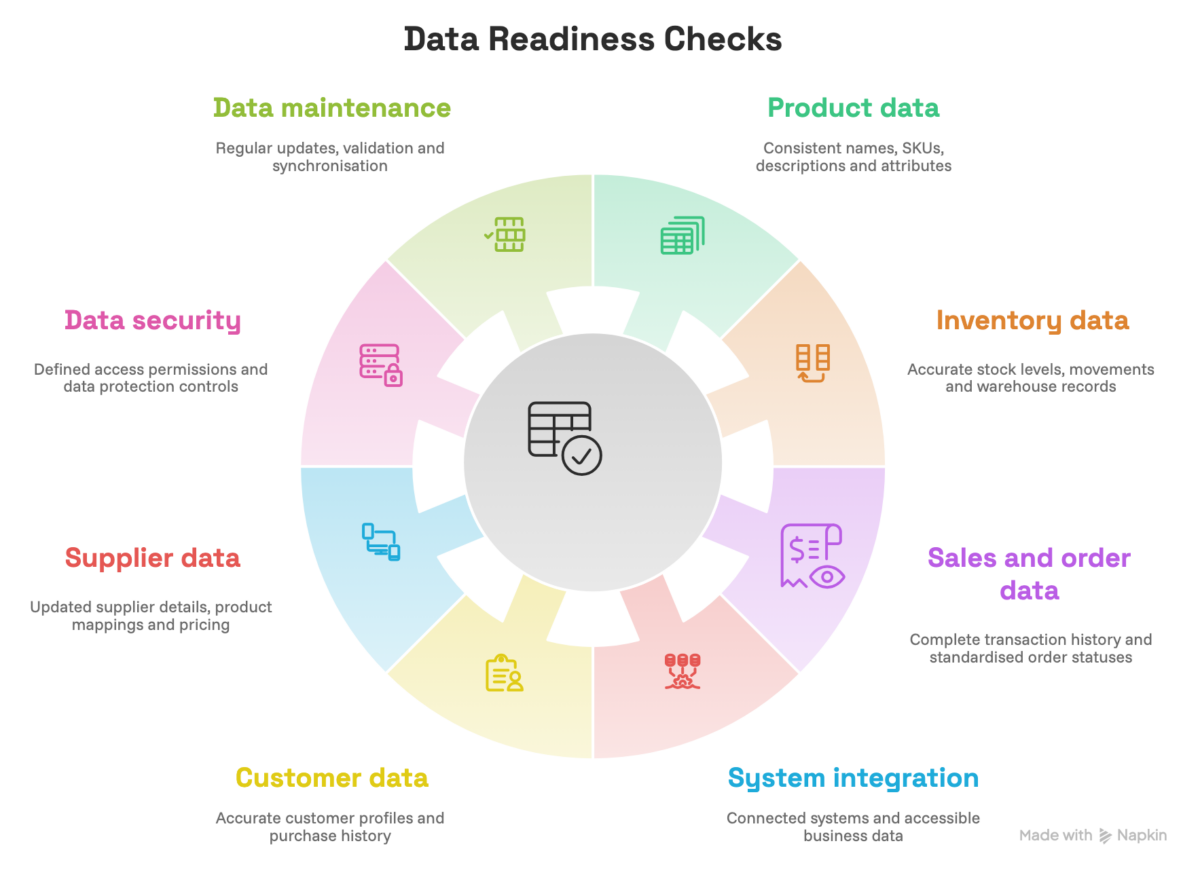
If several areas need improvement, businesses should address the most important data gaps before deploying AI applications.
Not every AI project requires perfectly structured data. However, understanding existing data limitations and preparing the relevant information can help businesses avoid unreliable outputs and unnecessary implementation challenges.
Conclusion: Build a Strong Data Foundation Before Adopting AI
Successful AI adoption starts with reliable business data. Inconsistent product records, inaccurate inventory figures, incomplete order histories, and disconnected systems can limit how effectively AI applications support business operations.
For retailers and wholesalers, improving data quality involves more than cleaning spreadsheets. It requires maintaining accurate information across ERP, ecommerce, inventory, and supplier management systems.
At 2Hats Logic Solutions, we help businesses connect their systems, automate data-intensive workflows, and improve how business information moves across platforms. From ERP integrations and email orders to ERP automation to AI-driven inventory planning. Our solutions help businesses build a stronger foundation for AI adoption.
Before introducing AI into your operations, start by understanding your existing data and identifying where improvements are needed.
Ready to prepare your business data for AI?
Talk to our team about your data and automation requirements.
Want a Quick Summary?
Table of contents

Related Articles