Greetings! I'm Aneesh Sreedharan, CEO of 2Hats Logic Solutions. At 2Hats Logic Solutions, we are dedicated to providing technical expertise and resolving your concerns in the world of technology. Our blog page serves as a resource where we share insights and experiences, offering valuable perspectives on your queries.
Quick Summary
AI-powered auto-reorder automates purchase order creation for distributors by monitoring inventory, forecasting demand, evaluating supplier options, and syncing orders with the existing ERP. It helps prevent stockouts, reduce excess inventory, free up procurement time, and improve purchasing decisions. The system works alongside ERP platforms such as Business Central, SAP, Xentral, and Odoo without requiring an ERP replacement.
Most distributors have invested heavily in ERP systems, including Business Central, SAP, Xentral, and Odoo. These systems track inventory in real time, manage supplier data, and handle financials. They’re sophisticated tools designed to run the business.
But one critical process still happens manually, which is purchase order creation.
Someone checks inventory levels. Creates a PO. Enters it into the ERP. Sends it to suppliers. Does this 50–100 times per week. It’s repetitive, slow, and pulls smart people away from actual strategic work.
There’s a better way. It’s called AI-powered auto-reorder. This AI automation can handle much of this procurement process while working with the systems you already use.
This guide explains what it actually does, how it works with systems you already have, and why it matters for your bottom line.
Why Manual Systems Break as You Scale
Here’s something that happens to most distributors as they grow:
At first, manual procurement works fine. You have 20 products, a couple of suppliers, and one person handling orders. They know the rhythm. They know when Q4 hits, demand goes up. They order more. Then you grow. You add more products. More suppliers. Different warehouse locations. Seasonal patterns that vary by product. Customer requests get more complex.
Now the same process that worked at €2M revenue doesn’t work at €10M.
Here’s what breaks:
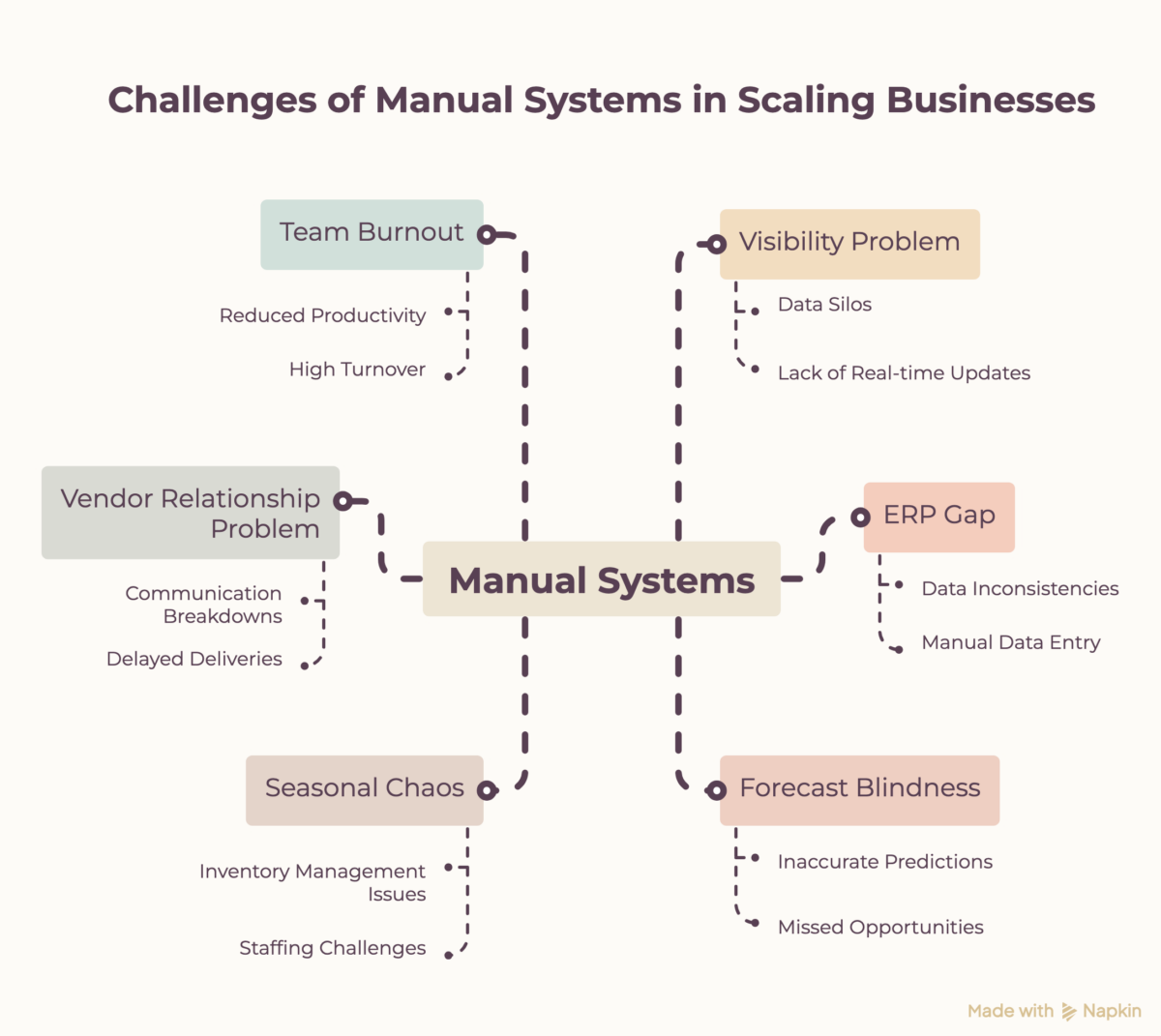
The visibility problem
When everything is manual, you need someone actively watching inventory. Checking it daily. Or multiple times a day during peak season. The problem is no one can be everywhere at once.
So inventory gets missed. A product you sell regularly drops to critical levels, and no one notices until a customer order comes in and you can’t fulfill it. By then it’s too late; you’ve already lost the sale.
Or the opposite happens: You order too much “just to be safe,” and it sits in your warehouse for months. That money that could have been working for your business is just… sitting there.
The ERP gap
You invested in a good ERP system. Business Central, SAP, Xentral, Odoo, whatever you use. Your inventory data is live in there.
But here’s the problem: Your procurement process isn’t connected to it.
Inventory drops in your ERP. But your procurement team doesn’t see that automatically. They’re checking spreadsheets or emails or asking the warehouse manager. Then they create the PO manually. Then they re-enter it into the ERP.
You have all this data, but it’s not being used intelligently. It’s like having a powerful engine but using it in first gear.
The forecast blindness
Right now, you don’t really know what you’ll need next month. You’re reacting to what’s happening today.
A supplier asks, “What’s your volume commitment next quarter?”
You can’t answer. So they quote you full price. No volume discount. No early-payment incentive.
But a distributor who can say “We’ll buy 10,000 units” gets 8–12% off. They get better payment terms. They get priority when demand spikes.
You’re leaving discounts on the table because you can’t forecast accurately.
The seasonal chaos
Q4 hits. Demand jumps 50–100%. Your team has to scramble.
Do you order too much? (Ties up cash, excess inventory.) Do you order too little? (Stockouts, lost sales.)
There’s no good answer when you’re doing it manually. You’re guessing.
A smart system learns, “Every year in October, demand for this product goes up by this percentage.” It pre-adjusts your reorder points. It increases order quantities automatically. You never get caught off-guard.
The vendor relationship problem
Your suppliers want to work with you strategically. But they can’t, because you’re unpredictable.
Sometimes you order 100 units. Sometimes 500. Sometimes nothing for three weeks, then an urgent order.
They can’t plan their production. You can’t get their best pricing or service. The relationship stays transactional.
But if you could say, “Here’s our forecast for the next 12 weeks,” everything changes. You get treated differently.
Team burnout
Your procurement team is smart. They understand business. They should be negotiating contracts, solving problems, and planning strategy.
Instead, they’re creating POs. Over and over. Friday through Friday.
By the time they could do something strategic, they’d been exhausted from the repetitive work.
So what changes when you automate?
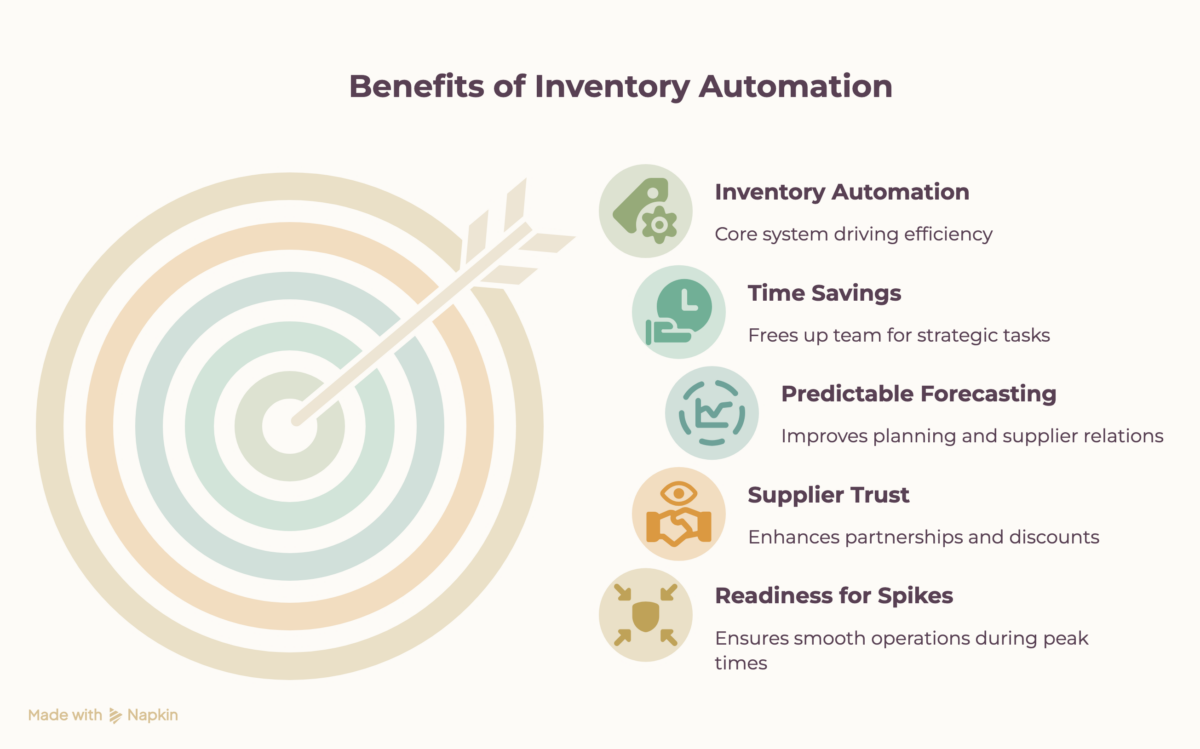
The system watches inventory continuously. When it hits the trigger point, a PO is created automatically and synced to your ERP instantly.
No manual monitoring. No missed orders.
Your team gets their time back. They use it on work that actually matters.
Your forecasting becomes predictable. Suppliers trust you. You get discounts.
Seasonal spikes don’t surprise you anymore. You’re ready.
The interesting part: This isn’t new technology. Distributors have been doing this for years. The question is, why aren’t you?
How AI-Powered Auto-Reorder Actually Works
Your ERP tracks inventory in real-time. An AI system watches this data continuously. When inventory for a product reaches a certain point, the system doesn’t just flag it, it acts.
First, it predicts demand. It looks at historical sales data, seasonal patterns, upcoming trends, current stock levels, and supplier lead times. It calculates, “Product X normally sells 40 units per week. In October, demand jumps to 60 units per week. Lead time from the supplier is 7 days. We need a safety buffer. The reorder point should be 65 units.
When stock drops to 60 units, the system triggers.
Now it evaluates suppliers. Supplier A charges €10 per unit with a 5-day lead time. Supplier B is €9.50 per unit but takes 10 days. Supplier C is faster at 2 days but more expensive. The system picks the best option based on your situation right now. If you have cash flow breathing room, it chooses the cheaper supplier. If demand is about to spike, it picks the fastest one.
The PO is generated automatically with the right quantities, pricing, and vendor. It syncs directly into your ERP. The supplier receives it. Your team doesn’t need to do anything.
From the moment inventory hits the threshold to the moment the order is live in your system: 2–5 seconds.
Compare this to what you’re probably doing now:
Manual work takes 30–60 minutes per order. Someone has to check levels, decide what to order, find the supplier, create the PO, enter it into the ERP, and send it out. Basic automation handles that faster, but it still uses the same rigid rule every time. Order at 50, buy 100, and always use Supplier A. It doesn’t adapt to seasonality, cash flow, or vendor performance.
AI does. It learns from your patterns and makes decisions that fit your business right now.
Real Impact: What Changes
Here’s what this actually means for your business.
- Prevent Stockouts Before They Happen
With automated PO generation tied to your ERP inventory data, you’re never discovering you’re out of stock when a customer order arrives. The system predicts demand before it happens. Your reorder point adjusts automatically to seasonal spikes. A DACH distributor we worked with went from 15 preventable stockouts per year to 2–3. That’s revenue protected, customers retained.
- Free Up Working Capital Tied in Excess Inventory
Manual procurement tends to order “just to be safe,” which means excess inventory sitting in your warehouse. When AI manages reorder points, it orders what you actually need, adjusted by demand forecast. One mid-sized distributor reduced average inventory by 20% while maintaining the same service level. That freed up €250K in working capital. Not a one-time gain. Every month.
- Get Your Procurement Team Back to Strategy
Procurement automation means your team stops creating routine purchase orders. They go from spending 70% of their time on paperwork to spending 70% of their time on work that matters, vendor negotiations, performance analysis, and growth planning. This shift alone makes many distributors realize they can stop hiring just to handle volume.
- Negotiate Better Vendor Terms and Pricing
When you can tell a supplier, “Here’s our forecast for the next 12 weeks,” the dynamic changes. They can plan production. You get volume discounts. You get priority during their capacity crunches. Most distributors report 5–10% better pricing within the first six months just from having predictable orders.
- Scale Revenue Without Adding Headcount
While other distributors are managing reorders manually, you’re handling growth differently. Your inventory turns faster. Your cash flow is healthier. Your customer service is more reliable. This isn’t a back-office improvement, it’s a competitive advantage.
Addressing the Real Concerns
Before you implement, here’s what you need to know.
Messy Data Isn’t a Barrier to Getting Started
A common objection we hear is that inventory data is scattered across different systems or incomplete. The good news: AI actually thrives in these situations. The system learns from whatever data you have: imperfect historical records, seasonal anomalies, and data gaps. AI finds the patterns underneath the noise. If your data were perfectly clean and organized, you would have solved this manually already.
You Keep Full Control Over Vendor Selection
Another concern is losing control to automation. This misses how modern auto-reorder works. The AI recommends the best option based on price, speed, and reliability. But you set the rules. You can lock in: “Always use Supplier A for Product X because of our strategic relationship.” Or “Never let total inventory exceed €1.5M.” Or “Don’t order more than 30% above the forecast.” The system operates within your guardrails while providing the intelligence layer.
You Don’t Need to Replace Your ERP
Your Business Central, SAP, Xentral, or Odoo doesn’t go anywhere. AI auto-reorder sits on top of your existing system and uses the inventory data already flowing through it. There’s no rip-and-replace project. Your team doesn’t need to relearn their entire system. You keep working with the ERP you have today, it just becomes smarter.
Implementation Happens in Weeks, Not Months
The typical timeline is 4–8 weeks from decision to live orders. Weeks 1–2 involve auditing your inventory data and supplier information. Weeks 3–4 have the AI system training on your historical patterns. Weeks 5–6 run in “recommendation mode,” where the system suggests orders but your team approves them first, with validation before full automation. Weeks 7–8, you go live. You see real results quickly, not six months from now.
Supplier Data Improves as the System Runs
You don’t need perfect supplier information to start. Begin with whatever you have: pricing, lead times, and on-time delivery rates. As the system generates and tracks orders, it learns more about each supplier’s actual performance. The recommendations get better over time automatically.
So here’s where you are now.
You understand what auto-reorder does. You know it prevents stockouts, frees up working capital, and gets your team back to strategy work. You’ve seen that it works with your existing ERP, doesn’t require months of implementation, and keeps you in control.
But here’s the question most distributors ask next: “What would this actually save us?”
The answer is different for every business. A distributor losing €50K annually to preventable stockouts gets one result. A distributor with €500K tied up in excess inventory gets another. A distributor spending the equivalent of two full-time people on manual PO creation gets yet another. You need to know your number.
Conclusion
The reality of manual procurement is this. It consumes time, creates errors, and ties up capital. These aren’t small problems. They compound. What we’ve shown you is that there’s a different way to operate. One where purchase orders generate themselves based on demand forecasts, where your team stops doing repetitive work, and where stockouts become rare instead of routine. This isn’t theoretical. Distributors across DACH and beyond are already using AI auto-reorder to run leaner, smarter procurement workflows.
Not sure how much time and working capital your current procurement process is costing you?
We’ll assess your inventory data, procurement workflow, and ERP setup to identify where automation could make the biggest impact.
FAQ
How does AI auto-reorder work with an ERP?
AI auto-reorder connects with your existing ERP to access inventory, sales, supplier, and purchasing data. It uses this information to calculate reorder needs and can create and sync purchase orders back to the ERP.
Can AI automatically create purchase orders?
Yes, AI can generate purchase orders when inventory reaches the required reorder point, using factors such as forecasted demand, supplier lead times, pricing, and inventory levels.
How does AI decide when to reorder inventory?
The system considers factors such as current inventory, historical sales, forecasted demand, seasonality, safety stock, and supplier lead times to determine when a product should be reordered.

Related Articles