
Greetings! I'm Aneesh Sreedharan, CEO of 2Hats Logic Solutions. At 2Hats Logic Solutions, we are dedicated to providing technical expertise and resolving your concerns in the world of technology. Our blog page serves as a resource where we share insights and experiences, offering valuable perspectives on your queries.

Quick Summary
• AI automation helps dealerships capture more leads, close faster, and keep customers coming back to the service bay.
• Dealership chatbots, predictive maintenance, CRM AI, and EV service tools are the four highest-impact starting points.
• Start with one use case, pilot it for 90 days, measure the results, then scale.
So, you’re running a dealership or a service center, and it feels like you’re fighting fires all day.
Leads slip through the cracks because nobody followed up fast enough. Your service bays are backed up, but you can’t find enough technicians. Customers expect instant answers at 11 p.m. on a Sunday, and your team clocks out at six.
Sound familiar? You’re not alone.
New-vehicle front-end margins have dropped to historic lows for many dealerships. Fixed operations now carry more than half of the total gross profit at most dealer groups. And there’s a technician shortage that keeps getting worse across North America and Europe.
Here’s the thing: the dealerships pulling ahead right now aren’t working harder. They’re working smarter, with AI automation handling the repetitive, time-sensitive tasks that humans frankly shouldn’t be doing manually anymore.
This article breaks down exactly how AI is reshaping automotive retail and service. We’ll walk through real use cases, show you what’s working today, and give you a practical roadmap to get started, no matter your dealership’s size.
What Does AI Automation Mean for a Dealership?
AI automation, in an automotive context, refers to systems that learn from your dealership’s data, CRM records, service histories, website behavior, and connected-car telematics, and then predict outcomes and trigger actions independently.
That’s fundamentally different from the DMS (Document Management System) software most dealers are used to. Traditional platforms like CDK Global or Reynolds & Reynolds run on fixed rules: if X happens, do Y. AI flips that model. Instead of following pre-written instructions, it finds patterns in your data and adapts as new information comes in.
Here’s a simple way to think about it:
Three technologies power most of what we’ll cover in this article:
• Machine Learning (ML): analyzes your sales and service data to predict things like which lead is most likely to buy or which car needs brakes next month.
• Natural Language Processing (NLP): powers chatbots, email classifiers, and sentiment analyzers that understand human language, including automotive jargon.
• Computer Vision (CV): Interprets images and video for tasks like automated vehicle inspections and body-damage detection.
AI for Automotive Sales
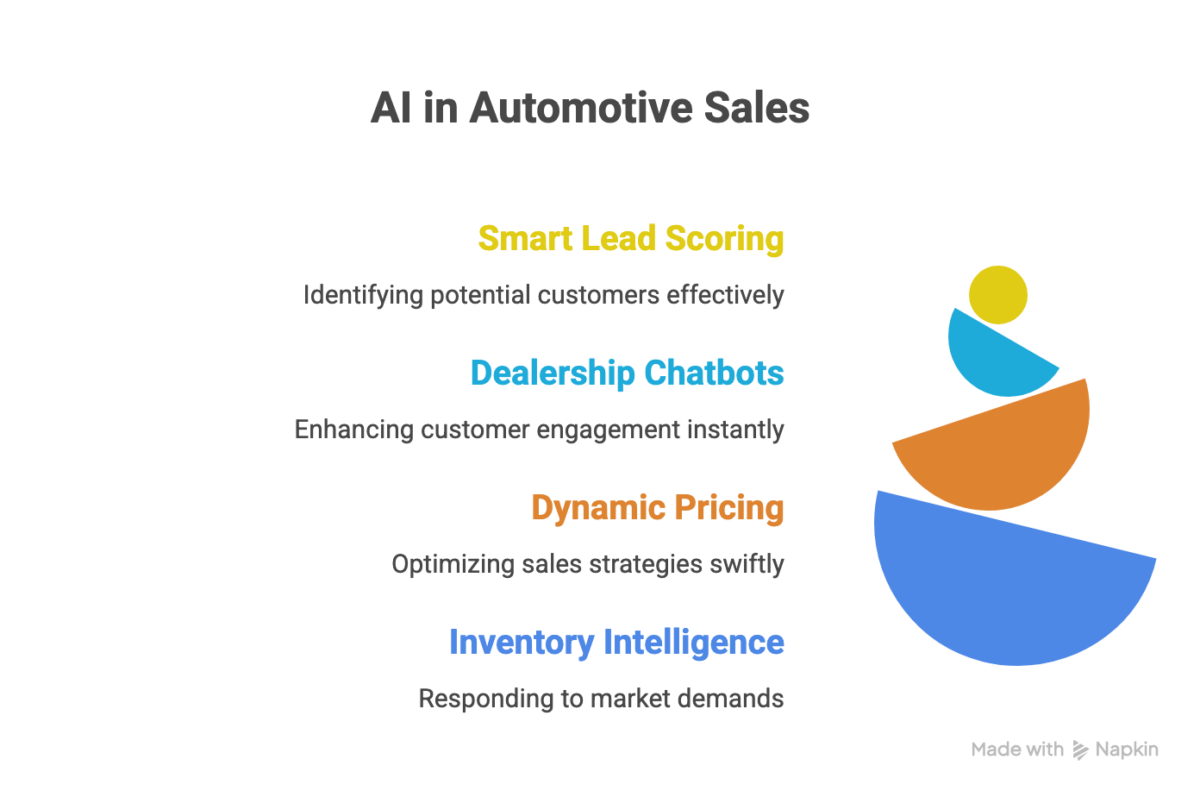
Smart Lead Scoring That Works
Most dealerships treat every lead the same. A form fill from someone who browsed six VDPs and used the trade-in tool gets the same round-robin treatment as a tire-kicker who bounced in 30 seconds.
AI lead scoring fixes that.
It looks at behavioral signals, page views, time on site, return visits, and trade-in tool usage and assigns each lead a probability-to-convert score. Then it routes that lead to the salesperson with the best match based on expertise and close rate, not just whose turn it is.
The result? Faster response times, higher appointment-set rates, and fewer hours wasted chasing cold leads.
Dealership Chatbots
Let’s be real: most chatbots are awful. But automotive-specific chatbots are a different breed.
A good dealership chatbot integrates with your live inventory feed, CRM, and OEM incentive data in real time. When a customer asks about a specific trim at midnight, they get an accurate answer. The interaction logs themselves in the CRM automatically. And a qualified lead is waiting for your BDC when they walk in the next morning.
Multilingual support matters too, especially if you’re serving diverse metro markets.
The make-or-break feature? Human handoff. The best chatbots know when to escalate to a real person, and they pass along the full context so the customer doesn’t have to repeat themselves.
Ready to turn more leads into showroom visits?
Dynamic Pricing and Inventory Intelligence
AI pricing tools adjust your used-vehicle list prices based on market velocity, days in stock, competing local listings, and real-time search demand. On the acquisition side, AI can tell you which vehicles to buy at auction by matching local demand predictions to available units.
Dealers using these tools consistently report fewer aged units sitting past 60 days and faster inventory turns.
Tip: Don’t try to implement everything at once. If you’re a single-rooftop dealer, start with a chatbot. It’s the lowest-cost, fastest-ROI entry point into AI; most break even within 60–90 days.
Automotive CRM AI
Here’s a stat that should bother every dealer: Most CRM databases are full of money-making opportunities that nobody ever sees.
Traditional CRM is a glorified contact list with task reminders. AI-enhanced CRM is a predictive engine that surfaces revenue opportunities you didn’t know existed.
Equity Mining and Conquest Campaigns
Equity mining is the poster child for CRM AI. The system cross-references a customer’s vehicle equity, loan balance, OEM incentives, and payment history to flag who’s ready to trade up right now.
Instead of blasting a generic offer to your entire database, the AI triggers a personalized email or SMS to a specific customer with a specific vehicle recommendation. It’s targeted, timely, and far more effective than spray-and-pray marketing.
Want to go further? Conquest campaigns use the same AI to target competitive-brand owners based on local registration data and service-defection patterns.
Sentiment Analysis
NLP-based sentiment analysis scans your emails, chat logs, call recordings, and online reviews to score customer mood in real time.
If a customer’s last three interactions show declining satisfaction, the system flags them before they leave a one-star review or defect to another brand. Your service advisor gets an alert and makes a proactive call with a goodwill gesture.
That’s the difference between losing a customer and saving one.
AI in the Service
Predictive Maintenance for Customer Vehicles
This is where AI delivers some of its most tangible, dollar-for-dollar value.
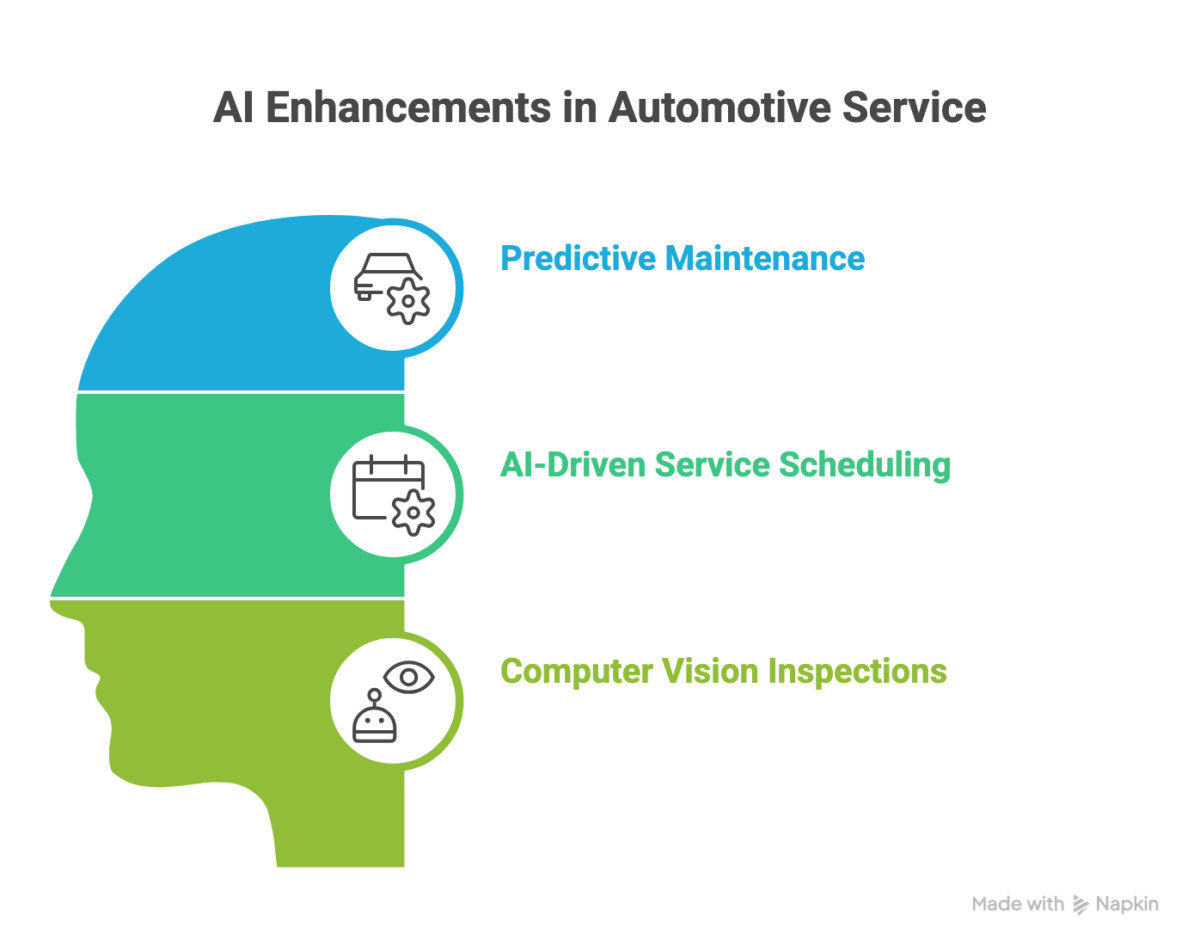
Connected-car telematics from OEM platforms like GM OnStar, Ford FordPass, and BMW ConnectedDrive feed AI models that predict component failures before they happen. Brake pad wear, battery degradation, tire replacement timing, and transmission fluid condition are all forecastable.
The business impact is a shift from reactive break-fix visits to planned, higher-margin service appointments.
But the customer experience impact is even bigger. Imagine getting a message that says, “Your brake pads have about 2,000 miles left; let’s schedule before they’re metal-on-metal.” That kind of proactive outreach builds trust in a way that waiting for something to fail never can.
AI-Driven Service Scheduling
Intelligent scheduling goes beyond a calendar app. AI considers technician certifications, bay type, estimated job time, parts availability, and whether the customer wants to wait or drop off.
When a walk-in shows up or a repair runs long, the system re-sequences the day’s queue dynamically. Less idle time, fewer bottlenecks, shorter customer waits.
Computer Vision Inspections
AI-powered cameras at the drive-in lane can detect body damage, tire tread depth, and fluid leaks automatically. The result is a digital multi-point inspection with photo and video evidence sent directly to the customer’s phone.
Customers who see visual proof of a problem approve recommended work at much higher rates than those who hear a verbal estimate. It’s simple: show, don’t tell.
Tip: Predictive maintenance and computer vision inspections pair perfectly. Use telematics to bring the customer in, then use CV to document everything during the visit. It’s a trust-building one-two punch.
EV Service Automation
EVs have fewer moving parts, which means fewer routine service visits. But when they do need attention, the complexity spikes: high-voltage battery systems, power electronics, and thermal management.
AI helps in three critical areas:
• Battery health monitoring: AI models track charge/discharge cycles, temperature history, and driving patterns to predict degradation. This lets you schedule battery service proactively, especially before warranty expiry.
• OTA update management: tracking which vehicles have pending software updates and coordinating them with physical service visits.
• Charging infrastructure: AI optimizes charger scheduling on your lot for fleet vehicles, courtesy charging, and loaner top-ups while shifting consumption to off-peak hours to cut energy costs.
Even small touches count. Sending a customer a message that says “your car is fully charged and ready for pickup” closes the loop between service and communication in a way that feels premium.
Dealers who build EV service AI capabilities now will own this relationship. Those who wait will be playing catch-up against OEMs and third parties who learned faster.
AI Tools Compared
Here’s a quick side-by-side to help you figure out where to start based on your budget and pain points:
| AI Solution Category | What It Does | Setup Investment | Payback |
|---|---|---|---|
| Chatbots & Virtual Assistants | 24/7 lead capture via website, SMS, and social chat | Low | 2–4 months |
| CRM AI & Equity Mining | Flags trade-up-ready customers and automates personalised outreach | Medium | 3–6 months |
| Dynamic Pricing Engine | Adjusts used-vehicle prices based on market demand and days in stock | Low–Medium | 2–4 months |
| Predictive Maintenance | Forecasts vehicle repairs using telematics and service history data | High | 6–12 months |
| Computer Vision Inspections | Automates multi-point vehicle inspections with camera-based damage detection | High | 6–12 months |
| EV Battery Health AI | Monitors battery state-of-health and predicts degradation for proactive service | High (Custom) | 12+ months |
Mistakes That Will Burn Your AI Budget
AI is powerful, but it’s not magic. Here are the five mistakes we see dealers make most often:
1. Deploying AI before cleaning your data. If your CRM is full of duplicates and your service history has gaps, the models will learn the wrong patterns.
2. Ignoring staff adoption. A $5,000/month tool that your salespeople refuse to use delivers exactly zero ROI. Training and internal champions matter.
3. Underestimating DMS integration complexity. Plugging into CDK or Reynolds isn’t always plug-and-play. Budget time and money for it.
4. Forgetting about compliance. GDPR in the DACH region, CCPA in California, and the FTC Safeguards Rule for US dealers: AI doesn’t exempt you from any of it.
5. Expecting overnight results. Chatbots can break even in two months. Predictive models need six to twelve months of data. Set realistic timelines.
Tip: Before you sign any vendor contract, ask one question: “Can I export my data if I leave?” If the answer is no or vague, walk away. Data portability is non-negotiable.
What’s Coming Next
Three trends will shape the next few years:
• Zero-touch service: The car diagnoses itself, and notifies the owner. OEM connected-car platforms are 60-70% of the way there. The dealer-side automation layer is the missing piece.
• Generative AI for sales: Think personalized video walkarounds generated for each online shopper and AI-assisted F&I product recommendations tailored to individual risk profiles.
• AI-native dealer platforms: New entrants like Tekion are building DMS and CRM from scratch with AI at the core, not bolting it onto 1990s architecture. The pressure to modernize will only grow.
The dealers who invest in AI capabilities now will own the customer relationship. The ones who wait will spend the next decade playing catch-up.
Your 7-Step AI Implementation Roadmap
Ready to get started? Here’s the playbook:
1. Audit your data. Clean your CRM, standardize service history, and deduplicate your DMS records. This isn’t glamorous, but it’s the foundation everything else sits on.
2. Pick one use case. Don’t boil the ocean. Choose the single highest-pain, highest-ROI problem, usually a chatbot or predictive service outreach.
3. Shortlist 2-3 vendors. Request demos using your actual data, not canned samples.
4. Run a 90-day pilot on one rooftop or department. Define success metrics before day one.
5. Train your team. Two to four hours of role-specific, hands-on training. Appoint an internal AI champion.
6. Review KPIs monthly. Refine prompts, model settings, and workflow rules based on real results.
7. Scale with a playbook. Document what worked in your pilot, then roll it out to additional locations and departments.
Conclusion
At 2Hats Logic, we help automotive businesses implement AI chatbots, predictive maintenance systems, CRM intelligence, and custom automation workflows, without the enterprise overhead.
Let’s talk about what AI can do for your business.
FAQ
Can a small, independent dealer afford this?
Absolutely. SaaS-priced tools mean you can start with one application for under budget and expand as the ROI justifies it.
What is predictive maintenance for cars?
It’s AI that uses connected-car data to forecast when a component (brakes, battery, tyres) will need service, before it fails. Service centers use these predictions for proactive outreach instead of waiting for a breakdown.
Do customers actually like dealership chatbots?
The automotive-specific ones? Yes. When a chatbot can answer an accurate, trim-level question at midnight and log the interaction automatically, it captures leads that would otherwise vanish. Generic bots, on the other hand, are a liability.
How does AI improve customer retention?
Three ways: equity mining identifies upgrade-ready customers, sentiment analysis catches unhappy ones before they leave, and predictive service reminders keep them coming back to your bay instead of an independent shop.

Related Articles