
Greetings! I'm Aneesh Sreedharan, CEO of 2Hats Logic Solutions. At 2Hats Logic Solutions, we are dedicated to providing technical expertise and resolving your concerns in the world of technology. Our blog page serves as a resource where we share insights and experiences, offering valuable perspectives on your queries.
Most RPA projects don’t fail because of the technology. They fail because of what happens after the first bot goes live.
Teams automate one process, then two, then ten. Different departments build bots in isolation. Nobody documents anything. Security teams have no visibility. And before long, the organization has a sprawling collection of automations that nobody fully understands, some broken, some redundant, and almost none of them aligned with the company’s broader goals.
Sound familiar? This is the governance gap. And it’s the single biggest reason why enterprises that invest heavily in Robotic Process Automation (RPA) still struggle to see meaningful returns at scale.
RPA success depends on how you manage bots, not just which tool you choose. Whether you’re running ten bots or ten thousand, governance is what separates a sustainable automation program from an expensive mess.
This guide covers everything you need to know: what RPA governance actually is, the core frameworks and models that work in practice, how to manage the full bot lifecycle, and how to scale automation without losing control. If you’re serious about making RPA work long-term, this is your blueprint.
Ready to govern your automation program the right way?
Ready to start your project?
What Is RPA Governance?
RPA governance is the system of rules, processes, and oversight structures that control how bots are built, deployed, and managed across an organization.
Think of it like city planning. You can let anyone build anything, anywhere, and things might work fine for a while. But eventually, roads don’t connect, buildings violate safety codes, and the whole thing becomes unmanageable. Governance is the planning framework that keeps everything functional and scalable.
In practical terms, RPA governance covers:
- Policies and standards for how automation is designed and deployed
- Roles and responsibilities defining who owns, builds, and monitors bots
- Approval and change management workflows to control what gets automated
- Security and compliance controls to protect data and meet regulatory requirements
- Lifecycle management to track bots from design through to retirement
Why Governance Matters
Without governance, bots multiply without oversight. With it, automation becomes a strategic asset.
Here’s what strong RPA governance delivers:
- Prevents automation chaos by giving every bot a clear owner, purpose, and process
- Protects company data by enforcing access controls and audit trails
- Helps automation scale without creating new technical debt or security risks
- Improves ROI by eliminating redundant bots and prioritizing high-value processes
- Supports compliance by logging every bot action and keeping documentation current
The organizations seeing the highest returns from RPA aren’t the ones with the most bots; they’re the ones with the best governance.
Common Problems Without RPA Governance
Let’s look at what actually happens when governance is absent or treated as an afterthought.
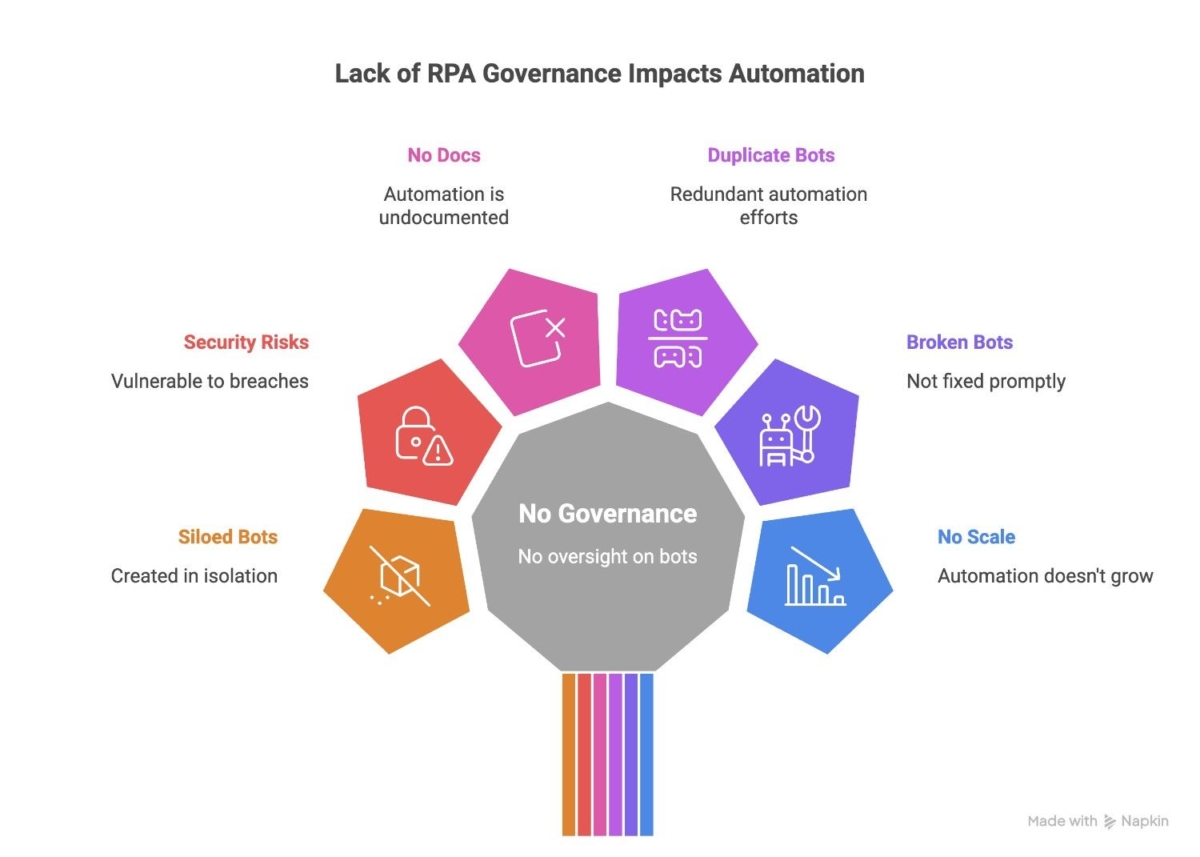
Bots created in silos.
Individual teams build automations without any central visibility. Finance builds one bot, HR builds another, IT builds three more. Nobody knows what exists, what it does, or whether it duplicates something already running elsewhere.
Security risks.
Bots often handle sensitive data, financial records, employee information, and customer data. Without proper access controls, credential management, and audit logging, every bot becomes a potential vulnerability.
No documentation.
When the person who built a bot leaves the company, the automation becomes a black box. Nobody knows how it works, what it touches, or how to fix it when it breaks.
Duplicate automations.
Without a central registry, the same process often gets automated multiple times across different departments. This wastes development time and creates inconsistencies.
Broken bots not fixed.
When bots fail silently with no monitoring or alert system in place, errors accumulate unnoticed. Transactions fail. Reports are wrong. The business pays the price.
Automation doesn’t scale.
Without standardized architecture and shared components, every new automation project starts from scratch. Growth becomes expensive and slow.
These aren’t edge cases; they’re the norm for organizations that jump into RPA without a governance strategy. The technology works. The process around it breaks things down.
Core Components of RPA Governance
Enterprise Automation Framework
An enterprise automation framework is the structural foundation of your governance model. It defines:
- Policies and standards: What counts as an automation candidate? What platforms are approved? What coding standards must bots meet?
- Roles and responsibilities: Who has the authority to approve new automation projects? Who owns each bot in production? Who handles incidents?
- Approval workflows: How does an automation request move from idea to deployment? Who reviews it at each stage?
- Automation lifecycle tracking: How do you record what each bot does, when it was last updated, and what its performance looks like?
This framework isn’t bureaucracy for its own sake. It’s what allows automation to grow without becoming unmanageable.
Governance Models
There’s no single right model, but there are three that work in practice:
Decentralized (Business-Led): Individual departments own their automations. Fast to start, but difficult to scale. Works best for small organizations or in the early stages of an RPA program.
Center of Excellence (CoE): A dedicated team sets standards, approves projects, and manages the automation portfolio centrally. Strong governance and consistency, but it can become a bottleneck if not structured well.
Federated Hybrid Model: Business units have local automation capability, but operate within standards defined by a central CoE. This model balances speed with control and is the most common choice for large enterprises scaling RPA across multiple departments.
Choosing the right model depends on your organization’s size, maturity, and how much autonomy different departments need. Most enterprises start centralized and evolve toward a federated model as automation scales.
Establish a Center of Excellence (CoE)
What Is a CoE?
A Center of Excellence is a dedicated team responsible for setting the strategic direction and operational standards of your RPA program. It’s not just a support function; it’s the governance engine that keeps automation aligned with business goals.
A CoE typically includes:
- An Automation Lead or Head of CoE with strategic oversight
- RPA Developers responsible for building and maintaining production bots
- A Process Analyst who evaluates and prioritizes automation candidates
- A Security and Compliance Specialist to manage risk
- Business Relationship Managers who act as the bridge between IT and business units
CoE Responsibilities
A high-functioning CoE does more than approve requests. Its responsibilities include:
- Evaluating and approving automation projects based on feasibility, ROI, and strategic fit
- Documenting all processes and maintaining up-to-date records for every bot in production
- Training teams, both developers and business users, on RPA tools, standards, and best practices
- Monitoring ROI across the automation portfolio and reporting on performance to leadership
- Managing risk by enforcing security policies, compliance requirements, and change management procedures
Centralized vs. Federated CoE
A centralized CoE keeps full control within one team. Every automation project is designed, built, and maintained by CoE developers. The advantage is consistency and strong governance. The risk is speed; centralized teams can become a bottleneck as demand grows.
A federated CoE distributes some development capability to business units while keeping governance centralized. Business units can build their own automations using approved tools and templates, but they must comply with standards set by the CoE. This model scales better and is the preferred approach for large enterprises managing automation at scale.
Lifecycle Management for Bots
Bots must be treated like real software, not desktop shortcuts that get deployed and forgotten.
CI/CD for Automation
Mature RPA programs apply the same software engineering practices to bots that development teams apply to enterprise applications:
- Version control: Every bot script is tracked in a version control system (e.g., Git). Changes are logged, reviewed, and reversible.
- Testing environments: Bots are tested in development and staging environments before being promoted to production. Automated testing catches regressions before they cause damage.
- Deployment pipelines: Standardized CI/CD pipelines ensure that bot deployments are consistent, auditable, and repeatable.
- Bot retirement strategy: Bots that are no longer needed are formally decommissioned, not just switched off. Retirement includes archiving documentation, revoking access, and notifying stakeholders.
Bot Lifecycle Stages
Every bot goes through a defined set of stages:
- Discovery: Identify the process, document the current state, and assess automation potential
- Design: Create the Process Definition Document and Solution Design Document
- Build: Develop the bot using approved tools, coding standards, and reusable components
- Test: Validate the bot in a controlled environment with real-world scenarios
- Deploy: Promote to production through the approved deployment pipeline
- Monitor: Track performance, error rates, and exceptions in real time
- Improve: Regularly review and update the bot based on process changes and performance data
Skipping any of these stages is how bots end up broken, undocumented, or misaligned with the processes they’re supposed to automate.
Security and Access Control
Role-Based Access Control (RBAC)
Not everyone should have access to every bot. RBAC ensures that users can only interact with the automations relevant to their role.
In practice, this means:
- Bot developers have access to build and test environments, but not production
- Process owners can monitor bot performance, but can’t modify configurations
- CoE leads have oversight across all environments
- Each bot should have its own unique identity and credentials, never shared accounts
This limits the blast radius if a credential is compromised and makes it much easier to audit who did what and when.
Credential Management
Bots regularly interact with systems that require authentication, applications, databases, and APIs. How those credentials are stored and managed matters enormously.
Best practices include:
- Encrypted credential storage using a dedicated credential vault (e.g., CyberArk, HashiCorp Vault, or the native credential manager in your RPA platform)
- No hardcoded credentials in bot scripts, ever
- Avoiding shared accounts, which make auditing impossible and increase security risk
- Regular credential rotation to limit exposure in the event of a breach
Compliance and Auditability
Regulated industries like finance, healthcare, and insurance face strict requirements around data handling and process documentation. Even outside those industries, audit trails are critical for troubleshooting and governance.
Every bot should:
- Log all actions taken, including system interactions, data accessed, and decisions made
- Maintain audit trails that can be reviewed during compliance audits or incident investigations
- Be aligned with relevant regulations, whether that’s GDPR, HIPAA, SOX, or industry-specific frameworks
Governance without auditability is governance on paper only. The logs are what prove it’s actually working.
Monitoring and Observability
Real-Time Monitoring
You can’t manage what you can’t see. Real-time monitoring gives you visibility into what every bot is doing, how it’s performing, and whether it’s encountering problems.
Effective monitoring covers:
- Bot uptime and availability: Is the bot running when it’s supposed to be?
- Transaction success and failure rates: How many processes are completing successfully? How many are failing?
- Processing speed: Is the bot meeting SLA requirements?
- Queue depth: Are work items piling up faster than bots can process them?
Alerts and Incident Management
When something goes wrong, you need to know immediately, not when a business user calls to report an error two days later.
A robust alerting strategy includes:
- Automated alerts triggered by predefined thresholds (e.g., error rate exceeds 5%, bot offline for more than 15 minutes)
- Escalation paths that define who gets notified, when, and how
- Incident response procedures for common failure types, so the team can resolve issues quickly without starting from scratch each time
- Post-incident reviews to identify root causes and prevent recurrence
KPIs for Automation
Monitoring isn’t just about catching failures; it’s about understanding whether your automation program is delivering value. Key metrics to track include:
- ROI per bot: Is this automation saving more than it costs to maintain?
- Error rates: How often do bots fail or produce incorrect outputs?
- Bot uptime: What percentage of scheduled runtime is the bot actually operational?
- Processing speed: How does the bot’s performance compare to the manual baseline?
- Straight-through processing rate: What proportion of transactions complete without human intervention?
These metrics should be reviewed regularly by the CoE and shared with business stakeholders to demonstrate value and identify improvement opportunities.
Documentation and Audit Trails
Required Documentation
Good documentation is what makes bots maintainable, auditable, and transferable. Every automation should have at a minimum:
- Process Definition Document (PDD): Describes the current state of the process, steps, inputs, outputs, exceptions, and rules. This is the source of truth for what the bot is supposed to do.
- Solution Design Document (SDD): Describes how the bot works technically, architecture, components, integration points, and configuration details.
- Runbook: Operational guide for the bot, covering how to start and stop it, what to do when it fails, and who to contact for support.
Why Documentation Matters
Documentation is often treated as optional or completed after the fact. That’s a mistake.
- Easier maintenance: When a process changes or a bot breaks, documentation tells the next developer exactly what they’re working with.
- Compliance support: Audit teams need to verify that automated processes follow approved procedures. Documentation provides that evidence.
- Knowledge sharing: Documentation prevents critical knowledge from living only in one person’s head and disappearing when they leave.
A simple rule: if it’s not documented, it doesn’t exist from a governance perspective.
Process Selection Governance
Choose the Right Processes
Not every process is a good automation candidate. Governance includes a structured approach to identifying and prioritizing which processes to automate.
The best candidates share these characteristics:
- High volume: The process runs frequently enough that automation produces meaningful time savings
- Rule-based: Decisions follow clear, defined rules without requiring judgment calls
- Low exceptions: Edge cases are rare and can be handled through documented escalation paths
- Measurable ROI: The value of automating the process can be calculated and tracked
Processes that score well on all four dimensions should move to the top of the automation pipeline.
Avoid Automating Bad Processes
This is one of the most common and most costly mistakes in RPA: automating a broken process and then being surprised when the bot consistently produces broken results.
Before any automation project begins, the process must be:
- Documented and mapped in its current state
- Optimized and simplified where possible
- Tested manually to confirm that it produces consistent, correct outputs
Automation amplifies whatever is already there. A clean, well-defined process becomes a fast, reliable bot. A messy, inconsistent process becomes a fast, unreliable one.
Bot Design Best Practices
Modular Automation Design
Building bots as modular, reusable components is one of the highest-leverage practices in enterprise RPA.
Instead of building each automation as a monolithic script, break it into components that can be reused across multiple bots. For example, a “login to SAP” component can be used by dozens of different automations, meaning when SAP updates its interface, you fix it once, and every bot benefits.
Modular design also makes testing easier, maintenance faster, and onboarding new developers more straightforward.
Coding Standards
Bots are production software. They should be held to production software standards:
- Naming conventions: Consistent, meaningful names for variables, workflows, and bot files
- Code reviews: Every bot should be reviewed by a second developer before deployment
- Testing: Unit tests, integration tests, and end-to-end tests before production release
- Error handling: Every bot should handle exceptions gracefully, logging the failure, alerting the relevant team, and exiting cleanly rather than crashing
Treat Bots as Production Software
This point deserves emphasis. Bots are not desktop macros. They are enterprise software running on company infrastructure, interacting with business-critical systems, and processing sensitive data.
That means they need:
- Proper version control and change management
- Security reviews before deployment
- Ongoing monitoring and maintenance
- Formal retirement procedures when they’re no longer needed
Organizations that treat bots like quick-fix scripts tend to accumulate technical debt fast. Those who treat bots like production software build automation programs that scale.
Continuous Improvement and Maintenance
Deploying a bot is not the end of the project; it’s the beginning of the next phase.
Effective bot maintenance includes:
- Regular performance reviews: At a minimum, quarterly, review each bot’s KPIs against its original business case. Is it still delivering the expected value?
- Proactive updates: When upstream systems change, a software update, a UI change, or a process modification, bots must be updated before they break, not after.
- Fixing or retiring broken bots: A bot that frequently fails should be fixed or decommissioned. Running a broken bot wastes resources and erodes trust in automation.
- Continuous improvement cycles: Use performance data and user feedback to identify opportunities to make each automation faster, more accurate, or more capable.
The best RPA programs treat automation as a continuously improving capability, not a static deployment.
Scaling RPA Across the Enterprise
Avoid Automation Silos
Scaling RPA means spreading automation capabilities across departments while maintaining governance and avoiding duplication.
Practical strategies include:
- Shared bot libraries: Make reusable components available across all teams through a central repository
- Cross-department visibility: Maintain a central automation registry so teams can see what already exists before building something new
- Shared infrastructure: Where possible, use shared automation infrastructure rather than department-by-department deployments
Citizen Developer Governance
Many enterprises want to enable business users, not just IT, to build automations. This “citizen developer” model can dramatically accelerate RPA adoption, but it requires its own governance structure.
Key controls include:
- Structured training programs: Citizen developers must be trained on approved tools, coding standards, and governance requirements before building anything
- Approval workflows: Citizen-built automations must go through a review and approval process before deployment
- Guardrails on scope: Define clearly what citizen developers can and cannot automate. High-risk processes involving sensitive data should require CoE involvement.
Automation Roadmap
Scaling safely requires a roadmap. Start with a small number of high-value, low-complexity automations. Build the governance infrastructure in parallel. Then expand deliberately.
A phased approach:
- Pilot: Two to five automations, full governance infrastructure, lessons documented
- Scale within a department: Ten to twenty automations, CoE fully operational, metrics tracked
- Cross-department rollout: Federated model activated, citizen developer program launched
- Enterprise-wide scale: Hundreds of bots, fully operational governance, continuous improvement cycles running
Trying to scale too fast without a governance foundation in place is what causes the problems described at the beginning of this guide.
RPA Governance for AI and Intelligent Automation
Modern RPA increasingly incorporates AI capabilities, natural language processing, computer vision, and machine learning-based decision making. This adds significant power, but also new governance challenges.
When AI is involved in automation, governance must address:
- Managing AI decisions: When a bot makes a decision based on an AI model, there must be a clear record of what inputs led to what decision. Black-box AI in production automation is a compliance and operational risk.
- Data quality controls: AI models are only as good as the data they’re trained on. Governance must include processes for validating data quality and detecting model drift.
- Human-in-the-loop workflows: For high-stakes decisions, loan approvals, medical record updates, and fraud flags, AI-driven bots should route to human review rather than acting autonomously. Governance defines when and how that escalation happens.
- Ethical automation rules: Organizations should define explicit policies for where AI automation is appropriate and where it isn’t, particularly in processes that affect individuals (hiring, lending, healthcare, customer service).
As RPA evolves toward agentic automation, where AI agents autonomously plan and execute multi-step workflows, these governance requirements become even more critical.
Real-World Governance Models
Financial Services: A large bank implemented a federated CoE model after its initial centralized approach couldn’t keep pace with demand. Business units were trained and empowered to develop low-risk automations independently, while all automations involving customer data required CoE review. Compliance audit trails were automated, providing regulators with on-demand access to bot logs. The result: a threefold increase in automation throughput with no significant increase in security incidents.
Healthcare Systems: A regional hospital network faced strict HIPAA compliance requirements that initially made leadership hesitant to adopt RPA. By implementing role-based access control, encrypted credential vaults, and comprehensive audit logging from day one, the organization built a governance model that satisfied compliance teams. Automations were deployed for claims processing, appointment scheduling, and records management, with every bot action logged and auditable.
IT Service Providers: A global IT services company used RPA governance to standardize automation delivery across multiple client environments. A central CoE defined standards and templates; client-facing teams customized within those boundaries. Reusable bot libraries reduced development time significantly across projects, and centralized monitoring meant incidents could be detected and resolved before clients noticed.
RPA Governance Checklist
Use this checklist to assess the maturity of your RPA governance program:
- CoE created: Dedicated team with defined roles and leadership
- Lifecycle defined: All bot stages documented from discovery through retirement
- Security rules set: RBAC, credential management, and audit logging in place
- Monitoring active: Real-time dashboards and automated alerts configured
- Documentation ready: PDDs, SDDs, and runbooks created for all production bots
- Continuous improvement plan: Regular performance reviews and update cycles scheduled
- Process selection criteria: Clear standards for what qualifies as an automation candidate
- Coding standards enforced: Naming conventions, code reviews, and testing protocols are active
- Compliance alignment: Bot logging and documentation meet regulatory requirements
- Automation roadmap in place: Phased scaling plan with clear milestones
Common Mistakes in RPA Governance
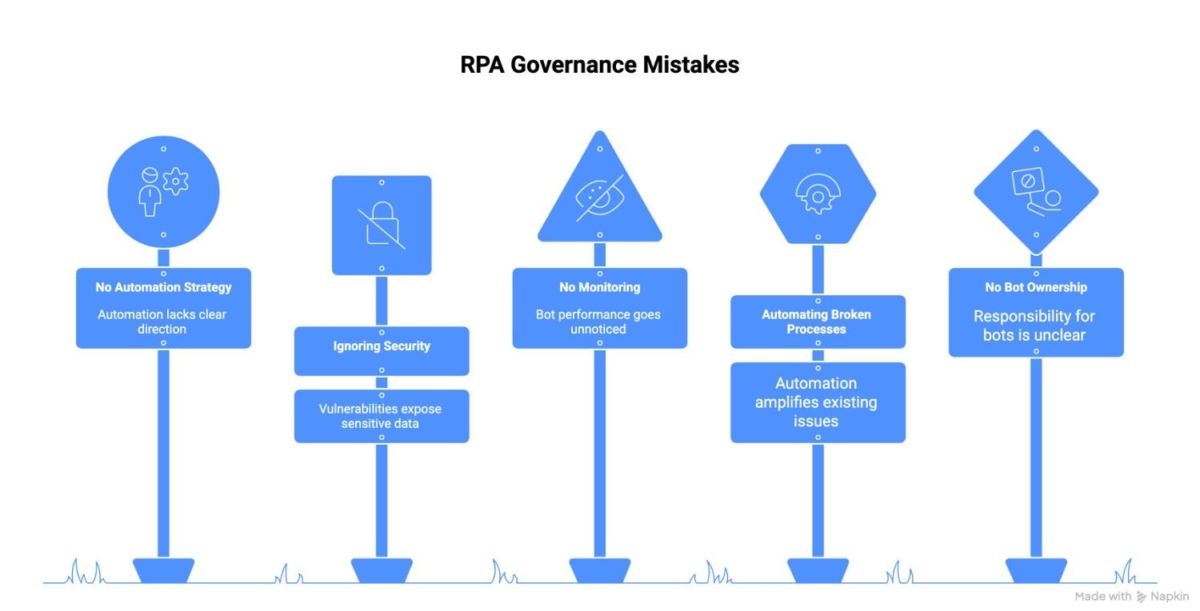
Starting automation without a strategy.
Building bots before defining governance is building on sand. The first few automations may work fine, but the problems emerge at scale.
Ignoring security.
Bots with excessive permissions, shared credentials, and no audit logging are a security team’s nightmare. This mistake is particularly costly in regulated industries.
No monitoring.
Deploying a bot and assuming it works is not a strategy. Silent failures in automated processes can cause significant damage before anyone notices.
Automating broken processes.
As discussed earlier, automating a poorly designed process doesn’t fix it; it just makes the problems happen faster.
No ownership of bots.
Every bot in production needs a named owner responsible for its performance and maintenance. “Orphan bots” automations with no clear owner are a governance liability.
The Future of RPA Governance (2026–2030)
The next five years will bring significant changes to what RPA governance needs to cover.
Agentic automation oversight.
As AI agents become capable of autonomously planning and executing complex workflows, governance frameworks must evolve to manage decisions made without direct human instruction. This includes defining the boundaries of autonomous action, audit requirements for AI-driven decisions, and escalation paths when agents encounter novel situations.
Self-healing bots.
AI-powered RPA platforms are beginning to offer self-healing capabilities, bots that can detect when a UI has changed and automatically update their own scripts. Governance must define how these changes are reviewed and approved before taking effect in production.
AI governance policies.
Organizations will need formal policies covering data quality, model management, bias detection, and ethical use of AI in automation, separate from, but integrated with, existing RPA governance frameworks.
Automation compliance frameworks. Regulatory bodies are beginning to pay closer attention to automated decision-making processes. Expect industry-specific compliance frameworks for automation to emerge, particularly in finance and healthcare.
Organizations that build strong governance foundations now will be far better positioned to navigate these shifts than those scrambling to retrofit governance onto an unmanaged automation estate.
We Help You Build Automation Programs That Last
Governance is the difference between an automation program that delivers lasting value and one that creates new problems faster than it solves old ones. It’s also one of the most common areas where organizations need expert support.
Our team works with enterprises at every stage of the RPA journey, from building CoEs and selecting the right governance model to designing bot lifecycle frameworks, implementing security controls, and establishing the monitoring infrastructure that keeps automation running reliably.
If your organization is struggling to scale RPA, experiencing governance gaps, or looking to build the right foundation before rolling out automation more broadly, we can help. Our services span governance strategy, CoE design, security architecture, process selection, and ongoing bot management support.
Reach out to our team to discuss your automation program and find out what the right governance model looks like for your organization.
FAQ
What is RPA governance?
RPA governance is the system of rules, processes, and oversight structures that control how software bots are designed, deployed, monitored, and managed. It covers everything from security and compliance to lifecycle management, documentation, and performance monitoring.
Why do RPA projects fail without governance?
Without governance, automation programs grow in an uncontrolled way. Bots are created in silos, documentation doesn't exist, security controls are absent, and there's no systematic way to detect or fix failures. Over time, this creates technical debt, compliance risk, and a collection of automations that cost more to maintain than they save.
What is a Center of Excellence in RPA?
A Center of Excellence (CoE) is a dedicated team responsible for setting the strategic direction and operational standards of an RPA program. It evaluates and approves automation projects, defines development standards, trains teams, monitors ROI, and manages risk across the automation portfolio.
How do you manage bots at scale?
Managing bots at scale requires a federated governance model, a central automation registry, standardized development practices, reusable component libraries, real-time monitoring, and a phased scaling roadmap. Without these elements, managing large numbers of bots quickly becomes unmanageable.
What security controls are needed for RPA?
Essential security controls include role-based access control (RBAC), encrypted credential storage, unique bot identities (no shared accounts), comprehensive audit logging, and regular security reviews. In regulated industries, bots must also meet industry-specific compliance requirements such as HIPAA or GDPR.
What governance model is best for large companies?
Most large enterprises benefit from a federated hybrid model, where a central CoE sets standards and manages high-risk automations, while business units can build lower-risk automations within those standards. This model balances governance with the speed needed to scale automation across complex organizations.
Table of contents
- What Is RPA Governance?
- Common Problems Without RPA Governance
- Core Components of RPA Governance
- Establish a Center of Excellence (CoE)
- Lifecycle Management for Bots
- RPA Governance for AI and Intelligent Automation
- Real-World Governance Models
- RPA Governance Checklist
- Common Mistakes in RPA Governance
- The Future of RPA Governance (2026–2030)
- We Help You Build Automation Programs That Last

Related Articles