Greetings! I'm Aneesh Sreedharan, CEO of 2Hats Logic Solutions. At 2Hats Logic Solutions, we are dedicated to providing technical expertise and resolving your concerns in the world of technology. Our blog page serves as a resource where we share insights and experiences, offering valuable perspectives on your queries.
Tired of generic upsells that don’t convert? The average online store loses potential revenue because product recommendations feel robotic and irrelevant. Customers abandon carts, scroll past suggested items, and leave without adding that second product that could’ve doubled your order value.
AI product recommendations can increase your average order value (AOV) by 20-30% when implemented correctly. Amazon attributes 35% of its revenue to its recommendation engine, but you don’t need its billion-dollar budget to compete.
In this guide, you’ll discover why AI personalization is essential, the recommendation types that drive revenue, real case studies showing 15-30% gains, and how to avoid common pitfalls.
Why Your Online Store Needs AI Personalization Now
Higher conversions: When a customer sees “Customers who bought this camera also bought this lens,” they’re 3x more likely to add both to cart than if you just showed “Related products.”
Amazon-like experience for small shops: You don’t need a data science team. Platforms like Shopify and WooCommerce now offer plug-and-play AI that learns from your store’s data automatically.
Reduced cart abandonment: Intelligent recommendations on cart pages can recover 15-20% of abandoning customers by showing them lower-priced alternatives or complementary items that justify the purchase.
Real-world example: A fashion boutique using AI recommendations on their WooCommerce store saw their AOV jump from AED 280 to AED 365 (30% increase) within 45 days, just by showing “Complete the look” bundles powered by collaborative filtering.
Pro Tip: If you’re in fashion, beauty, or home decor, prioritize visual AI recommendations that show “Style it with” options. For B2B or technical products, focus on specification-based matching.
Types of AI Recommendations for Beginners
Feeling overwhelmed by AI terminology? Let’s break down the recommendation types that actually matter for your store, no computer science degree required.
Think of AI recommendation types like cooking styles. Each produces different results, and the best chefs (or ecommerce managers) know when to use which approach:
1. Collaborative Filtering (The “People Like You” Approach)
How it works: This engine looks at what similar customers bought and suggests products based on patterns. If 100 customers who bought a yoga mat also bought resistance bands, the AI will recommend bands to the next yoga mat buyer.
Best for:
- Stores with at least 100+ orders per month
- Fashion, consumer electronics, beauty products
Real example: A Shopify electronics store shows “Customers who bought this iPhone case also purchased this screen protector” → 22% of customers add both to cart.
Limitation: This suffers from the “cold start problem”; new products or new stores without purchase history won’t have enough data. That’s where content-based filtering helps.
2. Content-Based Filtering (The “Products Like This” Approach)
How it works: Instead of looking at customer behavior, this engine analyzes product attributes, color, size, category, price range, materials, and recommends similar items.
Best for:
- New stores with limited sales history
- Stores with large catalogs (500+ products)
- Home goods, B2B supplies, pet products
Real example: A furniture store recommends “Mid-century modern chairs in a similar oak finish” based on what the customer is viewing, no purchase data needed.
The catch: Content-based recommendations feel safe but predictable. They won’t surprise customers with unexpected pairings that drive higher AOV.
3. Hybrid Engines (The Best of Both Worlds)
How it works: Combines collaborative + content-based filtering. Uses product attributes when there’s no behavioral data, then switches to pattern-matching as your store grows.
Best for: Any serious ecommerce store planning to scale
Platforms: Most modern AI plugins (Klaviyo, Nosto, LimeSpot) use a hybrid by default
Why this matters: You get accurate recommendations from day one that get smarter as you collect more data.
Pro Tip: Hybrid recommendation engines (combining collaborative + content-based filtering) outperform single-method approaches by 35% for stores with 500+ products. Most modern plugins use this automatically.
The Four Recommendation Placements Every Store Needs
Now that you understand the engines, here’s where to show recommendations:
Upsell Recommendations (Add More Value)
Where: Product pages, mid-scroll
Message: “Upgrade to premium version” or “Bundle and save 15%.”
Example: A camera product page shows “Get this camera with a 64GB SD card and case for €150 off”
Cross-Sell Recommendations (Complete the Purchase)
Where: Cart page, checkout
Message: “Frequently bought together” or “You might also need”
Example: Laptop in cart → AI suggests laptop sleeve, mouse, USB hub
“Customers Also Viewed” (Discovery)
Where: Product pages, post-purchase emails
Message: Subtle nudge to explore alternatives
Example: Customer viewing blue dress → AI shows similar dresses in red, green, and patterns
“Recently Viewed” (Bring Them Back)
Where: Homepage, exit-intent popups
Message: Remind customers what they were browsing
Example: Customer returns to site → “Continue shopping: Nike Air Max Size 9 you viewed yesterday”
Ready to Implement AI Recommendations?
Common Pitfalls and Solutions
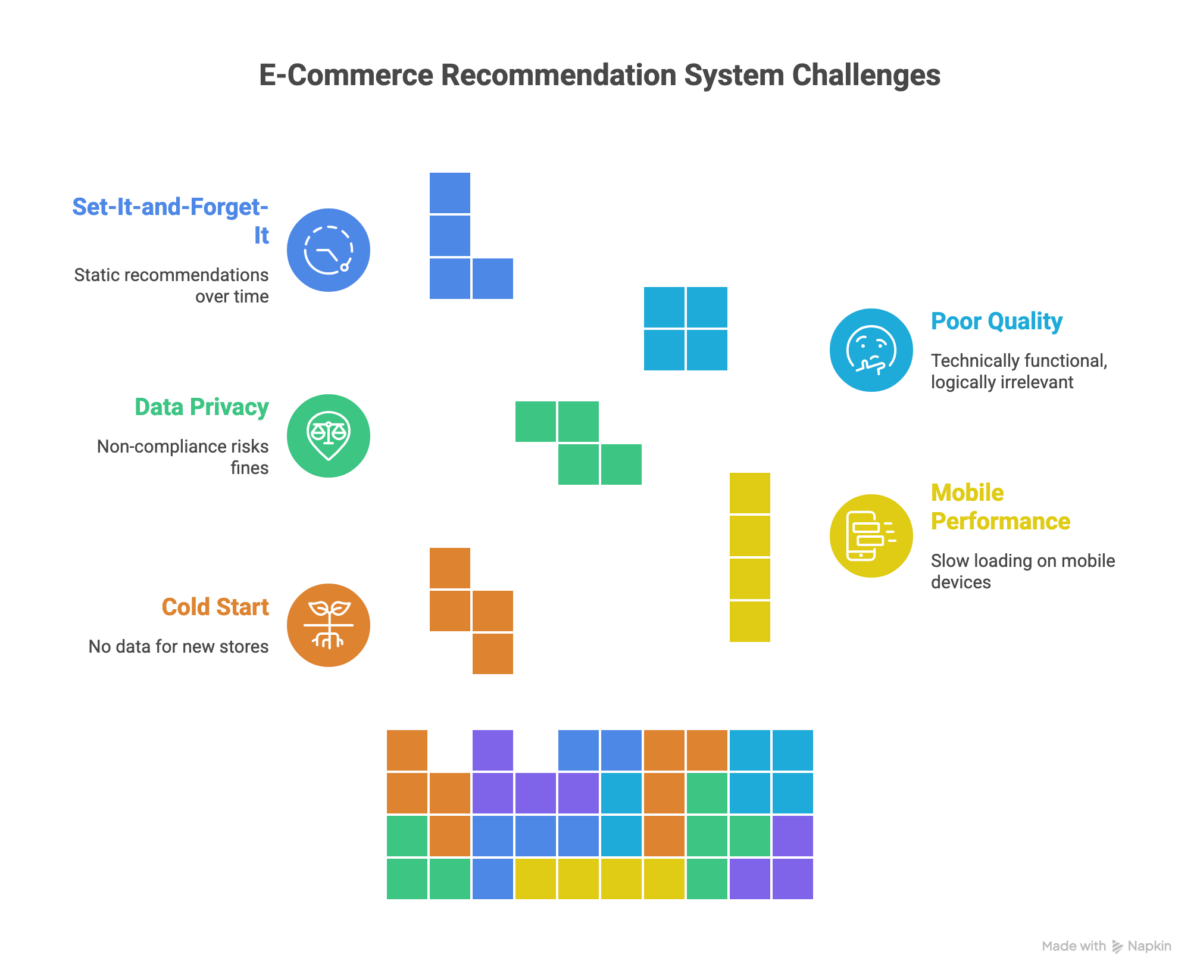
Pitfall 1: The Cold Start Problem
Issue: New stores without behavioral data produce irrelevant recommendations.
Solution: Start with content-based filtering, transition to collaborative filtering as data grows. Hybrid systems handle this automatically.
Pitfall 2: Mobile Performance Issues
Issue: Slow-loading widgets on mobile.
Solution: Lazy loading, optimized images, reduced mobile product count, and regional performance testing.
Pitfall 3: Data Privacy Non-Compliance
Issue: Tracking without GDPR/PDPL compliance risks fines.
Solution: Cookie consent, updated privacy policies, data anonymization, compliance-built systems.
Critical: Non-compliance can result in fines up to €20M or 4% of annual revenue.
Pitfall 4: Poor Recommendation Quality
Issue: Technically functional but logically irrelevant recommendations.
Solution: Regular audits, category boundaries, manual overrides, continuous refinement.
Pitfall 5: Set-It-and-Forget-It
Issue: Static recommendations as your store evolves.
Solution: Monthly reviews, seasonal optimization, continuous A/B testing, and algorithm retraining.
Warning: Start with 1-2 high-traffic pages, gather data for 2 weeks, then expand.
Conclusion
The evidence is clear: AI product recommendations increase average order value by 20-30% within 90 days. While most stores still rely on generic suggestions, early adopters are capturing significant market share through intelligent personalization.
The math is simple. A store doing $30,000 monthly with a 20% AOV increase gains $6,000 per month. Wait three months, and that’s $18,000 left on the table.
FAQ
Will AI product recommendation work for my small product catalog?
Yes. Stores with 20+ products benefit from content-based recommendations immediately. For catalogs under 50 products, we use hybrid approaches that don't require extensive behavioral data.
Do I need technical skills to manage this?
No. Once implemented, the AI runs automatically. You'll get a dashboard to monitor performance, but no coding or technical maintenance is required. We handle all technical aspects.
What if my store doesn't have many orders yet?
New stores use content-based filtering (matching by product attributes) rather than behavioral patterns. This works from day one without requiring purchase history.
What's the difference between AI product recommendation and basic "related products"?
Basic "related products" show items from the same category randomly. AI recommendations analyze individual customer behavior, purchase patterns, and product attributes to show items they're most likely to buy—resulting in 3-5x higher conversion rates.

Related Articles