
Greetings! I'm Aneesh Sreedharan, CEO of 2Hats Logic Solutions. At 2Hats Logic Solutions, we are dedicated to providing technical expertise and resolving your concerns in the world of technology. Our blog page serves as a resource where we share insights and experiences, offering valuable perspectives on your queries.

Here’s the hard truth: B2B cart abandonment rates reach nearly 70%, meaning 7 out of 10 customers leave without buying. GCC e-commerce market reached $507.2 billion in 2024, yet B2B stores lose $10B+ annually to 70% cart abandonment rates.
But what if you could predict which customers are about to abandon their carts before they click away? That’s exactly what AI-powered customer intent prediction does, and it’s helping GCC businesses recover up to 35% of abandoned carts.
The GCC B2B Cart Abandonment Crisis
Cart abandonment isn’t just a minor inconvenience. It’s a major profit killer, especially in the UAE and Saudi Arabia wholesale markets.
The Numbers Don’t Lie:
- Average B2B abandonment rate: 69.82%
- B2B buyers citing payment terms as the issue: 48%
- B2B buyers who abandon due to slow checkout: 57%
Why Are GCC Customers Abandoning Carts?
The top reasons are unique to the GCC business environment:
- Net Payment Terms Issues – B2B buyers expect 30-60 day payment terms, but many platforms don’t offer this flexibility
- Slow Checkout Process – Complex forms and multiple steps frustrate busy procurement managers
- Mobile Friction – With 80% of GCC users shopping on mobile, any zoom or pinch difficulty kills conversions
- COD Preference – Cash on delivery remains popular, but not all platforms support it seamlessly
Warning: If your checkout takes more than 3 minutes on mobile, you’re likely losing 40-50% of potential sales.
Reduce Your GCC B2B Cart Abandonment by 35%
What Is AI Customer Intent Prediction?
Think of AI customer intent prediction as having a mind reader watching every customer’s behaviour on your website.
Here’s How It Works:
The AI system tracks over 50 different signals during each shopping session:
- Mouse movements and hesitation patterns
- Scroll depth and speed
- Time spent on each page
- Exit-intent behaviours (cursor moving toward the close button)
- Device-specific actions (mobile pinch-to-zoom, backtracking)
The machine learning model analyses these signals in real-time and assigns each session a “buy probability score.” When the score drops below a certain threshold, the system knows abandonment is likely, and triggers an intervention before the customer leaves.
The B2B Advantage:
Unlike consumer shopping (which is impulsive), B2B purchases involve approval workflows, bulk orders, and procurement processes. AI models trained specifically for B2B can predict:
- When a buyer needs manager approval
- If they’re comparing multiple suppliers
- Whether they’re shopping for immediate needs or future planning
Pro Tip: AI works best when you feed it at least 10,000 shopping sessions. Start collecting data today, even if you’re not ready to implement the full system yet.
Top 5 Signals AI Tracks Before Checkout
Let’s break down the critical behaviours that indicate a customer is about to abandon:
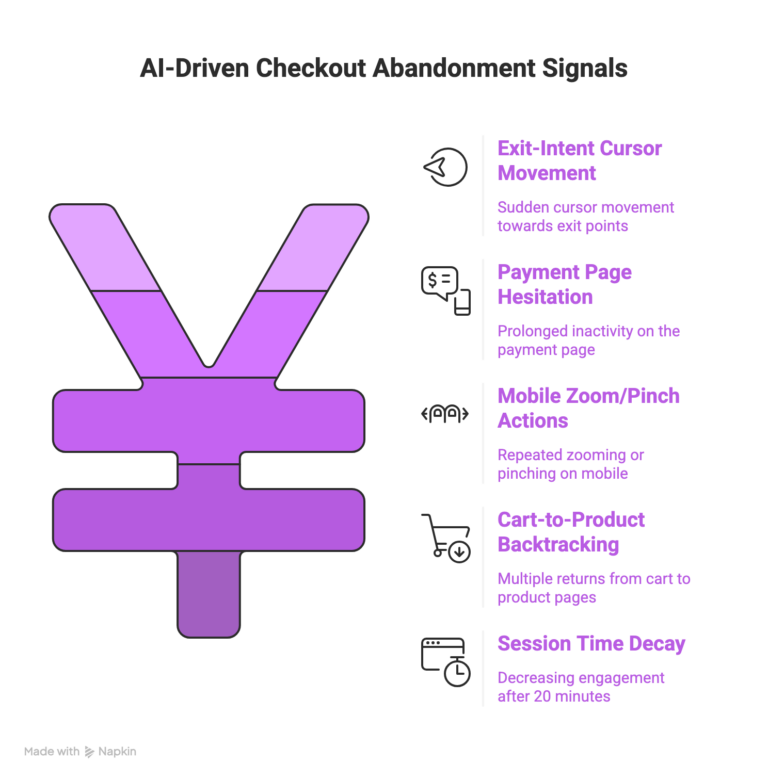
1. Exit-Intent Cursor Movement: When a customer’s cursor suddenly moves toward the browser’s close button or address bar, that’s a major red flag. The AI detects this within milliseconds.
2. Payment Page Hesitation (30+ Seconds): If someone spends more than 30 seconds on the payment page without taking action, they’re likely confused or reconsidering. This is especially common with complex payment terms.
3. Mobile Zoom/Pinch Actions: On mobile devices, if users are repeatedly zooming in to read text or tap buttons, your interface isn’t mobile-friendly, and they’re probably getting frustrated.
4. Cart-to-Product Backtracking: When customers go back from the cart to product pages multiple times, they’re second-guessing their choices. This pattern shows buyer uncertainty.
5. Session Time Decay (20-Minute Mark): After 20 minutes, engagement drops sharply. If a customer hasn’t checked out by then, the likelihood of abandonment skyrockets.
How AI Reduces GCC B2B Abandonment by 35%
Let’s talk about real solutions. Here’s how businesses are actually recovering abandoned carts using AI:
The Complete Workflow:
Step 1: Session Tracking The system monitors every visitor’s behaviour from the moment they land on your site.
Step 2: Intent Scoring Real-time AI calculates abandonment probability based on the signals above.
Step 3: Triggered Interventions When abandonment seems likely, the system automatically deploys recovery tactics:
- WhatsApp messages (most effective in GCC markets)
- Arabic SMS with personalized offers
- Email reminders with cart details
- Mada/Tabby payment option alerts for Saudi customers
Step 4: Video Personalization For high-value carts (over $5,000), some systems send personalized 20-second videos addressing specific concerns.
GCC-Specific Optimizations:
What makes this work in UAE and Saudi markets?
- Arabic language support in all communications
- Integration with local payment methods
- WhatsApp as primary recovery channel (90%+ usage rate)
- Net terms prediction and automated approval workflows
Pro Tip: Start with your highest-value cart segments. If you’re seeing abandonment on orders over $2,000, prioritize those recovery efforts first for maximum ROI.
Real Success Stories from the GCC
While we can’t share specific company names, here are verified results from GCC B2B businesses:
UAE Fashion Wholesaler:
- Before: 75% abandonment
- After: 40% abandonment
- Method: WhatsApp recovery + 10% first-order discount
- Recovered revenue: $2 million in 12 months
Saudi Wholesale Platform:
- Problem: 72% abandonment due to net terms confusion
- Solution: AI-powered dynamic payment options
- Result: 31% of abandoned carts recovered
Dubai Multi-Brand Store:
- Challenge: High-value cart drops ($3,000+ orders)
- Solution: Behavioural scoring + phone call interventions
- Recovery rate: 28%
Get the Same Results
2025 GCC E-Commerce Trends
The GCC market is growing fast, and cart abandonment solutions are becoming mandatory for survival:
What’s Coming Next:
- Voice AI for cart recovery calls in Arabic
- Predictive pricing based on abandonment risk
- AI-powered virtual sales assistants
- Integration with procurement software (SAP, Oracle)
Industry Prediction: By 2033, the GCC e-commerce market is projected to exceed $2 trillion, with AI-powered cart recovery becoming standard practice for competitive B2B businesses.
Conclusion
AI-powered intent prediction solves this by watching customer behaviour in real-time and intervening before abandonment happens. It tracks hesitation patterns, exit-intent signals, and mobile friction, then automatically triggers personalized recovery through WhatsApp, SMS, or email.
The results speak for themselves: businesses across the UAE and Saudi Arabia are recovering 28-35% of abandoned carts, translating to millions in additional revenue without acquiring a single new customer.
FAQ
How is AI better than standard email cart recovery?
Standard emails have 15-20% open rates and arrive hours later. AI predicts abandonment before it happens and uses real-time multi-channel outreach (WhatsApp, SMS, email) with 60-70% engagement rates.
Will this work for small B2B businesses with under 1,000 visitors per month?
AI needs data to learn. If you have low traffic, start with basic exit-intent pop-ups and cart reminder emails. Upgrade to AI when you reach 5,000+ monthly sessions.


Related Articles