
Greetings! I'm Aneesh Sreedharan, CEO of 2Hats Logic Solutions. At 2Hats Logic Solutions, we are dedicated to providing technical expertise and resolving your concerns in the world of technology. Our blog page serves as a resource where we share insights and experiences, offering valuable perspectives on your queries.

Many businesses still receive customer orders through emails, PDFs, and faxes. While these channels are familiar, manually reading each order and entering the details into an ERP system is time-consuming and prone to errors.
AI order data extraction solves this problem by automatically capturing order information from unstructured documents like emails, PDF files, and fax orders. Using technologies such as OCR and machine learning, AI converts this data into a structured format that can be directly integrated with any ERP system.
This helps businesses process orders faster, reduce manual effort, and improve accuracy, especially when order volumes grow or multiple order formats are involved.
What Is AI Order Data Extraction?
AI order data extraction is the process of automatically identifying and capturing order details from unstructured sources such as emails, PDF documents, and fax orders using artificial intelligence.
Instead of manually reading each order, AI systems use OCR and machine learning models to extract key information like customer details, product names, quantities, prices, and delivery information. This data is then converted into a structured format that ERP systems can understand.
The main goal of AI order data extraction is to reduce manual data entry, minimize errors, and speed up order processing, especially for businesses that receive a high volume of orders in different formats.
Why Businesses Still Struggle with Email, PDF & Fax Orders
Despite modern ERP systems, many businesses still receive orders through emails, PDFs, and fax documents. These formats are often unstructured, making them difficult to process automatically.
Some common challenges include:
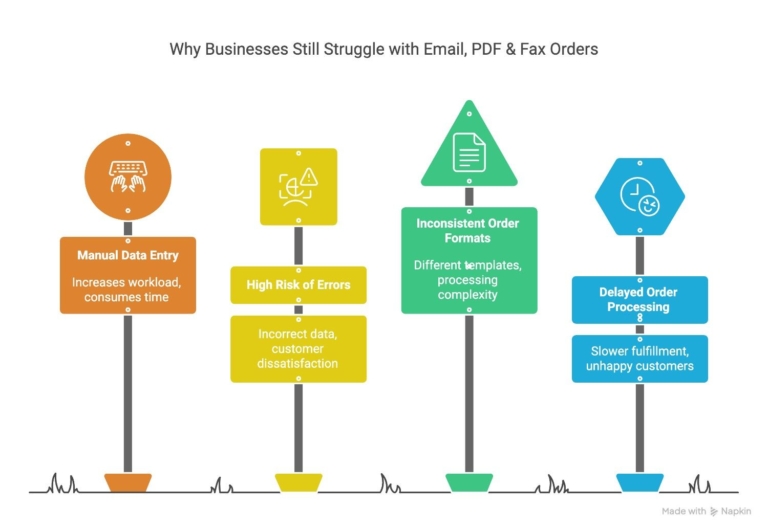
- Manual data entry, which takes time and increases operational workload
- High risk of errors, such as incorrect quantities, prices, or customer details
- Inconsistent order formats, especially when different customers use different templates
- Delayed order processing, leading to slower fulfillment and unhappy customers
How AI Extracts Order Data from Emails, PDFs & Faxes
AI uses a combination of OCR, machine learning, and pattern recognition to extract order data from unstructured documents like emails, PDFs, and fax orders.
Here’s how the process typically works:
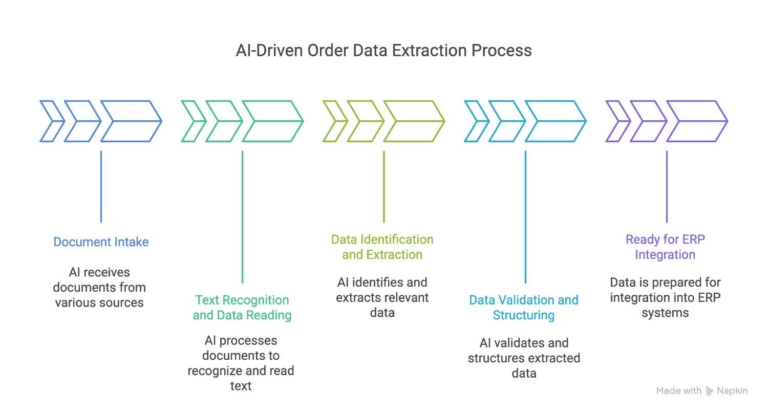
- Document intake
Orders received via email, PDF attachments, or fax are automatically captured and sent to the AI system. - Text recognition and data reading
OCR technology reads text from scanned PDFs and fax images, while AI models understand the content of emails and digital documents. - Data identification and extraction
The AI identifies key order fields such as customer name, product details, quantities, prices, and delivery information, even when formats vary. - Data validation and structuring
Extracted data is validated for accuracy and converted into a structured format that matches ERP requirements. - Ready for ERP integration
Once structured, the order data can be pushed directly into the ERP system for further processing.
This automated approach allows businesses to handle different order formats efficiently without relying on manual data entry.
How Extracted Order Data Integrates with ERP Systems
Once order data is extracted and structured, it can be seamlessly integrated into ERP systems. The AI maps the extracted fields, such as customer details, product information, quantities, and pricing, to the corresponding fields in the ERP.
Integration can happen through APIs, middleware, or custom connectors, depending on the ERP system in use. Since the data is already structured and validated, it enters the ERP as a ready-to-process order rather than raw input.
This ensures:
- Faster order creation in the ERP
- Consistent data across systems
- Reduced dependency on manual checks
- Smooth handling of high-order volumes
Because the extraction process is ERP-agnostic, businesses can use this approach with almost any ERP system without changing their existing workflows.
Key Benefits of AI Order Data Extraction for ERP Users
AI order data extraction offers clear operational and business benefits, especially for teams working closely with ERP systems.
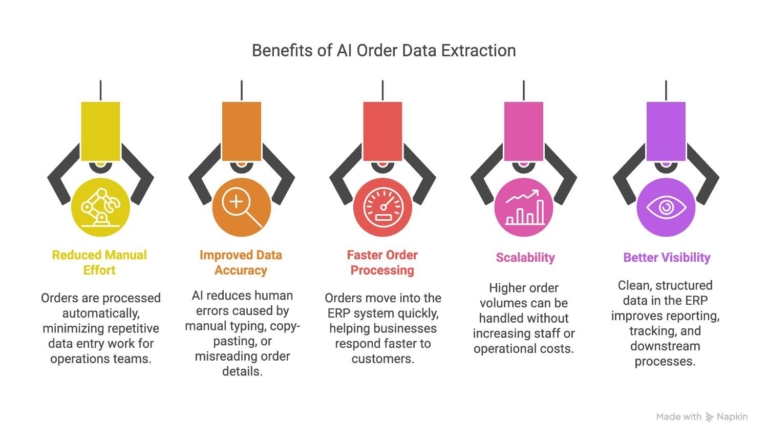
- Reduced manual effort
Orders are processed automatically, minimizing repetitive data entry work for operations teams. - Improved data accuracy
AI reduces human errors caused by manual typing, copy-pasting, or misreading order details. - Faster order processing
Orders move into the ERP system quickly, helping businesses respond faster to customers. - Scalability without extra resources
Higher order volumes can be handled without increasing staff or operational costs. - Better visibility and control
Clean, structured data in the ERP improves reporting, tracking, and downstream processes.
These benefits help businesses streamline order management while making better use of their existing ERP systems.
Common Use Cases Across Industries
AI order data extraction is useful across many industries where orders arrive in different formats and volumes.
- Manufacturing
Distributors and dealers often send purchase orders via email or PDF. AI helps extract order details and push them directly into the ERP without manual intervention. - Wholesale and distribution
Bulk orders received in varying templates can be processed faster and more accurately using AI-based extraction. - Retail and eCommerce (B2B)
B2B customers frequently place repeat orders through emails or attachments. AI ensures faster order entry and consistent data handling. - Logistics and supply chain
Order and delivery documents received via fax or scanned PDFs can be digitized and structured for ERP workflows. - Healthcare and pharmaceuticals
AI helps process structured and unstructured order documents while reducing data entry errors and delays.
AI Order Data Extraction vs Manual Order Entry
Manual order entry has been the traditional way of processing orders from emails, PDFs, and faxes. However, it becomes inefficient and prone to errors as order volumes increase.
Here’s a simple comparison:
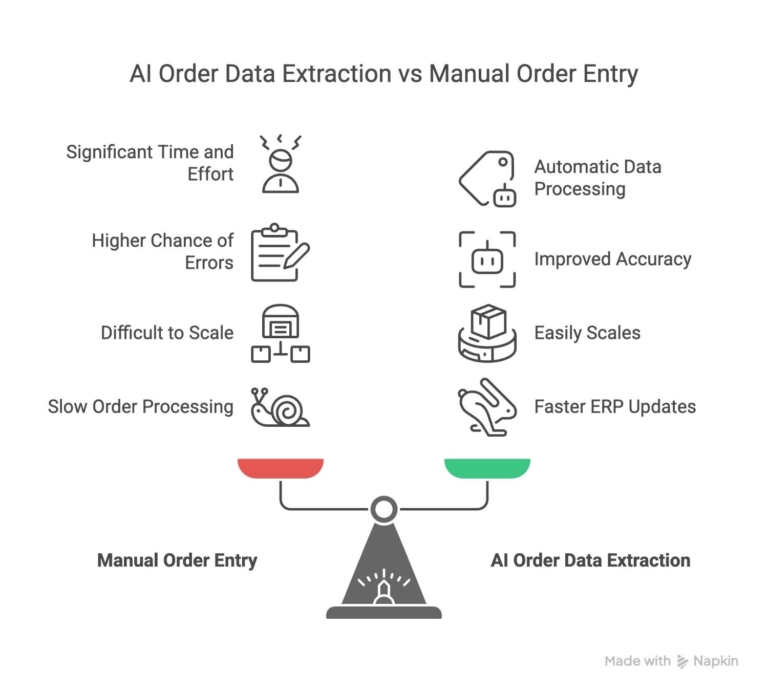
Manual Order Entry
- Requires significant time and human effort
- Higher chance of data entry errors
- Difficult to scale with growing order volumes
- Slows down order processing and fulfillment
AI Order Data Extraction
- Automatically captures and processes order data
- Improves accuracy through validation and learning
- Easily scales without adding operational staff
- Enables faster and more consistent ERP updates
For businesses aiming to improve efficiency and reduce operational bottlenecks, AI-based order data extraction is a more sustainable solution than manual processing.
Things to Consider Before Implementing AI Order Automation
Before implementing AI order data extraction, businesses should consider the following:
- Document formats and sources
Identify all types of orders for which you receive emails, PDFs, and scanned faxes, and ensure the AI solution can handle them. - ERP compatibility
Check whether the AI system can integrate with your existing ERP through APIs, middleware, or connectors. - Data accuracy and validation
Understand how the AI validates extracted data and handles exceptions to minimize errors. - Security and compliance
Ensure sensitive customer and order data is protected and complies with relevant regulations. - Scalability and flexibility
Choose a solution that can grow with your order volume and adapt to new formats or business changes.
Considering these factors will help businesses implement AI order automation effectively and maximize its benefits.
Conclusion
AI order data extraction is transforming the way businesses handle orders from emails, PDFs, and faxes. By automating the capture and processing of order details, companies can reduce manual effort, minimize errors, and speed up order processing, all while seamlessly integrating with their ERP systems.
For businesses facing growing order volumes or multiple order formats, implementing AI-driven order extraction is a practical and scalable solution. It not only streamlines operations but also frees up teams to focus on more strategic tasks, improving efficiency and overall business performance.
FAQ
Can AI extract order data from unstructured PDFs and emails?
Yes. AI uses OCR and machine learning to read unstructured PDFs, scanned faxes, and emails, extracting key details like customer info, products, quantities, and prices.
Will AI work with my existing ERP system?
Most AI order extraction solutions are ERP-agnostic and can integrate via APIs, middleware, or custom connectors without changing your current workflows.
How accurate is AI order data extraction?
AI significantly reduces errors compared to manual entry. Accuracy improves over time as the system learns from exceptions and corrections.
Can AI handle large volumes of orders?
Yes. AI scales easily, processing hundreds or thousands of orders daily without adding extra staff.
Is it secure to process customer order data with AI?
Reputable AI solutions use encryption and comply with data protection regulations to ensure customer information stays secure.
Table of contents
- What Is AI Order Data Extraction?
- Why Businesses Still Struggle with Email, PDF & Fax Orders
- How AI Extracts Order Data from Emails, PDFs & Faxes
- How Extracted Order Data Integrates with ERP Systems
- Key Benefits of AI Order Data Extraction for ERP Users
- Common Use Cases Across Industries
- AI Order Data Extraction vs Manual Order Entry
- Things to Consider Before Implementing AI Order Automation
- Conclusion


Related Articles