
Greetings! I'm Aneesh Sreedharan, CEO of 2Hats Logic Solutions. At 2Hats Logic Solutions, we are dedicated to providing technical expertise and resolving your concerns in the world of technology. Our blog page serves as a resource where we share insights and experiences, offering valuable perspectives on your queries.
You’ve got repetitive tasks piling up. Your team is spending hours on work that should take minutes, processing orders, extracting data from supplier emails, updating ERP records, and chasing invoice approvals. You know automation is the answer. But which one?
A quick search yields three options: traditional automation, RPA, and now agentic AI. Each promises to save time, cut costs, and free your team to focus on higher-value work. Each also comes with its own learning curve, implementation complexity, and price tag.
And here’s where most businesses get stuck. It is not because the technology is too complex, but because nobody clearly explains what each solution actually does, where it works, and, more importantly, where it breaks down.
Traditional automation handles simple, rule-based triggers. RPA takes that further by mimicking human interactions across software systems. Agentic AI goes a step beyond. It doesn’t just execute tasks; it reasons, adapts, and makes decisions. Three different tools, three different levels of capability, and very different ROI depending on what your business actually needs.
If you’re running an e-commerce operation on Shopware, managing ERP workflows on Microsoft Dynamics 365 Business Central, or simply trying to reduce the manual load on your team, choosing the wrong automation approach doesn’t just waste budget. It creates technical debt, frustrated employees, and processes that break the moment something changes.
This guide cuts through the noise. We’ll break down exactly what each solution does, compare them side by side, and help you identify which one or which combination fits where your business is right now.
And if you need help making that call, we’ve got you covered on that, too.
Not sure which automation approach fits your business processes?
What Is Traditional Automation?
Traditional automation is the oldest and simplest form of process automation. At its core, it refers to using software tools, scripts, or rule-based systems to execute a predefined set of actions, without any human involvement, once the rules are set.
Think of it as an “if this, then that” logic. If an order is placed, send a confirmation email. If a form is submitted, create a database entry. If inventory drops below a threshold, trigger a restock alert. This is just a reliable and consistent execution of a fixed workflow.
Traditional automation has been around for decades and remains the backbone of many business operations today. It powers scheduled reports, automated email responses, batch data transfers, and basic system integrations. Tools like Zapier, Make (formerly Integromat), and basic scripting in platforms like Shopware or ERP systems fall broadly into this category.
Where It Works Well
Traditional automation thrives in environments where processes are
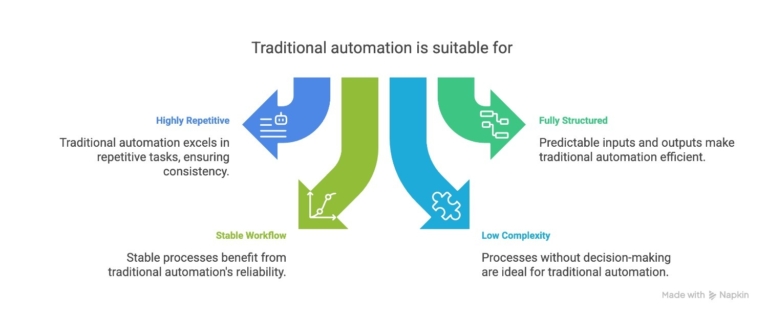
- Highly repetitive with little to no variation
- Fully structured with predictable inputs and outputs
- Stable, meaning the workflow rarely changes
- Low complexity means no decision-making or exceptions required
For example, automatically syncing new customer data from your e-commerce store to your ERP system every night is a perfect use case for traditional automation. The process is predictable, the data is structured, and nothing unexpected needs to be handled.
Where It Falls Short
The moment your process involves variability, exceptions, or unstructured inputs, traditional automation hits a wall. It cannot read a supplier email and extract the relevant order details. It cannot handle a document that arrives in a slightly different format than expected. It cannot make a judgment call when something falls outside the predefined rules.
It simply stops, or worse, silently produces incorrect outputs until a human steps in to fix it.
This rigidity is why many businesses that started with traditional automation eventually found themselves needing something more capable. That’s where RPA entered the picture.
What Is Agentic AI?
Agentic AI represents the next evolution in business process automation. Unlike RPA or traditional automation, Agentic AI doesn’t just execute predefined steps — it reasons, plans, and makes autonomous decisions to achieve a goal with minimal human intervention.
Think of it as the difference between a bot that follows a script and an intelligent agent that understands context, handles exceptions, and adapts when something unexpected happens.
What makes Agentic AI different:
- Goal-driven: Give it an outcome, not a set of instructions
- Context-aware: Understands unstructured data, emails, PDFs, and scanned documents
- Adaptive: Adjusts when processes change without requiring manual reprogramming
- Decision-making: Evaluates options and acts intelligently within defined boundaries
Where Agentic AI excels:
Agentic process automation is particularly powerful for workflows that involve unstructured data, multi-step decision-making, and cross-system coordination. For example, processing a supplier email, extracting order details, validating them against ERP records, and flagging discrepancies — all autonomously. This is exactly where email-to-ERP automation powered by Agentic AI delivers measurable ROI for e-commerce and ERP-driven businesses.
While still maturing, Agentic AI is already delivering real results for businesses running complex operations on platforms like Shopware and Microsoft Dynamics 365 Business Central.
When to Use Each Solution
Choosing between Agentic AI, RPA, and traditional automation comes down to one question: how complex and variable is your process?
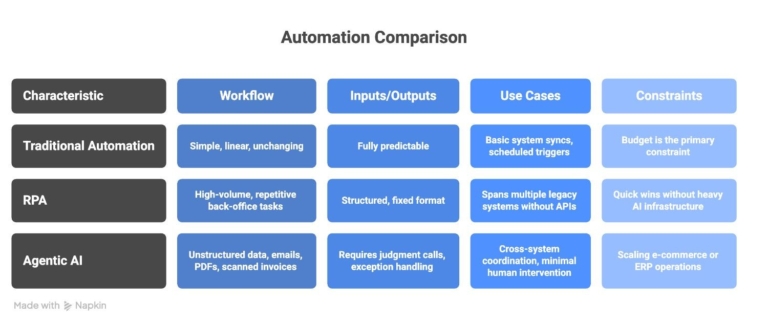
Use Traditional Automation when:
- Your workflow is simple, linear, and never changes
- Inputs and outputs are fully predictable
- You need basic system syncs or scheduled triggers
- Budget is the primary constraint
Use RPA when:
- You have high-volume, repetitive back-office tasks
- Processes span multiple legacy systems without APIs
- Data is structured and follows a fixed format
- You need quick wins without heavy AI infrastructure
Use Agentic AI when:
- Workflows involve unstructured data, emails, PDFs, and scanned invoices
- Processes require judgment calls or exception handling
- You need cross-system coordination with minimal human intervention
- You’re running e-commerce or ERP operations that scale rapidly
The honest reality: Many businesses actually need more than one. A Shopware merchant processing hundreds of daily orders may use traditional automation for inventory sync, RPA for structured invoice processing, and Agentic AI for handling supplier emails and ERP updates, all running in parallel.
Planning to automate your business processes but unsure where to start?
Real-World Use Cases: E-commerce and ERP Scenarios
Here’s how all three automation approaches play out in real business scenarios relevant to e-commerce and ERP operations.
Scenario 1: Order Processing on Shopware
- Traditional automation triggers a confirmation email when an order is placed.
- RPA extracts structured order data and pushes it into the ERP system.
- Agentic AI handles exceptions like incomplete orders, mismatched SKUs, or supplier delays, autonomously resolving or escalating based on context.
Scenario 2: Email-to-ERP Automation
- Traditional automation flags incoming supplier emails into a folder.
- RPA processes fixed-format purchase orders from those emails.
- Agentic AI reads unstructured supplier emails, extracts relevant data, validates against Microsoft Dynamics 365 Business Central records, and updates inventory, all without human intervention.
Scenario 3: Invoice Processing
- Traditional automation routes invoices to the correct department.
- RPA extracts data from standardized invoice templates.
- Agentic AI handles variable invoice formats, identifies discrepancies, cross-references ERP data, and flags anomalies for review.
Can They Work Together? The Case for Hybrid Automation
The Agentic AI vs. RPA debate isn’t really about picking a winner. It’s about understanding where each technology delivers the most value and building a hybrid automation strategy around that.
A practical hybrid model looks like this:
- Traditional automation handles simple, scheduled triggers like inventory updates, confirmation emails, and basic data syncs.
- RPA manages structured, high-volume back-office tasks like fixed-format invoice processing, legacy system data entry, and report generation.
- Agentic AI takes on the complex, dynamic layer, including reading supplier emails, extracting unstructured data, making decisions, and coordinating across ERP and e-commerce systems autonomously.
This layered approach gives businesses the reliability of rule-based automation, where processes are stable, and the intelligence of Agentic AI, where flexibility is needed.
For e-commerce businesses on Shopware or teams running Microsoft Dynamics 365 Business Central, a hybrid model isn’t just smart. It’s the most cost-effective path to full intelligent automation without ripping out existing infrastructure.
How to Choose the Right Automation Solution for Your Business
There’s no universal answer. The right automation solution depends on where your business is today and where you’re headed.
Start by asking these questions:
- What does your data look like? Structured and predictable → RPA or traditional automation. Unstructured and variable → Agentic AI
- How often do your processes change? Stable workflows → RPA. Frequently evolving → Agentic AI
- What’s your current infrastructure? Legacy systems with no APIs → RPA. Modern ERP and e-commerce stack → Agentic AI or hybrid
- What’s your automation goal? Quick wins on repetitive tasks → RPA. Long-term intelligent automation → Agentic AI
The biggest mistake businesses make is over-investing in RPA for processes that are too dynamic for it, then spending more fixing broken bots than they saved automating in the first place.
The Agentic AI vs RPA conversation ultimately isn’t about which technology wins. It’s about which combination moves your business forward without unnecessary complexity or wasted investment.
Start with your process. Understand your data. Then choose your tool or, better yet, work with experts to implement all three across real e-commerce and ERP environments.
At 2Hats Logic, that’s exactly what we do to help businesses cut through the noise and implement automation that actually works.
FAQ
What is the difference between Agentic AI, RPA, and traditional automation?
Traditional automation follows fixed rules inside systems. RPA (Robotic Process Automation) handles repetitive, rule-based tasks like data entry. Agentic AI goes further by enabling intelligent process automation with decision-making, goal-based execution, and adaptive workflows.
When should a business choose Agentic AI instead of RPA?
Businesses should choose RPA for structured, repetitive processes with clear rules. Agentic AI solutions are better suited for complex business process automation that requires autonomous decision-making, workflow orchestration, and coordination across multiple systems.
Can Agentic AI work alongside RPA and traditional automation?
Yes, many organizations adopt a hybrid automation strategy that combines rule-based automation, robotic process automation, and AI-powered agents to achieve scalable digital transformation and operational efficiency.


Related Articles