Greetings! I'm Aneesh Sreedharan, CEO of 2Hats Logic Solutions. At 2Hats Logic Solutions, we are dedicated to providing technical expertise and resolving your concerns in the world of technology. Our blog page serves as a resource where we share insights and experiences, offering valuable perspectives on your queries.

Choosing between Shopify and Shopware is no longer just about features or pricing.
For businesses in Germany, the decision-making process is more complex: data control, GDPR compliance, and AI capabilities all play a major role.
At the same time, AI is changing how e-commerce works:
- Personalized shopping experiences
- Automated customer support
- Smarter product recommendations
So the real question is no longer
“Which platform is better?”
It’s
“Which platform is better for AI-driven growth in the German market?”
This guide breaks that down in simple terms, so you can decide what actually fits your business.
Shopify vs Shopware: Quick Overview
Here’s a simple way to understand the difference between Shopify and Shopware:
- Shopify → Ready-to-use, fast setup, less technical effort
- Shopware → Flexible, customizable, built for complex business needs
Quick Comparison
| Aspect | Shopify | Shopware |
| Setup | Very easy, quick launch | Requires development effort |
| AI Usage | Built-in tools + apps | Custom integrations via APIs |
| Flexibility | Limited | High |
| Best For | D2C, small- to mid-size stores | B2B, complex and scaling businesses |
| Data Control | Limited | Strong (important for Germany) |
| Customization | App-based | Fully customizable |
What this means in real terms
- With Shopify, you can:
- Launch quickly
- Use AI features without much setup
- Manage your store without deep technical knowledge
- With Shopware, you can:
- Build exactly what your business needs
- Integrate AI into your workflows (ERP, PIM, etc.)
- Have better control over data and infrastructure
Quick decision hint
- If your priority is speed and simplicity → Shopify
- If your priority is control and scalability → Shopware
Why AI Matters in Modern E-commerce
AI is no longer a “nice-to-have” in e-commerce, it’s quickly becoming a core part of how online stores grow, compete, and retain customers.
For businesses choosing between Shopify and Shopware, the real question is:
How effectively can this platform help me use AI in my daily operations?
Want to see how AI can actually work in your store setup? Let’s break it down.
What AI actually does in E-commerce (practical view)
Instead of thinking of AI as something complex, think of it as automation + smarter decision-making.
Here’s where it directly impacts your store:
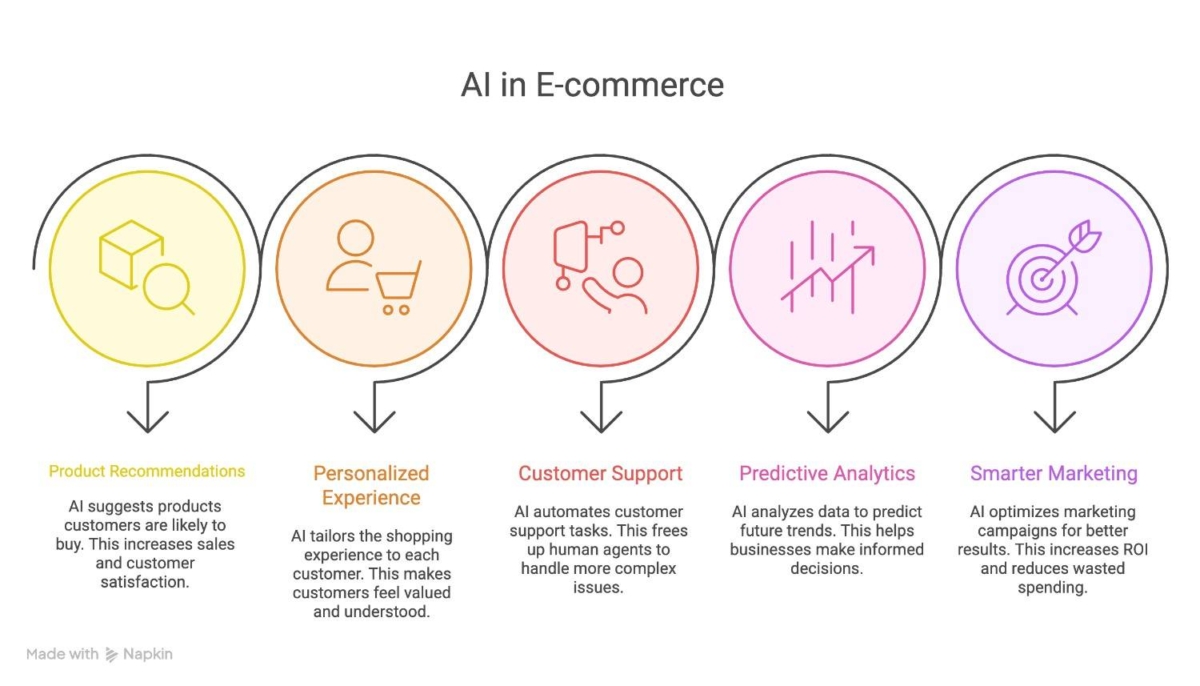
1. Product Recommendations that Convert
AI analyzes customer behavior (clicks, purchases, browsing patterns) to:
- Show relevant products
- Increase average order value
- Improve conversion rates
This is what you see as “You may also like” or “Recommended for you.”
2. Personalized Shopping Experience
AI helps tailor the store experience for each user:
- Dynamic homepage content
- Personalized offers
- Targeted emails
Instead of one generic store, every user gets a slightly different experience.
3. Customer Support Automation
AI-powered chatbots and assistants can:
- Answer common queries instantly
- Reduce support workload
- Improve response time
Especially useful for stores handling large volumes of inquiries.
4. Predictive Analytics
AI can help answer questions like the following:
- Which products will sell more next month?
- Which customers are likely to churn?
- When should you restock?
This helps in better planning and fewer missed opportunities.
5. Smarter Marketing Decisions
AI tools can:
- Optimize ad targeting
- Improve email campaigns
- Suggest better pricing strategies
Less guesswork, more data-driven decisions.
Why this matter more in the German market
For German businesses, AI is not just about growth, it’s also about how data is handled.
- Customer data usage must align with strict GDPR expectations
- Businesses often need more control over how AI tools access and process data
- Many companies rely on ERP and PIM systems, which need to work seamlessly with AI
This is where platform choice becomes critical.
The real difference comes down to this
Both Shopify and Shopware support AI, but in very different ways:
- One focuses on ease and speed
- The other focuses on flexibility and control
And that difference directly impacts:
- How you implement AI
- How far can you scale it
- How well does it fit your business model
How Does Shopify Support AI in E-commerce?
Shopify makes AI accessible by focusing on ease of use and ready-to-deploy tools. You don’t need a technical team to start using AI; it’s mostly built in or available through apps.
Quick Answer
Shopify is strong for AI if you want a quick setup and minimal complexity. But it can feel limiting if you need deep customization or full control over how AI works.
1. Built-in AI Features (Out of the Box)
Shopify has been actively adding native AI tools, such as:
- AI-generated product descriptions
- Email and marketing content suggestions
- Basic automation for store management
This helps merchants:
- Save time on repetitive tasks
- Launch campaigns faster
- Maintain consistency in content
2. Shopify Magic & Sidekick
Shopify is pushing AI further with tools like:
- Shopify Magic → Assists with content generation and store tasks
- Sidekick → An AI assistant that helps manage and optimize your store
These tools are designed to:
- Simplify decision-making
- Reduce manual effort
- Make AI usable even for non-technical users
3. AI Through Apps and Integrations
A big part of Shopify’s AI strength comes from its app ecosystem.
You can easily add tools for:
- Product recommendations
- Chatbots and customer support
- Marketing automation
- Personalization
The advantage:
- Plug-and-play setup
- No need to build from scratch
The limitation:
- You’re dependent on third-party tools
- Custom workflows can be restricted
4. Ease of Use (Biggest Advantage)
This is where Shopify really stands out.
- No coding required for most AI features
- Clean interface
- Fast implementation
For many businesses, this means:
You can start using AI in days, not months.
5. Where Shopify Falls Short
To make a fair decision, it’s important to look at limitations:
- Limited control over how AI processes data
- Custom AI workflows are harder to implement
- Dependency on apps increases long-term costs
- Less flexibility for complex business models (especially B2B)
What this means in real terms
- If you want quick wins with AI, Shopify works well
- If you need deep, customized AI tied to your business systems → it may feel restrictive
Not sure which platform fits your business? Get clarity before you decide.
How Does Shopware Support AI in E-Commerce?
Shopware takes a very different approach to AI compared to Shopify.
Instead of offering mostly ready-made tools, it focuses on flexibility, customization, and deep integrations.
Quick Answer
Shopware is better for AI if you need full control, custom workflows, and scalability.
But it requires technical expertise and more setup time.
1. API-First Architecture (Foundation for AI)
One of Shopware’s biggest strengths is its API-first approach.
This means:
- You can connect external AI tools easily
- You can build custom AI workflows
- You’re not limited to built-in features
In real terms:
You’re not just using AI, you’re designing how AI works for your business.
2. Custom AI Integrations
With Shopware, AI is not limited to plugins or built-in tools.
You can integrate AI for:
- Advanced product recommendations
- Customer segmentation based on internal data
- Predictive inventory management
- Dynamic pricing models
Especially useful when:
- You already use ERP or PIM systems
- You need AI to work across multiple systems
3. Better Data Control (Important for Germany)
For businesses in Germany, data control is a major factor.
Shopware allows:
- Greater control over hosting
- More transparency in data handling
- Easier alignment with GDPR requirements
This is critical when AI depends on customer and operational data.
4. Works Well with Complex Business Models
Shopware is particularly strong for:
- B2B stores
- Multi-channel setups
- Businesses with custom pricing or workflows
AI can be integrated into these complex processes, not just surface-level features.
5. Integration with ERP and PIM Systems
Many German businesses rely heavily on:
- ERP systems
- PIM tools
Shopware makes it easier to:
- Connect these systems
- Use their data for AI-driven decisions
This leads to:
- More accurate insights
- Better automation across the business
6. Where Shopware Requires More Effort
To keep it real, Shopware is not the easiest option:
- Requires Shopware developers for setup and customization
- Longer implementation time
- Higher initial investment
But in return:
- You get long-term flexibility and scalability
What this means in real terms
- If your goal is plug-and-play AI → Shopware may feel heavy
- If your goal is building AI around your business processes → Shopware is a strong choice.
Shopware offers greater customization flexibility. Shopify is the quickest way to reach the audience easily when you are looking for an audience that must be addressed quickly.
Which Platform is Better for AI in Germany?
This is the most important question, and the answer depends on how you plan to use AI in your business.
Quick Answer
- Choose Shopify if you want fast, easy-to-use AI tools with minimal setup
- Choose Shopware if you need custom AI integrations, strong data control, and scalability for complex business needs
Choose Shopify if…
Shopify is the better option when your focus is speed, simplicity, and quick AI adoption.
Go with Shopify if:
- You want to launch quickly without heavy development
- Your team is non-technical or small
- You prefer ready-made AI tools over building custom solutions
- Your business model is simple to moderately complex (D2C or small B2B)
- You’re okay using third-party apps for AI features
In simple terms:
Shopify works best when you want AI to support your business, not define it.
Choose Shopware if…
Shopware becomes the stronger choice when AI is central to your operations, not just an add-on.
Go with Shopware if:
- You need custom AI workflows tailored to your business
- You rely on ERP, PIM, or multiple systems
- Your business model is complex (especially B2B)
- You require greater control over customer data (important for Germany)
- You’re planning for long-term scalability
In simple terms:
Shopware works best when AI needs to be deeply integrated into how your business runs.
The Real Difference (Simplified)
- Shopify → AI is easy to use, but limited in flexibility
- Shopware → AI is flexible and powerful, but requires effort
What Most German Businesses Should Consider
For the German market, the decision often leans toward:
- Shopify → when speed and simplicity matter more than control
- Shopware → when data control, compliance, and complex workflows are critical
Especially for:
- B2B businesses
- Companies with strong backend systems
- Businesses planning long-term AI adoption
Final Decision Hint
If you’re still unsure, ask yourself:
- Do I want to use AI quickly → go with Shopify
- Do I want to build AI around my business processes → go with Shopware
Final Thoughts
Choosing between Shopify and Shopware isn’t about picking the “better” platform; it’s about choosing what fits your business today and where you want to go next.
If your priority is speed, simplicity, and quick AI adoption, Shopify gives you a faster path to get started.
If your focus is flexibility, data control, and building AI into your core operations, Shopware offers more room to grow, especially in the German market.
The key is to look beyond features and think in terms of the following:
- How AI will be used in your business
- How your systems will evolve
- How much control do you need over your data and workflows
If you’re still evaluating the right direction, it helps to look at real implementation scenarios. Whether you’re exploring Shopify development for faster go-to-market or considering Shopware development for more customized and scalable solutions, the right approach depends on your specific business requirements, not just the platform itself. Taking the time to make this decision carefully now can save significant effort and rework later.
FAQ
Which is better for the German market: Shopify or Shopware?
Shopware is often better for German businesses due to its flexibility, data control, and ability to handle complex B2B requirements. Shopify works well for simpler setups and faster launches.
Which platform is better for AI in eCommerce?
Shopify offers built-in AI tools that are easy to use, while Shopware allows more advanced and custom AI integrations. The right choice depends on how much control and customization you need.
Is Shopware better for GDPR compliance?
Yes, Shopware provides more control over data hosting and management, which makes it easier to align with strict GDPR requirements common in Germany.
Can Shopify handle advanced AI integrations?
Shopify supports AI through apps and built-in tools, but it has limitations when it comes to highly customized AI workflows compared to Shopware.
Should I choose Shopify or Shopware for a B2B business in Germany?
Shopware is generally a better fit for B2B businesses due to its flexibility in pricing, workflows, and integrations with ERP and PIM systems.
Is Shopify easier to use than Shopware?
Yes, Shopify is easier to set up and manage, especially for non-technical users. Shopware requires more technical expertise but offers greater flexibility.


Related Articles