
Greetings! I'm Aneesh Sreedharan, CEO of 2Hats Logic Solutions. At 2Hats Logic Solutions, we are dedicated to providing technical expertise and resolving your concerns in the world of technology. Our blog page serves as a resource where we share insights and experiences, offering valuable perspectives on your queries.

Ever feel like your policy administration team is drowning in paperwork?
Insurance executives tell us the same story: mountains of policy documents, endless manual data entry, compliance headaches that never sleep, and customers frustrated by slow processing times.
Here’s the thing: while your team works overtime reviewing documents and fixing errors, your competitors are processing policies in minutes using Intelligent Document Processing (IDP).
Let me walk you through exactly how IDP transforms insurance policy administration, with real numbers, practical examples, and a roadmap you can follow starting today.
What Is Intelligent Document Processing in Insurance?
Intelligent Document Processing combines OCR (Optical Character Recognition), Natural Language Processing (NLP), and Machine Learning to automatically read, understand, and process insurance documents.
Think of it as having a super-smart assistant who never gets tired, never makes typos, and can read 1,000 policy documents while you grab coffee.
Unlike traditional OCR, which just scans text, IDP understands context.
It knows the difference between a policy endorsement and a claims form. It extracts the policyholder’s name, coverage limits, and effective dates, then automatically routes everything to the right system.
Real-world example: A mid-sized insurer in Dubai was processing 500 policy renewals daily. Manual entry took 8-10 minutes per policy. After implementing IDP, processing time dropped to 90 seconds per policy with 98% accuracy.
That’s not incremental improvement. That’s transformation.
The Hidden Costs of Manual Policy Administration
Before we dive into IDP benefits, let’s talk about what manual processing is really costing you.
Time drain: Your underwriters spend 40-60% of their time on data entry instead of risk assessment.
Error rates: Manual processing typically has 3-5% error rates. On 10,000 annual policies, that’s 300-500 mistakes requiring rework.
Compliance risks: NAIC and GDPR violations can cost millions. Manual processes make audit trails messy and compliance verification slow.
Customer satisfaction: In 2026, customers expect instant quotes and same-day policy issuance. Manual processing means you’re losing deals to faster competitors.
According to McKinsey, insurers using automation see 30-50% cost reductions in policy administration within 18 months.
Your manual processes aren’t just slow, they’re expensive.
Core Benefits of IDP for Insurance Policy Administration
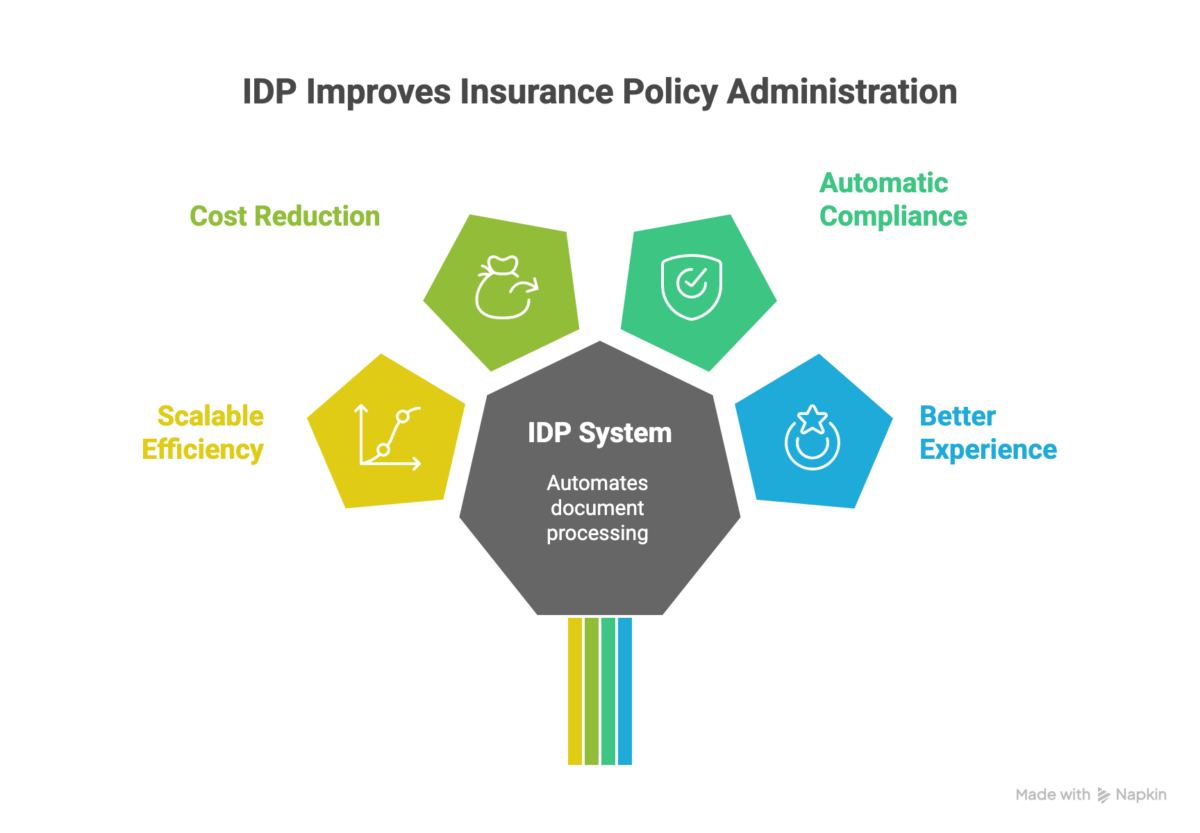
1. Efficiency That Scales
IDP processes documents 10-15x faster than manual teams.
A policy that took 10 minutes now takes under a minute. An endorsement that required three people and two days? Done in hours, automatically.
What this means for you: Your team handles volume spikes during renewal season without hiring temporary staff or paying overtime.
2. Cost Reductions You Can Take to the Board
Industry data shows a 30-50% cost reduction in document processing operations.
Here’s the math: If you process 50,000 policies annually at $8 per policy in labor costs, that’s $400,000. Cut that by 40%, and you’re saving $160,000 yearly, plus avoiding error-correction costs.
3. Compliance Becomes Automatic
IDP systems maintain complete audit trails for NAIC, GDPR, and regional regulations.
Every document extraction, validation, and approval gets timestamped and logged. When auditors come knocking, you show them clean, searchable records instead of file cabinets.
4. Customer Experience That Wins Business
Same-day policy issuance. Instant endorsement processing. Real-time renewal confirmations.
Your customers don’t care about your backend systems. They care about speed and accuracy. IDP delivers both.
Comparison: Manual vs. IDP Processing
| Process | Manual Processing Time | IDP Processing Time |
| Policy Issuance | 2-3 days | 2-4 hours |
| Endorsement Updates | 1-2 days | 15-30 minutes |
| Renewal Processing | 5-7 days | Same day |
| Claims Document Verification | 3-5 days | 4-6 hours |
Let's talk about your policy administration challenges.
Key Use Cases: Where IDP Makes the Biggest Impact
Policy Issuance and New Business Onboarding
New policy applications come with dozens of supporting documents, identification, property inspections, medical records, and financial statements.
IDP extracts all relevant data automatically, validates it against underwriting rules, and populates your policy administration system.
Example: A property insurer reduced new business onboarding from 5 days to 8 hours using IDP to process property valuations, title documents, and inspection reports.
Endorsements and Mid-Term Changes
Policy changes, adding drivers, updating coverage limits, changing beneficiaries, and generating paperwork.
IDP reads endorsement requests, identifies what’s changing, validates the information, and updates the policy record without human intervention.
Underwriting and KYC Verification
Underwriters need to verify identity documents, financial records, and third-party reports.
IDP extracts data from passports, driver’s licenses, bank statements, and credit reports, then cross-references everything against KYC databases and sanction lists.
Claims Processing Integration
When claims arrive, IDP extracts policy numbers, incident details, supporting documents, and injury reports, then routes everything to the right adjuster with pre-populated data.
Your claims team spends time investigating, not typing.
Renewal Automation and Updates
Renewal season shouldn’t feel like a natural disaster.
IDP processes renewal documents, identifies coverage changes, recalculates premiums based on updated risk data, and generates renewal notices automatically.
Pro Tip: Integrate IDP with your customer communication platform to send personalized renewal notices with updated terms, creating a seamless experience that improves retention rates.
How IDP Actually Works
Let’s demystify the technology. Here’s exactly what happens when a policy document enters your IDP system:
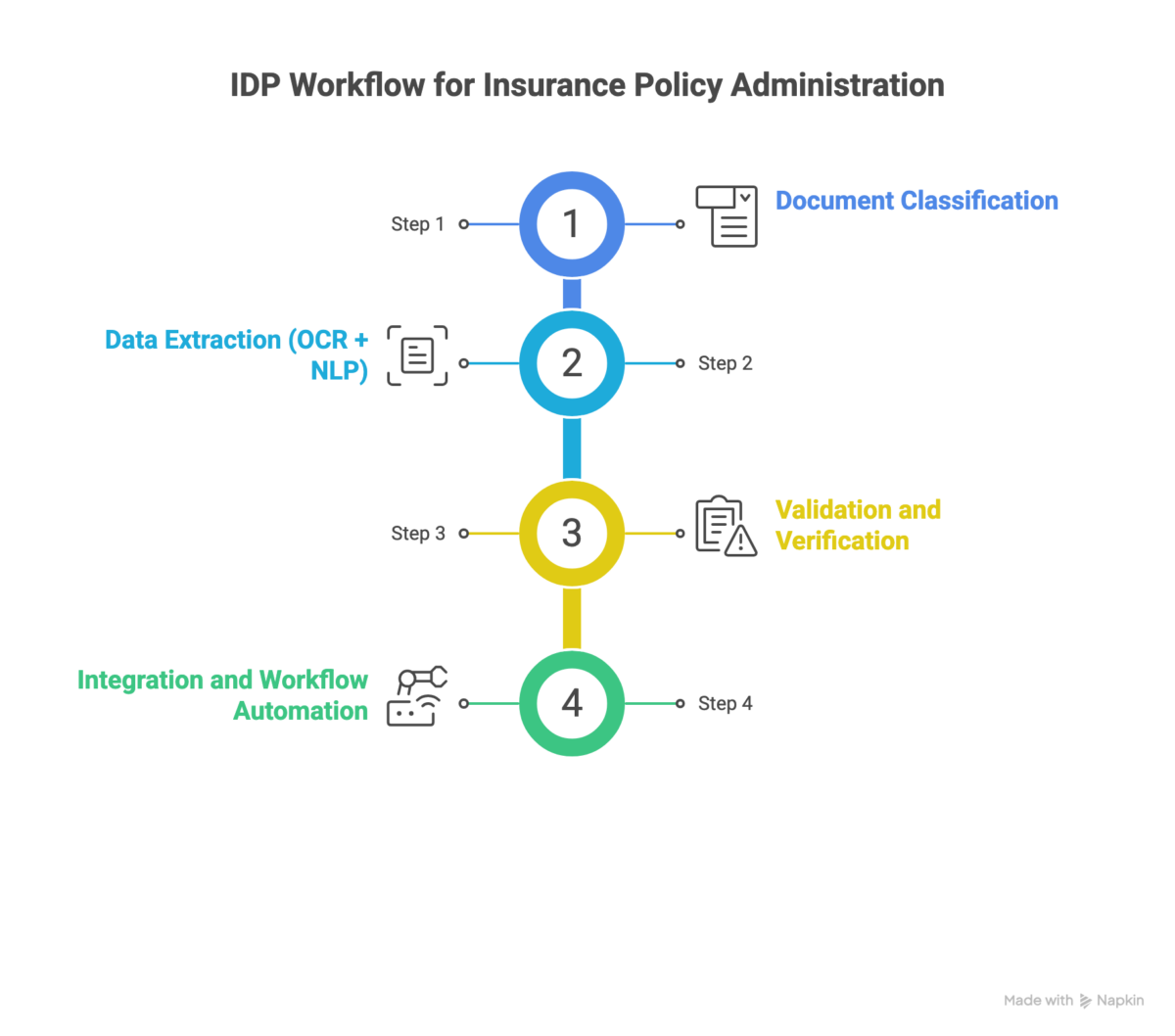
Step 1: Document Classification
Machine learning models identify document types. Is this a policy application, endorsement request, claims form, or renewal notice?
Classification accuracy typically exceeds 95% after initial training.
Step 2: Data Extraction (OCR + NLP)
OCR reads the text, even from handwritten forms, scanned PDFs, or photos taken on mobile devices.
NLP understands context. It knows “John Smith” is a name, “500,000” is a coverage limit, and “01/15/2025” is an effective date.
Step 3: Validation and Verification
Extracted data gets validated against business rules:
- Is the policy number format correct?
- Are coverage limits within the underwriting guidelines?
- Do dates make logical sense?
The system flags anomalies for human review.
Step 4: Integration and Workflow Automation
Validated data flows into your policy administration system (like Guidewire, Duck Creek, or custom platforms).
RPA (Robotic Process Automation) handles downstream tasks, sending confirmation emails, updating billing systems, and triggering underwriting workflows.
Real-world example: A health insurer integrated IDP with their ERP system (Microsoft Dynamics 365). Policy data extracted from applications automatically creates customer records, initiates billing, and triggers compliance checks, with zero manual handoffs.
ROI Metrics: Proving IDP Value to Stakeholders
Here’s what successful implementations deliver:
- Time savings: 70-80% reduction in document processing time.
- Cost reduction: 30-50% lower operational costs within 18 months.
- Error reduction: Manual error rates drop from 3-5% to under 0.5%.
- Customer satisfaction: 25-40% improvement in Net Promoter Scores due to faster service.
- Compliance: 90% reduction in audit preparation time with automated audit trails.
Case Study
A mid-sized property and casualty insurer, processing 75,000 policies annually, implemented IDP for policy administration.
Before IDP:
- 12-person team handling policy processing
- Average processing time: 6 days
- Error rate: 4.2%
- Customer complaints: 180/month about slow service
After IDP (12 months):
- 7-person team (5 reassigned to customer service and underwriting)
- Average processing time: 8 hours
- Error rate: 0.6%
- Customer complaints: 35/month
- Annual cost savings: $420,000
Pro Tip: Track “time to first decision” as a key metric; this measures how quickly underwriters receive complete, accurate information to make policy decisions. IDP can cut this from days to hours.
Overcoming Common Implementation Challenges
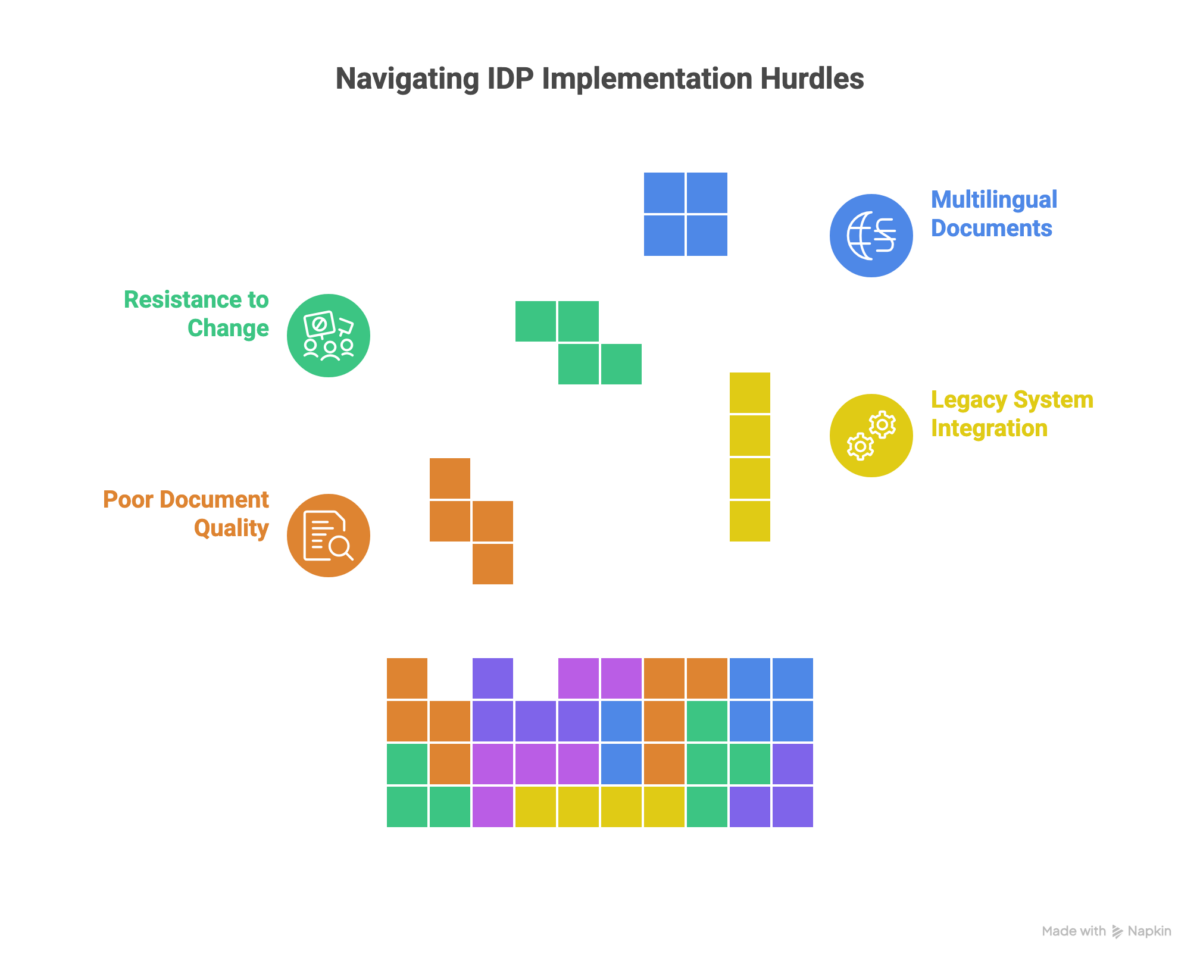
Challenge 1: Poor Document Quality
Faxed forms, crumpled papers, and low-resolution scans, these trip up basic OCR.
Solution: Modern IDP platforms use image enhancement and AI-powered reconstruction. They can read documents that would make traditional OCR fail completely.
Challenge 2: Legacy System Integration
Your 15-year-old policy admin system wasn’t built for modern APIs.
Solution: Use RPA to create a “virtual integration layer” that simulates human interaction with legacy systems while IDP feeds it clean data.
Challenge 3: Resistance to Change
Your team worries that automation means job losses.
Solution: Position IDP as eliminating boring work, not jobs. Freed-up capacity goes to higher-value activities like complex underwriting, customer consultations, and fraud investigation.
Challenge 4: Multilingual Documents
Mixed-language documents and regional terminology create complexity.
Solution: Choose IDP vendors with specific Arabic language training and regional insurance expertise. Test thoroughly with real documents from your market.
Conclusion
Here’s what you know now: Manual document processing is costing you money, slowing down your team, and frustrating your customers.
IDP isn’t some futuristic technology; it’s working today for insurers across the globe, delivering measurable results in months.
The real question is: How much longer can you afford to wait?
At 2HatsLogic, we’ve helped insurance companies across the Middle East and beyond implement IDP solutions that actually work, integrated with their existing systems, trained on their specific documents, and delivering ROI our clients can take to their boards.
We don’t just sell technology. We partner with you to design, implement, and optimize IDP workflows that fit your unique business.
FAQ
What exactly is Intelligent Document Processing, and how is it different from regular document scanning?
Regular OCR just converts text from images to a digital format. IDP actually understands what it's reading; it knows "John Smith" is a policyholder name, "$500,000" is a coverage limit, and automatically populates the right fields in your system. It's the difference between a photocopier and an intelligent assistant.
We already have an OCR system. Why would we need to upgrade to IDP?
Your OCR gives you text, but your team still manually identifies document types, finds relevant data, enters it into systems, and fixes errors. IDP does all of that automatically. If your team is still doing data entry after scanning, you're not really automated.
What types of documents can IDP handle?
Everything: policy applications, endorsements, renewals, cancellations, KYC documents, financial statements, inspection reports, medical records, claims forms, police reports, even handwritten forms and emails. If your team reads it, IDP processes it.
How does IDP handle handwritten forms or poor-quality documents?
Modern IDP uses image enhancement and AI reconstruction to read documents that traditional OCR can't handle, faxed forms, crumpled papers, low-resolution scans, and even handwriting. If the quality is too poor, the system flags it for manual processing rather than guessing.
Table of contents
- What Is Intelligent Document Processing in Insurance?
- The Hidden Costs of Manual Policy Administration
- Benefits of IDP for Insurance Policy Administration
- Key Use Cases: Where IDP Makes the Biggest Impact
- How IDP Actually Works
- ROI Metrics: Proving IDP Value to Stakeholders
- Overcoming Common Implementation Challenges
- Conclusion

Related Articles