
Greetings! I'm Aneesh Sreedharan, CEO of 2Hats Logic Solutions. At 2Hats Logic Solutions, we are dedicated to providing technical expertise and resolving your concerns in the world of technology. Our blog page serves as a resource where we share insights and experiences, offering valuable perspectives on your queries.
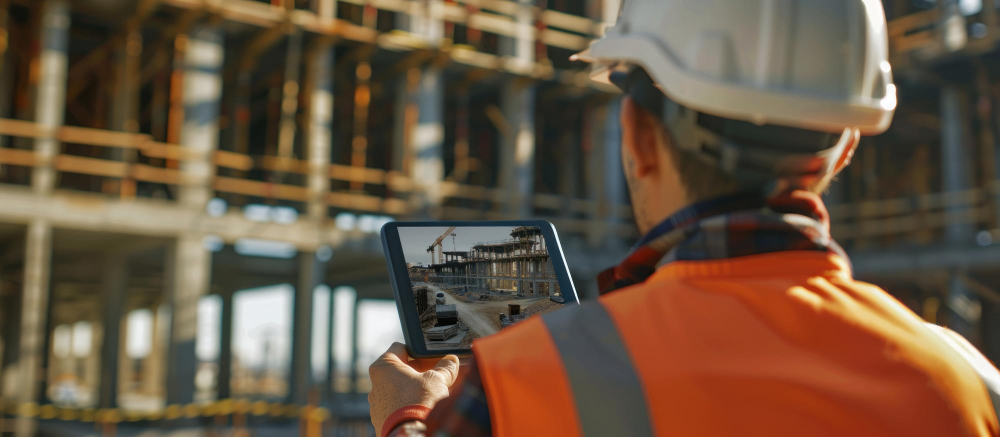
Construction sites remain among the most dangerous workplaces, with thousands of injuries and fatalities occurring annually. Traditional safety methods, while valuable, often rely on reactive measures and periodic inspections. Enter AI construction site monitoring, a technology promising to revolutionize construction safety through real-time hazard detection, automated compliance monitoring, and predictive analytics.
But does AI construction site monitoring for accident prevention actually deliver on its promises? This comprehensive guide examines the technology, real-world results, implementation strategies, and costs to help you make an informed decision.
What Is AI Construction Site Monitoring and How Does It Prevent Accidents?
AI construction site monitoring uses computer vision, machine learning, and IoT sensors to continuously observe construction sites, identify safety hazards, and alert teams before accidents occur. Unlike traditional safety oversight that relies heavily on human observation, AI safety monitoring systems operate 24/7, analyzing thousands of data points simultaneously.
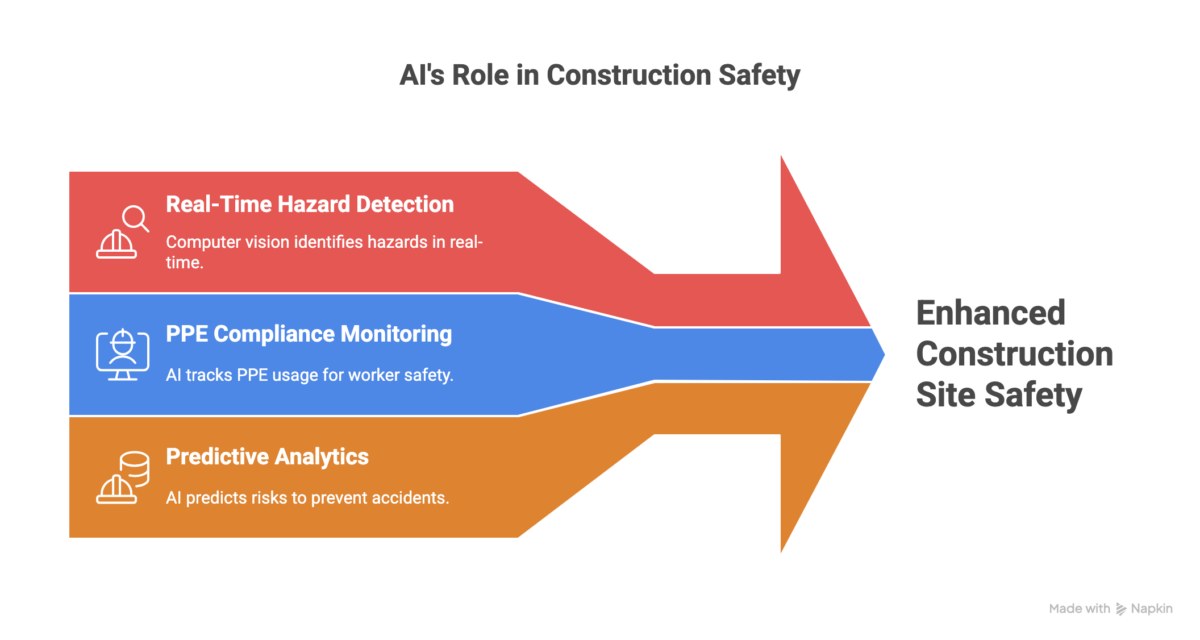
Real-Time Hazard Detection Using Computer Vision
Computer vision construction technology uses cameras equipped with AI algorithms to identify safety risks instantly. These systems recognize dangerous situations like workers approaching excavation edges, unstable scaffolding, or unauthorized personnel entering restricted zones.
Pro Tip: Position cameras at multiple angles to eliminate blind spots. Corner placements provide optimal coverage for hazard detection AI systems, capturing approximately 30% more safety incidents than single-angle installations.
The technology processes visual data in milliseconds, triggering immediate alerts to safety officers through mobile apps or centralized dashboards. Real-time monitoring eliminates the delay inherent in manual safety rounds, which typically occur only several times per day.
PPE Compliance Monitoring and Worker Safety Tracking
PPE detection AI represents one of the most practical applications of construction safety AI. These systems automatically verify whether workers wear required personal protective equipment, including hard hats, safety vests, gloves, and harnesses.
When the system detects a PPE violation, it generates instant notifications, enabling immediate corrective action. This automation transforms compliance monitoring from a periodic checkpoint to a continuous safety net.
Predictive Analytics for Construction Risk Management
Beyond real-time detection, predictive analytics construction capabilities analyze historical data to forecast potential safety incidents. Machine learning algorithms identify patterns, such as increased near-misses during certain shifts or elevated risks when specific equipment operates, allowing proactive risk mitigation.
Warning: Predictive models require at least 3-6 months of data to generate accurate predictions. Don’t expect immediate predictive insights during initial deployment phases.
Does AI Construction Monitoring Work?
The effectiveness of AI safety monitoring systems extends beyond theoretical benefits; real-world data demonstrate substantial accident reduction.
Construction Accident Reduction Statistics and Real-World Data
Independent studies show AI-monitored construction sites experience 40-60% fewer safety incidents compared to traditionally monitored sites.
Sites using comprehensive AI safety features report even more impressive statistics:
- 71% reduction in PPE violations
- 45% decrease in near-miss incidents
- 38% reduction in equipment-related incidents
- 60% faster emergency response times
Case Study: AI Safety Monitoring
A major infrastructure project in Dubai implemented construction safety monitoring across a 15-hectare site. Within eight months, the project recorded zero lost-time injuries, a dramatic improvement from the 12 incidents during the previous comparable period.
Ready to achieve similar results?
ROI Analysis: Cost Savings from Accident Prevention
Construction safety ROI extends beyond preventing human suffering. Each prevented injury saves direct costs (medical expenses, compensation claims) and indirect costs (project delays, productivity loss, reputation damage).
Key Features of AI-Powered Construction Safety Monitoring Systems
Understanding the capabilities of AI safety features helps you evaluate different platforms and deployment strategies.
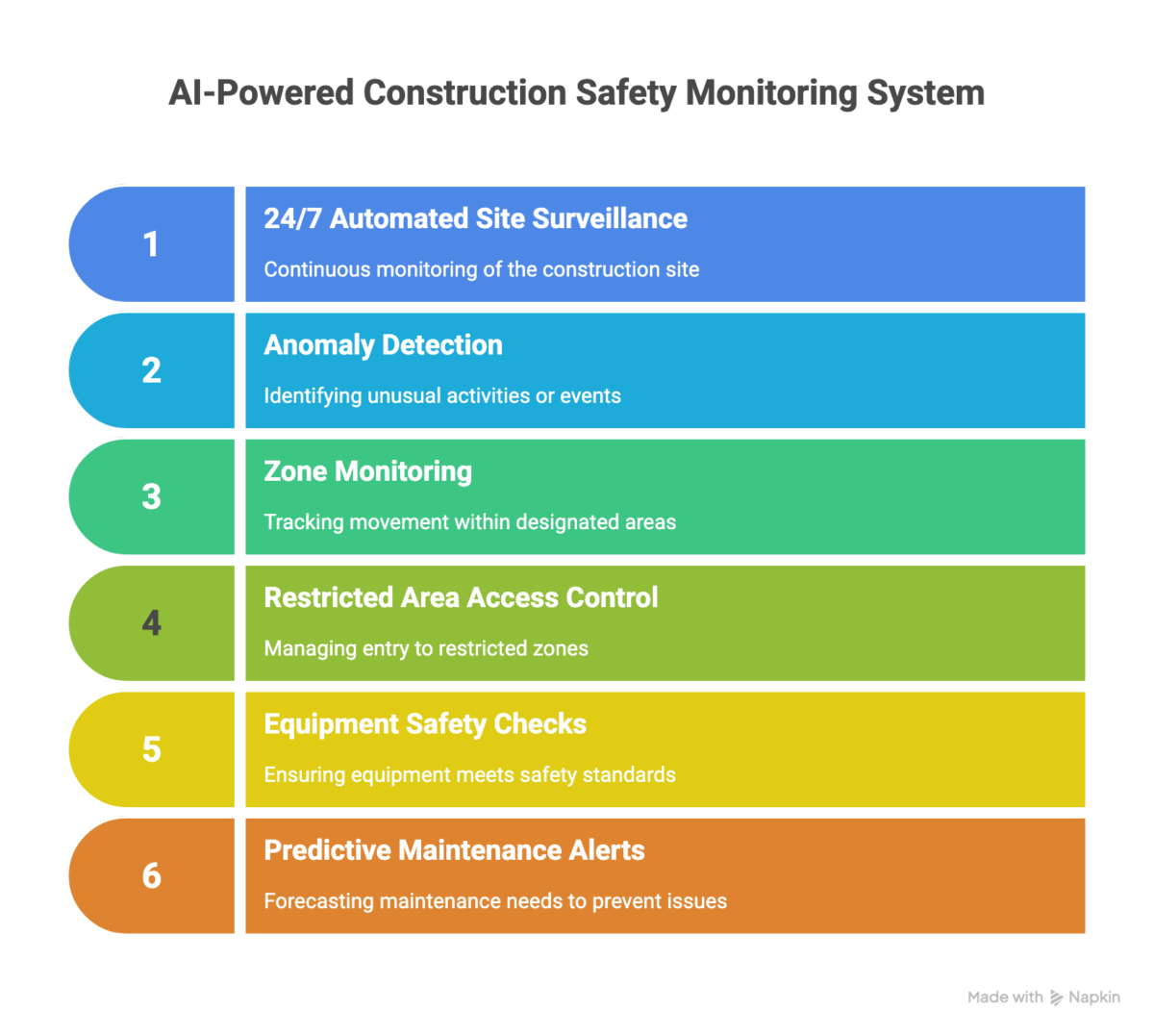
24/7 Automated Site Surveillance and Anomaly Detection
Automated surveillance operates continuously, unlike human safety officers who cannot maintain constant vigilance. These systems detect anomalies, unusual movements, unexpected equipment activation, or unauthorized site access, triggering immediate investigation protocols.
Zone Monitoring and Restricted Area Access Control
Zone monitoring technology creates virtual boundaries around dangerous areas. When workers or equipment enter restricted zones without authorization, the system instantly alerts safety personnel. This access control construction feature proves particularly valuable for protecting against excavation accidents and heavy equipment collisions.
Equipment Safety Checks and Predictive Maintenance Alerts
Equipment monitoring AI doesn’t just track machines; it analyzes operational patterns to predict maintenance needs before failures occur. This predictive maintenance construction capability prevents equipment-related accidents while reducing downtime and repair costs.
Pro Tip: Integrate equipment sensors with your AI monitoring platform for comprehensive machinery safety. This combined approach captures 85% more potential equipment failures than visual monitoring alone.
Real-Time Safety Dashboards and Incident Reporting
Safety dashboards consolidate data from multiple sources into actionable intelligence. Modern platforms provide customizable views for different stakeholders. Executives see high-level safety metrics while site managers access detailed incident reports and compliance tracking data.
How to Deploy AI Safety Monitoring on Construction Sites
Successful deployment requires careful planning across technical, operational, and human factors.
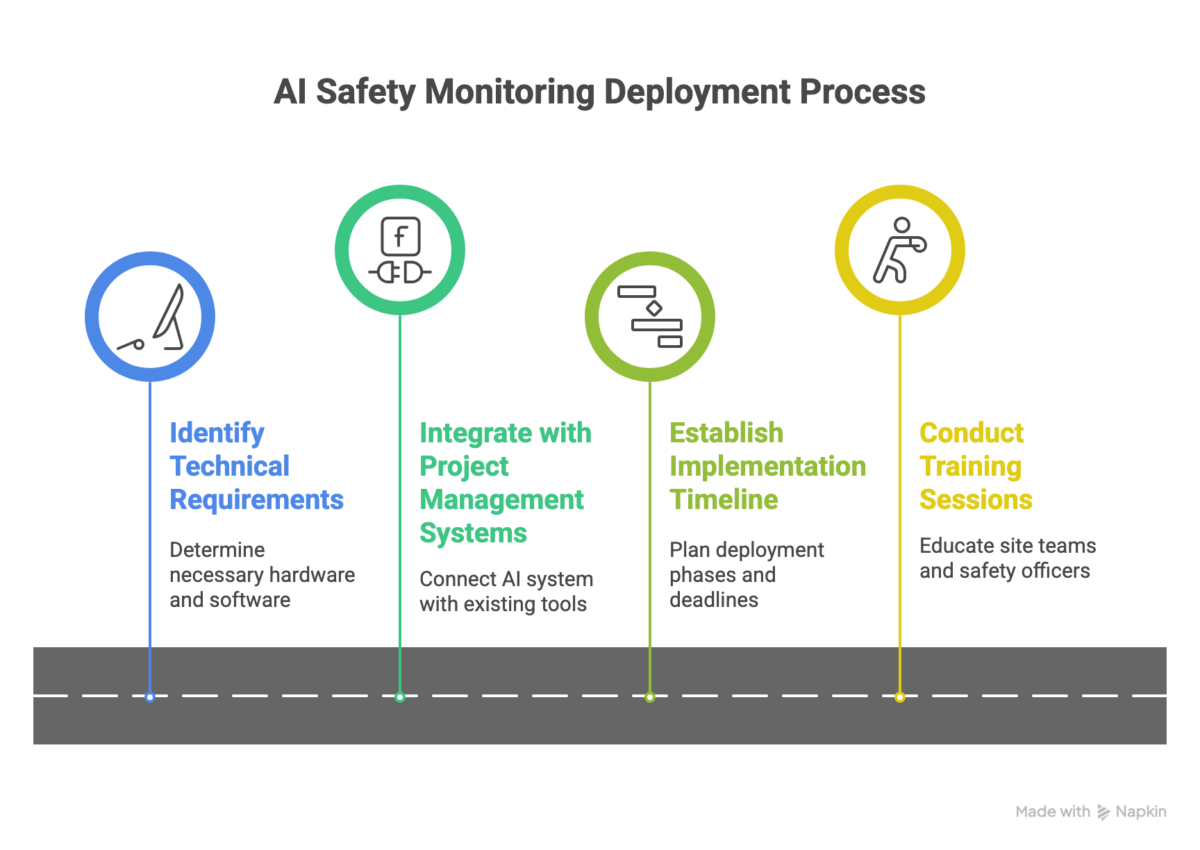
Technical Requirements and Infrastructure Needs
Infrastructure construction needs vary by platform, but typically include:
- High-resolution cameras (minimum 4MP for effective monitoring)
- Reliable connectivity (4G/5G or dedicated fiber for real-time functionality)
- Edge computing devices for local processing
- Secure cloud storage for data retention
Warning: Remote site connectivity remains a significant challenge. Budget for 4G/5G hotspots or satellite connectivity in areas lacking reliable internet infrastructure.
Integration with Existing Project Management Systems
BIM integration enables correlation between safety incidents and specific construction phases or locations.
Implementation Timeline and Deployment Phases
Expect a deployment timeline of 4-8 weeks for single sites:
- Week 1-2: Site assessment and infrastructure installation
- Week 2-3: System configuration and baseline establishment
- Week 3-4: Team training and parallel operation
- Week 4-8: Full deployment and optimization
Training Requirements for Site Teams and Safety Officers
User adoption depends on effective training. Allocate 4-6 hours for safety officer training on dashboard operation, alert management, and reporting. The general workforce needs basic awareness training (30-45 minutes) covering camera locations and system capabilities.
Common Challenges in AI Construction Site Monitoring
Anticipating implementation challenges enables proactive strategies.
Connectivity Issues on Remote Construction Sites
Remote site connectivity challenges require creative solutions. Consider:
- Cellular boosters for 4G/5G coverage enhancement
- Satellite connectivity for extremely remote locations
- Offline monitoring with periodic data synchronization
- Edge computing to minimize bandwidth requirements
Privacy Concerns and Worker Acceptance Strategies
Privacy concerns construction monitoring raises legitimate questions. Address them through:
- Transparent communication about system capabilities and limitations
- Clear policies on data access and retention
- Focus messaging on safety benefits rather than surveillance
- Worker participation in system configuration decisions
Future of AI in Construction Accident Prevention
Emerging technologies promise even more sophisticated safety capabilities.
Emerging Technologies: Drones, IoT Sensors, and Wearable Safety Devices
Construction drones provide aerial monitoring for large sites, while IoT sensors and safety systems monitor environmental conditions like toxic gas levels or structural vibrations. Wearable technology construction integrates biometric monitoring, detecting worker fatigue or heat stress before they cause accidents.
Regulatory Trends and Compliance Requirements for AI Safety Systems
Safety regulations increasingly recognize AI monitoring as best practice. Several jurisdictions now mandate automated safety monitoring for high-risk construction activities, a trend expected to accelerate through 2026.
Conclusion
Construction safety is at a turning point. Traditional methods alone are no longer enough, and the industry now has technology that can prevent incidents before they happen. AI monitoring has already reshaped how leading companies protect their teams, elevate safety standards, and stay ahead of regulatory and client expectations.
Yes, implementation requires effort, aligning teams, adapting processes, and introducing new systems. But countless projects have proven that these challenges are manageable, repeatable, and well worth the outcome.
At its core, this isn’t just a technology choice. It’s a commitment to your workers, your reputation, and your long-term safety culture. The tools exist. They work. And they’re now becoming the standard for companies that take safety seriously.
Your workers are watching. Your clients are evaluating. Your competitors are evolving.
Ready to strengthen your safety program with AI?
FAQ
How accurate is AI in detecting safety violations?
Modern PPE detection systems achieve 92-98% accuracy rates under good lighting conditions. Hazard detection accuracy varies by scenario but typically exceeds 85% for common safety risks.
Can AI monitoring work on sites with poor internet connectivity?
Yes, through edge computing solutions that process data locally and sync with cloud systems when connectivity becomes available. However, real-time alerts require at least basic cellular connectivity.
Does AI monitoring replace safety officers?
No, AI augments safety officers by enabling them to focus on complex situations requiring human judgment while the system handles routine monitoring and compliance verification.
Table of contents
- What Is AI Construction Site Monitoring and How Does It Prevent Accidents?
- Does AI Construction Monitoring Work?
- Key Features of AI-Powered Construction Safety Monitoring Systems
- How to Deploy AI Safety Monitoring on Construction Sites
- Common Challenges in AI Construction Site Monitoring
- Future of AI in Construction Accident Prevention
- Conclusion

Related Articles